The Gulf Isn’t Just Attracting FX Brokers; It’s Rewriting the Industry’s Map
A consulting firm just planted a flag in Dubai. On its own, that’s someone following the work, nothing more. But the real story is underneath: the retail CFD and FX industry has quietly shifted its centre of gravity to the Gulf, and the people running these firms are following.
For a decade, London and Cyprus were the two poles of this
business. London held the capital and the head offices. Limassol held the
engine room, the dealers, the compliance teams, and the sales floors that actually
run a retail broker. That map is being redrawn, and Dubai
is drawing the new lines.
FinTop’s own move into the emirate is one data point in that
shift, not the headline. The headline is why a specialist recruiter follows its
clients east at all. Because the clients are already there, and so are the
roles they cannot fill locally.
Start with the reason a broker picks a jurisdiction at all:
who signs off on it. The Dubai Financial Services Authority (DFSA), which
supervises firms in the Dubai International Financial Centre (DIFC), has built
the kind of reputation that puts it in the same sentence as the FCA, ASIC , and
MAS when institutional counterparties and prime brokers decide who they will
bank.
For a CFD or FX firm whose clients and banking partners increasingly want
a Tier 1 regulatory home rather than an offshore shell, that credibility is
most of the game.
Dubai is not the only credible route, either. The UAE’s
federal Capital Market Authority (CMA), which formally replaced the Securities
and Commodities Authority on 1 January 2026, and the Abu Dhabi Global Market’s
FSRA give firms more than one path to a Gulf licence, each suited to a
different model, from full retail brokerage to introducing-broker and advisory
setups.
The Brands Have Voted With Bricks
The clearest signal is not what firms say about the region.
It is what they have built into it. XTB, Plus500, and Pepperstone all run
licensed DIFC entities under the DFSA rather than cross-border arrangements:
XTB through XTB MENA, Plus500 through Plus500AE, and Pepperstone through
Pepperstone Financial Services (DIFC). IG runs a DIFC-registered entity there,
too.
When firms of that size commit to physical offices and
staffed desks instead of serving the Gulf from another time zone, it usually
means the trading revenue from the region has become too large to run remotely.
Bricks and mortar is an expensive way to make a point. They are making it
anyway.
The Money Has Already Moved
This is where the talent story stops being abstract.
FinTop’s salary survey, reported by Finance Magnates, put
hard numbers on the gap, and the gap is widest exactly where brokers
compete hardest: revenue and compliance.
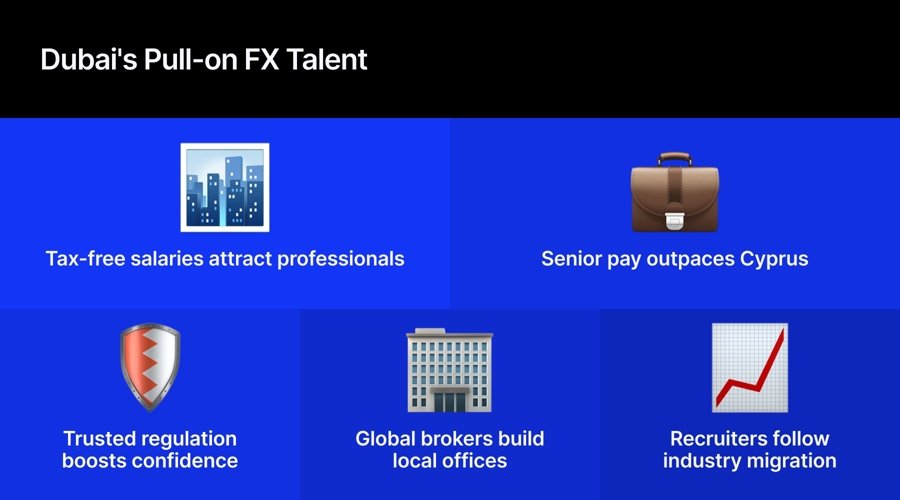
A Head of Sales in Dubai can earn up to around EUR 200,000,
more than double the Cyprus equivalent. A Chief Revenue Officer runs to EUR
327,000 in Dubai against EUR 144,000 in Cyprus. A Chief Operating Officer
reaches EUR 301,000 versus EUR 180,000.
Compliance tells the same story: a
Chief Compliance Officer or Chief Risk Officer in Dubai can command up to EUR
240,000, while a senior Head of Legal and Compliance in Cyprus tops out near
EUR 120,000, and compliance pay in Dubai has climbed by roughly 250%. Then add
the line, no spreadsheet in Limassol can answer: the UAE has no personal income
tax.
The Roles Brokers Are Actually Hiring For
This is not general hiring. A firm standing up a DIFC entity
needs specific people. Compliance officers who understand the DFSA’s
fit-and-proper regime and its prudential rulebook. Dealing and risk staff
fluent in leverage and margin frameworks that differ from EU or UK norms.
Sales
and business development teams who can work a market that spans UAE residents,
wider GCC clients, and a large expat trading base. Many of the groups now
building in the DIFC are asking the same recruiters they already use in London
and Cyprus to staff the new office, which is why a firm like FinTop follows
them.
The flow runs both ways. Dubai is not only pulling brokerage
staff out of Cyprus and London. It is pulling trading-tech and liquidity
specialists in from further afield, drawn by tax-free pay and the city’s
position between European, African, and Asian markets.
So, Is Cyprus Finished?
No, and the honest version of this argument has to say why. Cyprus
keeps its EU and MiFID passport, which Dubai cannot offer, and that alone
anchors a large part of the industry in Limassol. Its cost base is lower:
Dubai’s cost of living runs about 25% above Limassol’s, which eats into those
headline salaries. And the survey itself shows the gap is not one-directional.
A Cyprus CFO can out-earn a Dubai one, EUR 240,000 against EUR 196,000. A rung
below the C-suite, compliance and risk managers can still be paid more on the
island than in the emirate.
Those are footnotes to a direction of travel, though, not a
counter-trend. The pull east rests on two things that do not reverse with the
cycle: a regulator institutions trust, and pay that the tax regime makes hard
to match. When the reason for a move is structural, the move tends to be
durable.
What It Actually Costs Cyprus
So the real question is not whether Cyprus survives. It is
what it becomes. The likelier outcome is not collapse but demotion, from the
destination where CFD careers are built to the feeder that trains the people
Dubai then hires at a premium.
The talent that loses in that world is not
Cyprus itself. It is the individuals whose roles are commoditised and who, for
family or cost or preference, will not relocate. For anyone with a portable,
in-demand skill, the map just got bigger, and it may never shrink back to two
cities again.
A consulting firm just planted a flag in Dubai. On its own, that’s someone following the work, nothing more. But the real story is underneath: the retail CFD and FX industry has quietly shifted its centre of gravity to the Gulf, and the people running these firms are following.
For a decade, London and Cyprus were the two poles of this
business. London held the capital and the head offices. Limassol held the
engine room, the dealers, the compliance teams, and the sales floors that actually
run a retail broker. That map is being redrawn, and Dubai
is drawing the new lines.
FinTop’s own move into the emirate is one data point in that
shift, not the headline. The headline is why a specialist recruiter follows its
clients east at all. Because the clients are already there, and so are the
roles they cannot fill locally.
Start with the reason a broker picks a jurisdiction at all:
who signs off on it. The Dubai Financial Services Authority (DFSA), which
supervises firms in the Dubai International Financial Centre (DIFC), has built
the kind of reputation that puts it in the same sentence as the FCA, ASIC , and
MAS when institutional counterparties and prime brokers decide who they will
bank.
For a CFD or FX firm whose clients and banking partners increasingly want
a Tier 1 regulatory home rather than an offshore shell, that credibility is
most of the game.
Dubai is not the only credible route, either. The UAE’s
federal Capital Market Authority (CMA), which formally replaced the Securities
and Commodities Authority on 1 January 2026, and the Abu Dhabi Global Market’s
FSRA give firms more than one path to a Gulf licence, each suited to a
different model, from full retail brokerage to introducing-broker and advisory
setups.
The Brands Have Voted With Bricks
The clearest signal is not what firms say about the region.
It is what they have built into it. XTB, Plus500, and Pepperstone all run
licensed DIFC entities under the DFSA rather than cross-border arrangements:
XTB through XTB MENA, Plus500 through Plus500AE, and Pepperstone through
Pepperstone Financial Services (DIFC). IG runs a DIFC-registered entity there,
too.
When firms of that size commit to physical offices and
staffed desks instead of serving the Gulf from another time zone, it usually
means the trading revenue from the region has become too large to run remotely.
Bricks and mortar is an expensive way to make a point. They are making it
anyway.
The Money Has Already Moved
This is where the talent story stops being abstract.
FinTop’s salary survey, reported by Finance Magnates, put
hard numbers on the gap, and the gap is widest exactly where brokers
compete hardest: revenue and compliance.
A Head of Sales in Dubai can earn up to around EUR 200,000,
more than double the Cyprus equivalent. A Chief Revenue Officer runs to EUR
327,000 in Dubai against EUR 144,000 in Cyprus. A Chief Operating Officer
reaches EUR 301,000 versus EUR 180,000.
Compliance tells the same story: a
Chief Compliance Officer or Chief Risk Officer in Dubai can command up to EUR
240,000, while a senior Head of Legal and Compliance in Cyprus tops out near
EUR 120,000, and compliance pay in Dubai has climbed by roughly 250%. Then add
the line, no spreadsheet in Limassol can answer: the UAE has no personal income
tax.
The Roles Brokers Are Actually Hiring For
This is not general hiring. A firm standing up a DIFC entity
needs specific people. Compliance officers who understand the DFSA’s
fit-and-proper regime and its prudential rulebook. Dealing and risk staff
fluent in leverage and margin frameworks that differ from EU or UK norms.
Sales
and business development teams who can work a market that spans UAE residents,
wider GCC clients, and a large expat trading base. Many of the groups now
building in the DIFC are asking the same recruiters they already use in London
and Cyprus to staff the new office, which is why a firm like FinTop follows
them.
The flow runs both ways. Dubai is not only pulling brokerage
staff out of Cyprus and London. It is pulling trading-tech and liquidity
specialists in from further afield, drawn by tax-free pay and the city’s
position between European, African, and Asian markets.
So, Is Cyprus Finished?
No, and the honest version of this argument has to say why. Cyprus
keeps its EU and MiFID passport, which Dubai cannot offer, and that alone
anchors a large part of the industry in Limassol. Its cost base is lower:
Dubai’s cost of living runs about 25% above Limassol’s, which eats into those
headline salaries. And the survey itself shows the gap is not one-directional.
A Cyprus CFO can out-earn a Dubai one, EUR 240,000 against EUR 196,000. A rung
below the C-suite, compliance and risk managers can still be paid more on the
island than in the emirate.
Those are footnotes to a direction of travel, though, not a
counter-trend. The pull east rests on two things that do not reverse with the
cycle: a regulator institutions trust, and pay that the tax regime makes hard
to match. When the reason for a move is structural, the move tends to be
durable.
What It Actually Costs Cyprus
So the real question is not whether Cyprus survives. It is
what it becomes. The likelier outcome is not collapse but demotion, from the
destination where CFD careers are built to the feeder that trains the people
Dubai then hires at a premium.
The talent that loses in that world is not
Cyprus itself. It is the individuals whose roles are commoditised and who, for
family or cost or preference, will not relocate. For anyone with a portable,
in-demand skill, the map just got bigger, and it may never shrink back to two
cities again.