More Luxury Retailers Partner With Everyday Names to Lure Gen Z Shoppers – Commercial Observer
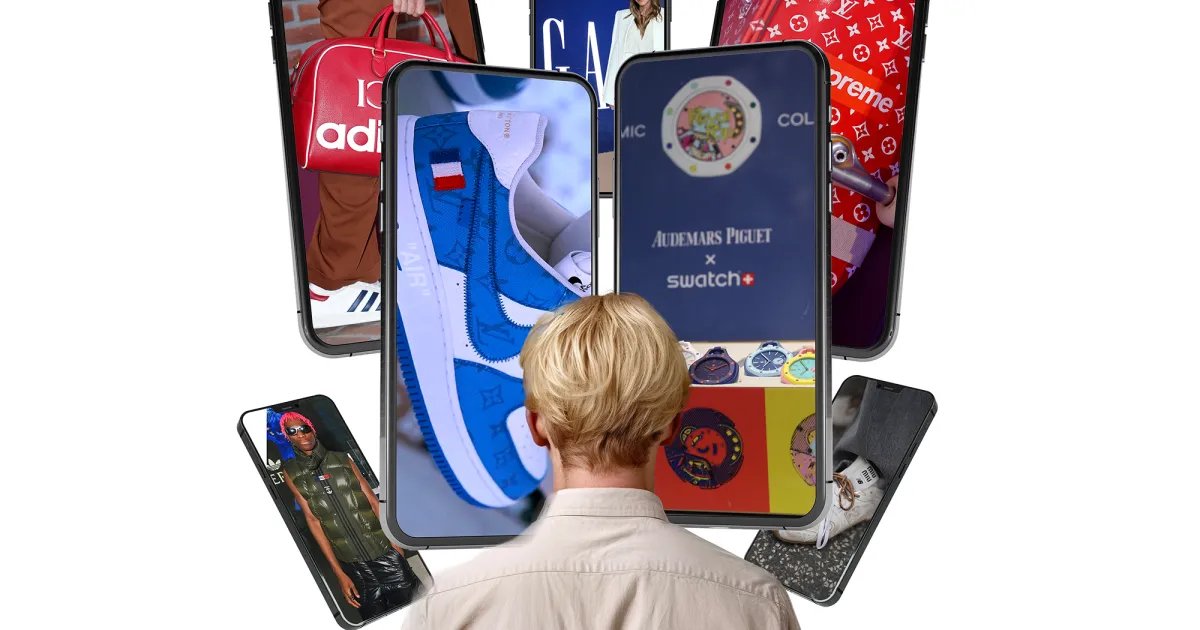
On May 16, watch brands Swatch and Audemars Piguet (AP) launched a collaborative line of eight pocket watches called Royal Pop, which, in addition to featuring designs that popped with vibrant colors, included a window into the inner workings of the watch. The intent of the Royal Pop watches, which retail for around $400 each, was to “invite a broader audience, including the younger generations, to experience mechanical watchmaking differently,” according to the AP website.
As people throughout the world quickly learned, the collaboration worked almost too well.
On the day of the new line’s unveiling, Swatch’s stores around the world were overrun. According to the Associated Press, police in Paris had to deploy tear gas to constrain the crowds, there were fistfights in Italy, and fans lined up throughout the night from New York to Singapore.
As of two days after the product launch, Royal Pop’s social media feeds had received 11 billion views.
While retail collaborations of this sort are hardly new, their frequency and popularity have been steadily rising in recent years as luxury brands like AP see creative downmarket collaborations as an effective way to introduce themselves to, and hopefully engender longtime brand loyalty from, younger consumers.
Part of the reason why more brands decided to take on collaborations is that with so much information at their disposal, it’s easier to precisely Target consumers more inclined to appreciate both brands.
“You have all of this access to information now, and you have all this social media online,” said Andrew Goldberg, a vice chairman at CBRE. “So you can go to Instagram, and you can see exactly who’s trending and who’s following who.”
But Goldberg also sees some of these collaborations as necessary expansion.
“So many of these brands have gotten big, and they’ve gotten to their core customer already,” said Goldberg. “They’re trying to think of how they can continue to develop and grow. All of these companies need to grow.”
While that sentiment is evergreen, the luxury goods market has been facing some challenges of late.
A May 2026 Global Luxury Retail report from Savills cited a “marginal contraction” of 2 percent in the global personal luxury goods market in 2025, accompanied by new luxury store openings worldwide falling to their lowest level since 2020 as brands adopt “more disciplined, selective growth strategies.”
The report, which indicated that new openings throughout North America declined by 13 percent in 2025, said that the global luxury market was dealing with “softer luxury goods spending, macroeconomic uncertainty and portfolio rationalization.”
Concurrently, the same report noted that luxury experiences — described as “hospitality, cruises, travel and fine dining” — grew by 3 percent, signifying a shift in spending priorities throughout the luxury market and a shot across the bow for makers and sellers of luxury goods.
But if the luxury goods market is facing shifting priorities and economic uncertainty from their traditional customers, luxury/non-luxury collaborations are one hoped-for solution for broadening their overall customer base.
The past five years alone have seen collaborations between Victoria Beckham and Gap, Gucci and Adidas, Moncler and Adidas Originals, Nike and both Louis Vuitton and Tiffany, Fendi and Skims, and two different collaborations between Prada-owned Miu Miu and New Balance. Other notable pairings in the years just prior included Dior and Air Jordan, Louis Vuitton and Supreme, and Prada and Adidas.
While this is the way for luxury brands today, it was not always the case.
“I started my career about 30 years ago in Paris, and have always done luxury,” said Eric Le Goff, vice chairman and head of luxury at Retail by MONA. “Luxury was, a client would come to a store to see the garment and then they’d leave, and that would be a 15-minute transaction. That model doesn’t exist anymore.”
That’s because with new generations relating to the world in different ways, luxury brands are facing the challenge of bringing new consumers with a different set of personal interests, values and priorities into the fold without diluting the prestige and exclusivity that made these brands special in the first place.
“When it came to luxury, [older consumers] wanted to own something. [The younger] generation is not so inclined to own a product,” said Le Goff, echoing the Savills report’s findings. “Their relationship with ownership is not the same as the one we grew up with. They want to experience the brand in different ways.”
The trick for luxury brands, then, is attracting younger consumers in a way that retains their brand-defining qualities, while understanding the aspects of the brand that might not fit into a new generation’s consumer ethos.
“Luxury brands are widening their aperture without necessarily abandoning the exclusivity that’s existed over generations,” said Todd Siegel, president of U.S. retail for Savills. “It’s not necessarily that luxury is becoming mass market. It’s that these brands are creating more controlled entry points and more experiential formats, producing more relationship-
building opportunities to reach a younger and broader audience.”
The concept of luxury/non-luxury pairings exploded across retail when Karl Lagerfeld paired with H&M in 2004 for a low-cost clothing collection that, according to fashion industry bible WWD, “had a seismic effect on the entire fashion system: breaking down barriers between luxury and mass, democratizing design in a new way, and foreshadowing an era of rampant collections, drops and pop-up concepts.”
Not all of these types of pairings had the intended effect — 2012’s collaboration between Target and Neiman Marcus, featuring items from Marc Jacobs, Oscar de la Renta and Diane von Furstenberg, was a notable flop, with items marked down 70 percent shortly after the products dropped. Yet, many succeeded in introducing revered luxury brands to younger consumers, especially as the trend ramped up in the late aughts and early this decade.
Part of the appeal has been allowing consumers to own products from high-price labels at lower price points.
“One defining element to how we’re seeing luxury expand is that ultra-luxury brands are creating price points or stand-alones that appeal to a younger audience,” said Siegel. “So, Chanel created the Chanel Fragrance and Beauty stores, the very nature of which is lower price points and lower barriers to entry for that consumer.”
Siegel notes that while young people may not be able to afford a Chanel bag, they can now own a Chanel-branded lipstick.
“It’s a very deliberate move by that luxury house to start cultivating connectivity with a young consumer,” he said.
Applying this logic to collaborations, Reid Litman, a global consulting director in the growth and innovation group at advertising and marketing giant Ogilvy, noted that successful high/low collaborations need more than just notable logos or affordable price points for the product. Rather, they need to introduce a product that bestows a relevant cultural meaning to younger consumers.
“A bad collaboration is sort of just licensing — it’s just two logos for the sake of it — whereas a great collaboration tends to say something. It generates action or inspires a community,” said Litman. “A collaboration can be valuable for Gen Z because it helps them tell a more interesting story about themselves.”
Part of that story, it seems, is to reflect the larger Gen Z trend of breaking down barriers in so many areas of life.
For example, when Gen Xers — often the parents of Gen Zers — were teenagers, the music they listened to was heavily delineated by genre, which then informed overall identity. So, if heavy metal was your musical preference, then you were a metalhead, with all that signified, including longer hair, jeans and sneakers, and either leather or denim jackets. If the music was emo, then you might have been an all-black-wearing Goth, etc. These categorizations were often strict, and came with lines that weren’t crossed — as in the vast separation between heavy metal and disco.
Strict categories of that sort have long since broken down in music, and in other areas of life as well. So much about diversity for Gen Z is about embracing different types of people. That includes breaking down and eliminating the importance of characterizations centering on race, religion or gender identity and expression that older generations more heavily considered, if not swore by.
Even TV shows and movies are more likely to reflect blended genres today, as opposed to being strictly “comedy,” “drama” or “horror” as they were decades ago.
As Gen Z has sought to bypass barriers in these areas of life and more, their attitude toward consumerism has similarly evolved. Questions of whether an item is luxury or non-luxury pale next to the importance of, “What does this item signify to me and the person I’ve become?”
“Previous generations tended to keep categories really, really separate,” said Litman. “Luxury, streetwear, sports and workwear were all their own categories. But Gen Z grew up mixing them and creating cocktails of these different categories. That’s normal now.”
Litman cites examples including Prada brand Miu Miu’s 2021 denim collaboration with Levi’s, or Louis Vuitton’s 2024 jacket designed by Pharrell Williams and inspired by workwear brand Carhartt.
“Luxury is no longer about just looking expensive. It’s really about signaling taste,” said Litman. “That’s what this latest wave of collaborations is giving: cultural signals.”
Thomaï Serdari, owner of the brand strategy firm Brand(x)Lux and a professor of marketing at the New York University’s Stern School of Business, noted, however, that marketing directly to Gen Z can be something of a tightrope walk, as some of those signals can be challenging to interpret by the demographic’s buying behavior.
“With Gen Z, it’s a very different generation. They’re a little confused, because they do say one thing, but they do another,” said Serdari. “For example, they say they support sustainability, but they don’t buy sustainable products. They say they are brand agnostic, but, when they find something they like, they become very loyal consumers. It’s a very interesting generation because they’re not fully certain about who they are, and they’re very easily influenced by their peers and by things they find online. Word of mouth is really, really powerful for this generation.”
And some of the cultural signals that can be clearly interpreted move into surprising territory, illustrating how out of the box marketers have to think to make an impact.
Coach, for example, has done successful collaborations with both Peanuts and Disney. To expand on Siegel’s point about reaching out to younger generations, while you can purchase a Disney x Coach leather bag with Mickey Mouse on the side for $495, you can also get a Disney x Coach leather slide or a Pluto-adorned wristlet for just $95.
“Coach has been very successful in collaborations with brands like Peanuts and Disney without diluting the value of the Coach brand,” said Richard Hodos, a vice chairman at JLL. “The Coach brand right now is among the top five internationally in terms of brand equity. So Coach is a very good example of a brand that does it very well.”
That said, some see reasons for skepticism about the now ubiquitous strategy.
Jonathan Schley, vice chairman of global retail advisory at Newmark, said he believes that as these collaborations became more the norm, they have slowly lost much about what made them special.
“Before it was more experimental and streetwear-focused. Now it’s a very mainstream concept to put two brands together. I don’t think it’s a winning strategy,” said Schley. “It used to be about the ideals of two brands in different spaces coming together — do we have shared ideals? But now, it’s very structured and organized. They often launch with a lot of hype, then you forget about them a few days later, and I’m not sure what they’ve achieved. ”
By way of example, Schley mentioned the Swatch x AP pairing. The product was exclusively available in Swatch stores, and he said he believes the collaboration’s brand goodwill may have unevenly flowed in that direction as well.
“AP didn’t distribute any part of that. They were co-marketed, but you couldn’t get them in AP stores or through any AP distribution channel. It was exclusively Swatch,” said Schley. “I don’t know that there was any AP collector who felt like this was a positive for their perception of the brand.”
Serdari noted that collaborations of this sort always risk diluting a brand.
“I don’t believe luxury brands need to collaborate to bring out their best,” said Serdari. “If anything, we could classify luxury brands in some sort of hierarchy. The ones that are always doing well and are successful are the ones that have a lot of creativity in-house.”
For those brands, said Serdari, a collaboration can become a moving target of sorts, a challenge in figuring out “whether they can truly understand what that new customer wants.”
“Marketing is always about understanding the customer,” said Serdari. “Since this is not the typical customer that walks into their boutique, that is the intellectual stretch that brands are trying out when they do these collaborations.”
When reaching out to Gen Z, then, Ogilvy’s Litman believes a better way to think about what they want is that their generation is actually less about breaking down barriers than assembling identities from scratch with the assumption that those barriers never existed in the first place. This, he said, is essential for brands to keep in mind in designing a successful collaboration.
“[Gen Z is] the least likely to use demographics or geography to describe themselves,” said Litman. “It’s not, ‘I’m French’ or ‘I’m American.’ It’s more, ‘I’m big into anime and love soccer.’ So Gen Z identity is increasingly assembled rather than something you’re born with.”
For brands planning collaborations, then, Litman believes it’s essential to remember that the intended clientele is not buying the logos so much as what those logos, when blended together, signify to the culture at large.
“If you think of a Spotify playlist, nobody asks whether Frank Ocean belongs next to Charli xcx. Sometimes borrowing from two different, seemingly separate buckets is kind of the point,” said Litman. “Great collaborations create new signals rather than just borrowing two logos. They let someone communicate a new way of seeing the world that neither brand or logo alone could have done in isolation.”
Larry Getlen can be reached at lgetlen@commercialobserver.com.