The Hidden Cost of Data Centers: Inside the Opposition
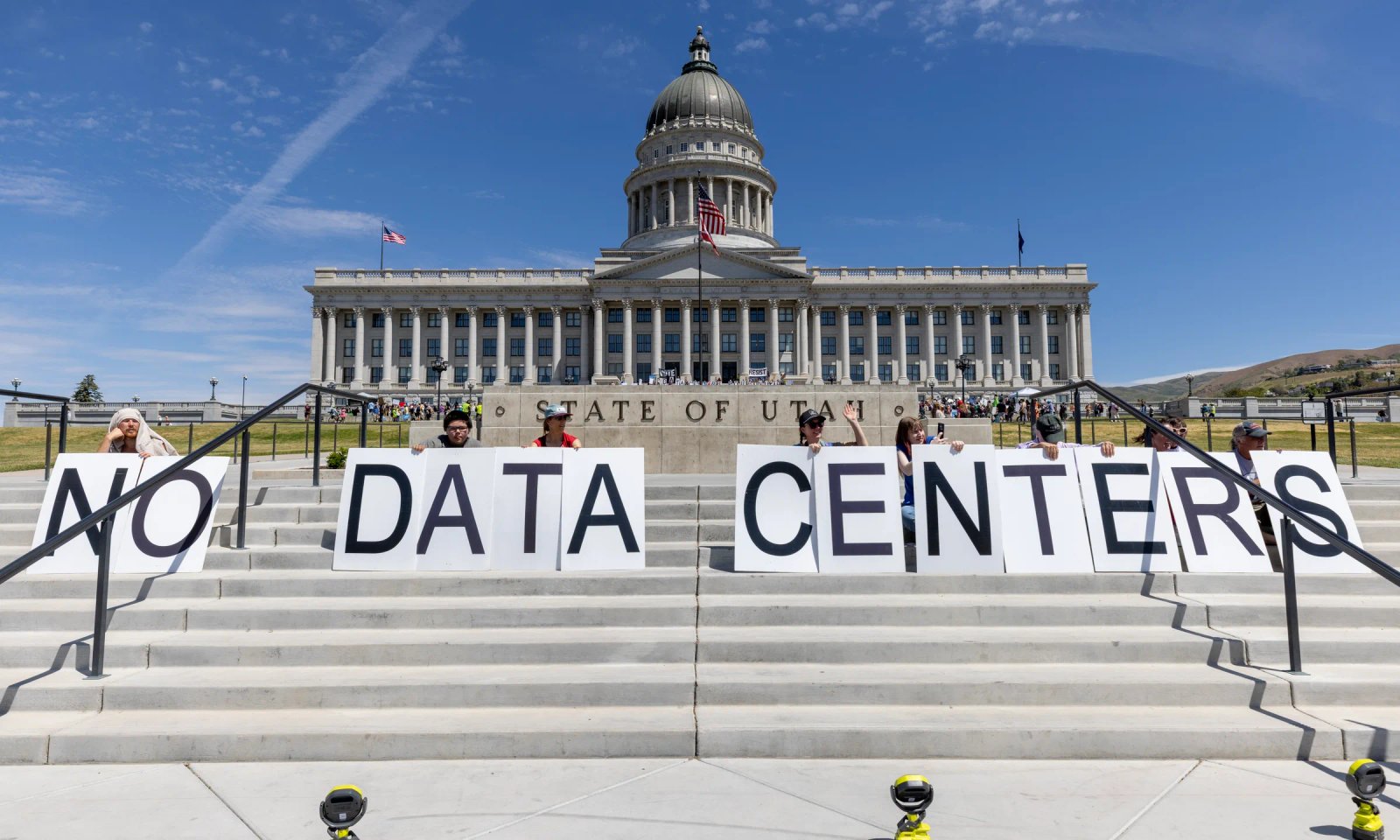
For a nation so utterly divided in its politics, there’s one issue bringing Americans together: A mistrust of data centers.
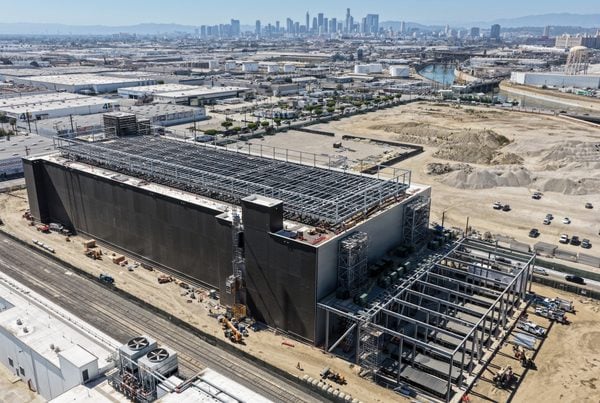
Data centers are facilities filled with computers and networking equipment that keep the internet, cloud services, apps and AI running. More than 4,500 data centers are already in operation, according to Data Center Map, a site that tracks data centers in the U.S. Dozens of those centers are massive, AI-driven facilities known as hyperscale data centers.
Municipalities that were once eager to court developers and tech companies with tax incentives are now scrutinizing proposals more carefully as public opposition mounts over whether the promised benefits outweigh the costs to local communities and residents.
A June poll by Heatmap News found that at least 70% of Americans oppose a data center being built near their home — in September 2025 it was 42%.
“The fights look local — it’s zoning hearings, it is noise complaints, it is coming from residents,” says David Bieri, an economist and associate professor at Virginia Tech’s School of Public and International Affairs. “But the crazy thing is that, of course, the money that decides these things is happening at a higher level.”
The data center honeymoon is over
Proponents of data centers say new facilities boost economic activity — bringing in jobs and tax revenue to municipalities, while keeping up with China in the race to build AI infrastructure. But locals are skeptical, and now governments at every level are beginning to balk, too.
Meet MoneyNerd, your weekly news decoder
So much news. So little time. NerdWallet’s new weekly newsletter makes sense of the headlines that affect your wallet.

As of late July, there are 18 states where laws restricting or considering restricting data center construction have been introduced, according to datacenterbans.com, which monitors — as the name suggests — moratoriums on data centers across the U.S.
Several of the new data centers about to break ground are part of a broader federal push to expand AI infrastructure. On June 30, U.S. Energy Secretary Chris Wright said during an Amazon Web Services conference that the issues data center opponents have raised are “overblown.” He said during the conference, “We’ll roll over the opposition to data centers faster than we otherwise should.”
Most of the action is happening at the local level, where communities can act more quickly than state or the federal governments. Some examples: Seattle’s one-year moratorium began on June 9; Broomfield, Colorado. has an 18-month pause that took effect on July 7; and Sarasota County, Florida. paused hyperscale data center construction as of early July.
Why the backlash is growing
Behind pushes for stronger safeguards is a pattern of secrecy over the impacts of data centers, critics say — leaving an already-frustrated public with even less information.
“There are a number of instances where large corporations — Google, in particular, and Meta — have worked quietly with authorities even using nondisclosure agreements, which is highly unusual in the sense that these NDAs didn’t expire once the projects were approved,” Bieri says. “In other words, the public has very little information about what the environmental impacts, quality of life impacts of these projects are.”
The growing scrutiny from local and state governments reflects a reckoning among communities confronting the trade-offs of the AI infrastructure race. The central question remains: What will the data center boom cost the people who live alongside it?
Data centers are testing electrical grids
“Data center alley,” located in Northern Virginia, is home to 70% of global internet traffic and possesses the highest concentration of data centers in the U.S., according to an analysis by The Roosevelt Institute. In Virginia, data centers now consume roughly 25% of the state’s electricity, driving utility rate hikes that Virginians and surrounding states absorb.
“I live in Baltimore, I’m 60 miles from the data centers in northern Virginia, and my bills are up because of those data centers, 60 miles away, because we’re on the same grid,” says Mitch Jones, deputy director of Food & Water Watch and managing director of policy and litigation at the nonprofit advocacy group.
“When our grid is so, so weak, it’s not built to handle that type of gigawatt level capacity,” Bieri says.
The electricity situation in Virginia and the broader region is a cautionary tale for the rest of the nation as data centers’ reach expands. And there’s no question that electric grids will be tested by the surge in data center growth. The Lawrence Berkeley National Laboratory estimates that U.S. data centers’ electricity usage could reach 9.5% to 15% of the nation’s electricity use by 2030, according to a June report. In 2024, that figure was 4.7%. And on July 21, BloombergNEF reported that data centers in the U.S. will account for one-fifth of the nation’s entire electricity consumption by 2035 — today it’s 5.9%.
“ If you’re building a bunch of these data centers, you’re essentially building new cities as far as electricity is concerned. ”
Mitch Jones, deputy director, Food & Water Watch
Nationwide, electricity bills have already been rising due to a variety of factors, including a surge in climate change-fueled air conditioning and heating usage, rebuilding and expanding aging electrical grids, persistent inflation and, yes, heightened demand from AI data centers. The World Resources Institute says there’s strong evidence that data center growth has contributed to price increases in the Mid-Atlantic, for example. And it cautions that customers in other areas of the country could experience similar price hikes.
“If you’re building a bunch of these data centers, you’re essentially building new cities as far as electricity is concerned,” Jones says. “That’s going to have a massive impact on the cost of just the parts needed to generate electricity for the rest of the grid.”
For example, a Meta data center under construction in Cheyenne, Wyoming., is expected to require 1.8 gigawatts of electricity to start and expand to consume 10 gigawatts. For reference, a single gigawatt powers 1 million homes — nearly double the number of people in the entire state.
Put another way, Bieri says a single data center requiring five gigawatts of electricity would consume about as much power as the entire city of San Francisco.
Servers are thirsty — and could strain local watersheds
Data centers require enormous amounts of water to keep servers from overheating, and the rise of AI is only increasing that demand. Researchers at the University of California, Riverside, estimated in 2023 that roughly 10 to 50 AI chatbot prompts could consume the equivalent of a standard bottle of water.
Facilities use evaporative cooling methods to keep server temperatures from spiking. As the cooling tower warms, the water evaporates, but that process permanently removes water from local watersheds. And as the water evaporates, minerals and salts are left behind and accumulate, requiring data centers to flush out the buildup and replace it with fresh drinking water.
The primary alternate cooling option isn’t much better. Data centers that use air-cooling increase the amount of electricity needed. “So you’re actually increasing the amount of water usage that’s being used to generate electricity because you’re needing more electricity to cool the system,” Jones says.
The Lincoln Institute of Land Policy says a mid-sized data center consumes as much water as a small town, while larger data centers consume as much as 50,000 people would — 5 million gallons of water daily. As expected, in the hottest climates, data centers require even more water to cool servers.
Large withdrawals of freshwater or groundwater can impact local water availability. During droughts or periods of high demand, data center water usage may strain local water supplies and threaten long-term water security. Additionally, water infrastructure maintenance and pipeline expansion could also fall on taxpayers over time.
Data facilities make for noisy and noxious neighbors
Being subjected to constant noise is its own special kind of hell. For residents living near data centers, that means a never-ending low-frequency hum from cooling systems and electrical equipment.
Data center noise spans multiple frequency ranges, which makes it difficult to measure sound with a decibel meter. And the Environmental and Energy Study Institute, a bipartisan nonprofit organization, says existing local noise ordinances often aren’t designed to regulate the constant industrial hum produced by data centers.
“You have a giant, large humming warehouse in your backyard that disturbs your quality of living and can also disturb your health because you can’t sleep as well,” Jones says.
In addition to sleep disruptions, people living near data centers have reported headaches and feeling a persistent vibration emanating from electrical equipment, high-powered cooling fans, large industrial refrigeration units, cooling towers, HVAC equipment and backup diesel generators.
Speaking of diesel generators, they’re routinely tested and can emit nitrogen oxides and fine particulate pollution into the air. And some newer AI data centers are installing on-site natural gas turbines to supplement electrical grid power, which creates a continuous source of emissions.
“You have to imagine they have generators the size of 18-wheeler trucks, and in some of the larger ones, they have close to 100 of them,” Bieri says. “They’re all diesel powered. And these generators are not just sitting there idly, they actually cycle them through readiness states. So can you imagine 100 stationary diesel engines going on for a test once a week in your neighborhood?”
The World Resources Institute, an independent nonprofit research organization, notes that backup diesel generators can emit 200 to 600 times more nitrogen oxides than natural power plants.
Long-term health effects specifically from hyperscale data centers have not been determined simply because they’re a new phenomenon. When it comes to localized public health issues, the research lags, Jones says. But projected health effects from noise and air pollution are well-established and include respiratory conditions, cardiovascular disease, hypertension, and hearing loss. Jones says other effects could manifest.
“There are concerns that are already cropping up with things like low birth weights, increased instances of miscarriage, cancer rates,” he says — though he cautions the studies so far have looked at smaller, existing data centers, not the hyperscale facilities now being built.
The property value question hanging over homeowners
Research is limited, but a 2025 study from George Mason University’s Center for Regional Analysis found that in Northern Virginia, homes closer to existing data centers actually sold for higher prices than those further away. The analysis pointed out that data centers tend to be built in areas that have strong existing infrastructure, good roads and access to jobs, which also increase home values for neighboring residents.
But those findings don’t necessarily answer what happens when a massive facility is built in rural neighborhoods without the pre-existing infrastructure or in markets outside of a major tech hub like Northern Virginia.
It’s most likely that proximity and perception will drive local markets. The more controversial the data center, the more likely that buyers may be resistant to the prospect of potential quality-of-life impacts like noise, electricity price hikes and water limitations.
“Something gets rezoned, your home value drops dramatically, there’s nothing you can do,” Bieri says. “People are trying to fight local land use regulation impacts on their property values by saying ‘you’re allowing this and essentially condemning our homes — and we can’t move.’”
Job expectations don’t match reality
After New York Gov. Kathy Hochul signed the one-year moratorium into law, President Donald Trump wrote on Truth Social that New York made a terrible mistake. He said, “One of the biggest Driving Forces in the Future for Jobs, are Data Centers. They are big, strong, bold, and Money Machines for the State in which they are built.”
But experts say job creation hasn’t exactly panned out. While facilities do create employment, the gains are significantly smaller than developers and tech companies promised.
Brookings Institution researchers analyzed 770 data centers, comparing counties with a large data center to counties without one. It found data centers do tend to increase local employment — about 4% to 5% over five to six years or roughly 2,000 to 4,000 jobs over six years for a typical county with 98,000 workers.
Construction jobs rose 11% after data centers arrived, but only provided a temporary boost to the local economy. “Construction jobs are temporary, and frequently, construction workers move into the community, build the facility and then move on to the next facility in a different community,” Jones says.
More permanent job growth depends heavily on whether the data center is a server warehouse or a hyperscale data center campus — the former produces more modest job growth than the latter. But the number of centers in an area also matters significantly. A county with four or more hyperscale data center campuses produced a 23% increase in information sector employment. Places that don’t have that concentration of data centers — and most do not — won’t see results that strong.
This future ‘isn’t inevitable’: The push to slow the data center boom
Most new data centers are expected to be built in rural areas. Some farmers are making a bundle selling off their land to developers, while remaining farmers and ranchers will need to compete for water and land, according to an analysis by Pew Research Center. Developers are also targeting tribal lands, where tribal governments can approve projects through permitting processes that tend to have fewer layers of state and local review.
Most proposed data centers are also being targeted in drought-stricken areas, according to a June analysis by The Guardian of data from the federal government and Cleanview, a market intelligence company that tracks data centers. New data centers entering areas with drought are intensifying concerns that AI infrastructure could deepen competition for already limited water supplies.
As data centers expand their footprint, communities continue to voice their anxieties and frustration in growing numbers. Brockovich’s initiative has also documented growing community concerns, with more than 8,100 communities reporting worries about data centers operating in or planned for their areas.
For these communities, the question is whether every proposed data center is a foregone conclusion, or whether there is room to reshape what comes next.
“This future that they’re selling us isn’t inevitable,” Jones says. “It’s a series of political decisions being made mainly at the local level — whether that’s your town, your city, your county — at the state level and then ultimately at the national level. We still have the ability to influence political decisions in this country and we’re seeing that play out in this field.”
Stay informed:
(Photo by Natalie Behring/Getty Images News via Getty Images)