XLV vs FHLC: Which Healthcare ETF Fits Your Portfolio?
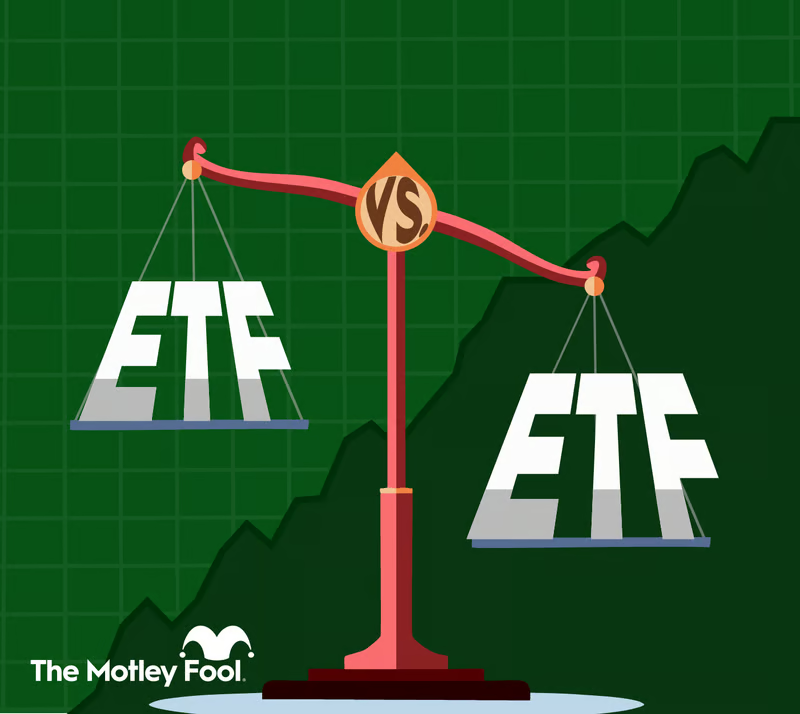
The Health Care Select Sector SPDR ETF (XLV +0.70%) and the Fidelity MSCI Health Care Index ETF (FHLC +0.56%) both offer low-cost exposure to domestic healthcare, but they differ significantly in their market-cap focus and liquidity profiles.
The healthcare sector can serve as a defensive anchor for diversified portfolios, offering a mix of steady pharmaceutical giants and high-growth biotech companies. This comparison examines how these two funds track the industry using different indexing strategies, highlighting their structural contrasts and historical risk-adjusted returns.
Snapshot (cost & size)
| Metric | FHLC | XLV |
|---|---|---|
| Issuer | Fidelity | SPDR |
| Share price | $78.40 (as of 2026-07-23) | $161.44 (as of 2026-07-23) |
| Expense ratio | 0.08% | 0.08% |
| 1-yr return (as of 2026-07-23) | 22.90% | 20.50% |
| Dividend yield | 1.30% | 1.60% |
| Beta | 0.59 | 0.55 |
| AUM | $3.2 billion | $41.7 billion |
Beta measures price volatility relative to the S&P 500; beta is calculated from monthly returns over the available fund history (up to five years). The 1-yr return represents total return over the trailing 12 months. Dividend yield is the trailing-12-month distribution yield.
Cost is not a differentiating factor here, as both funds carry a very low 0.08% expense ratio. However, investors seeking higher cash flow may prefer the State Street fund, which currently offers a higher distribution yield.
Performance & risk comparison
| Metric | FHLC | XLV |
|---|---|---|
| Max drawdown (5 yr) | (17.70%) | (17.10%) |
| Growth of $1,000 over 5 years (total return) | $1,276 | $1,332 |
What’s inside
The State Street Health Care Select Sector SPDR ETF focuses on the 60 largest healthcare companies in the S&P 500, offering a concentrated mega-cap portfolio. Its sector exposure is 99.00% healthcare, and its largest positions include Eli Lilly + Co (LLY +0.87%) at 16.11%, Johnson + Johnson (JNJ +1.59%) at 10.72%, and Abbvie Inc (ABBV +0.95%) at 7.79%. The fund was launched in 1998. State Street Health Care Select Sector SPDR ETF has paid $2.53 per share over the trailing 12 months, which, at its recent ~$161.44 share price, yields 1.60%.
The Fidelity MSCI Health Care Index ETF tracks a much broader index of 365 holdings, reaching into mid- and small-cap territory for more comprehensive market coverage. Its sector makeup is also 99.00% healthcare, but its top positions are less concentrated, including Eli Lilly + Co at 13.84%, Johnson + Johnson at 9.07%, and Abbvie Inc at 6.60%. The fund was launched in 2013. Fidelity MSCI Health Care Index ETF has paid $1.02 per share over the trailing 12 months, which, on its recent ~$78.40 share price, works out to a 1.30% yield.
For more guidance on ETF investing, check out the full guide at this link.
Which is the better buy
The Health Care Select Sector SPDR ETF (XLV) and the Fidelity MSCI Health Care Index ETF (FHLC) are both health care exchange-traded funds (ETFs). Yet, for investors seeking exposure to this defensive sector, there are important differences between these two funds. Let’s take a closer look at each fund to see how they compare to one another.
First, there’s XLV. This fund is the longstanding giant of the field, with a history stretching back nearly 30 years. XLV holds around 60 stocks, focusing most of its exposure on healthcare megacap stocks like Eli Lilly, Johnson & Johnson, and Abbvie. It has a decent dividend yield of 1.6% and a very low expense ratio of only 0.08%. As for performance, XLV has delivered a total return of 157% over the last 10 years, equating to a compound annual growth rate (CAGR) of 9.9%. That’s significantly below the S&P 500, which has generated a total return of 301% and a CAGR of 14.9% over the same period. Nonetheless, given healthcare’s traditional role as a defensive sector, some investors will still value the role that XLV — or another healthcare-focused ETF — can play in their portfolio.
Then there’s FHLC. This fund also seeks to gain exposure to the healthcare sector, but it does so in a slightly different way. FHLC holds over 360 stocks. So, while it also assigns significant weight to the healthcare giants like Lilly, Johnson & Johnson, and Abbvie, it also holds positions in smaller stocks like Sotera Health (SHC -0.80%), Kymera Therapeutics (KYMR +0.17%), and Insmed (INSM -0.46%). FHLC has a dividend yield of 1.3% and an identical expense ratio of 0.08%. Turning to performance, FHLC has generated a total return of 159% and a CAGR of 10.0% over the last 10 years, slightly outperforming XLV but falling well short of the S&P 500.
To sum up, XLV is by far the most popular healthcare ETF. However, investors who are seeking exposure beyond the 60 largest healthcare stocks may want to consider FHLC. The fund has ever so slightly outperformed XLV over the last 10 years. In addition, it has an identical expense ratio. Yet, XLV’s long track record, as well as its larger dividend yield, may still be the right choice for income-seeking investors.