Top Small Business Ideas Ranked by Consumer Demand

Starting a small business remains a keystone of the great American dream for many. And entrepreneurship is on a roll right now, according to Census Bureau data, with new business applications soaring in 2026.
The appetite for starting a local business is no exception. Homeowners rely on trustworthy, nearby tradespeople who can fix their leaky faucet ASAP. Similarly, dog owners want to feel reassured that there’s a reliable grooming spot close to hand for their beloved pet. And in the wake of the COVID-19 pandemic, the hospitality industry has shown positive signs of recovery in many localities, making restaurants another popular choice for prospective startups.
Many factors contribute to the success of a small business — from location to sufficient business funding. However, one major factor comes down to the basic law of supply and demand. To help budding entrepreneurs explore business ideas, OnDeck analyzed which types of businesses have high demand and relatively little supply. We produced rankings at the national level as well as for individual major cities.
What we did
We used Semrush search volume data to compare the number of businesses by type to the number of monthly Google searches for that service, nationwide and in major U.S. cities. The higher the search volume relative to the number of businesses, the more sought-after the local business and the higher the score.
Key Findings: Business types ranked by consumer demand.
- Web users make 823,000 Google searches for car rental businesses every month. With 24,214 such businesses in the U.S., that equates to 34 monthly searches per business — the highest demand for any local business type at the national level.
- Middle Eastern dishes are the most sought-after cuisine nationwide, with kebab shops scoring 14.5 searches per business.
- Locksmiths are one of the most in-demand businesses in New York City, with a score of 21.5 searches per business.
- In Austin, Texas, there are 66.7 monthly searches for kebab shops per existing kebab shop, making it the most in-demand cuisine in the city.
Car rental is the most in-demand local business across the U.S.
Our analysis shows that car rentals are by far the most sought-after local business type, with 34 monthly searches per car rental business currently operating in the U.S. This is 71.7% higher demand than the second most-sought local business type, tailoring (19.8 searches per business).
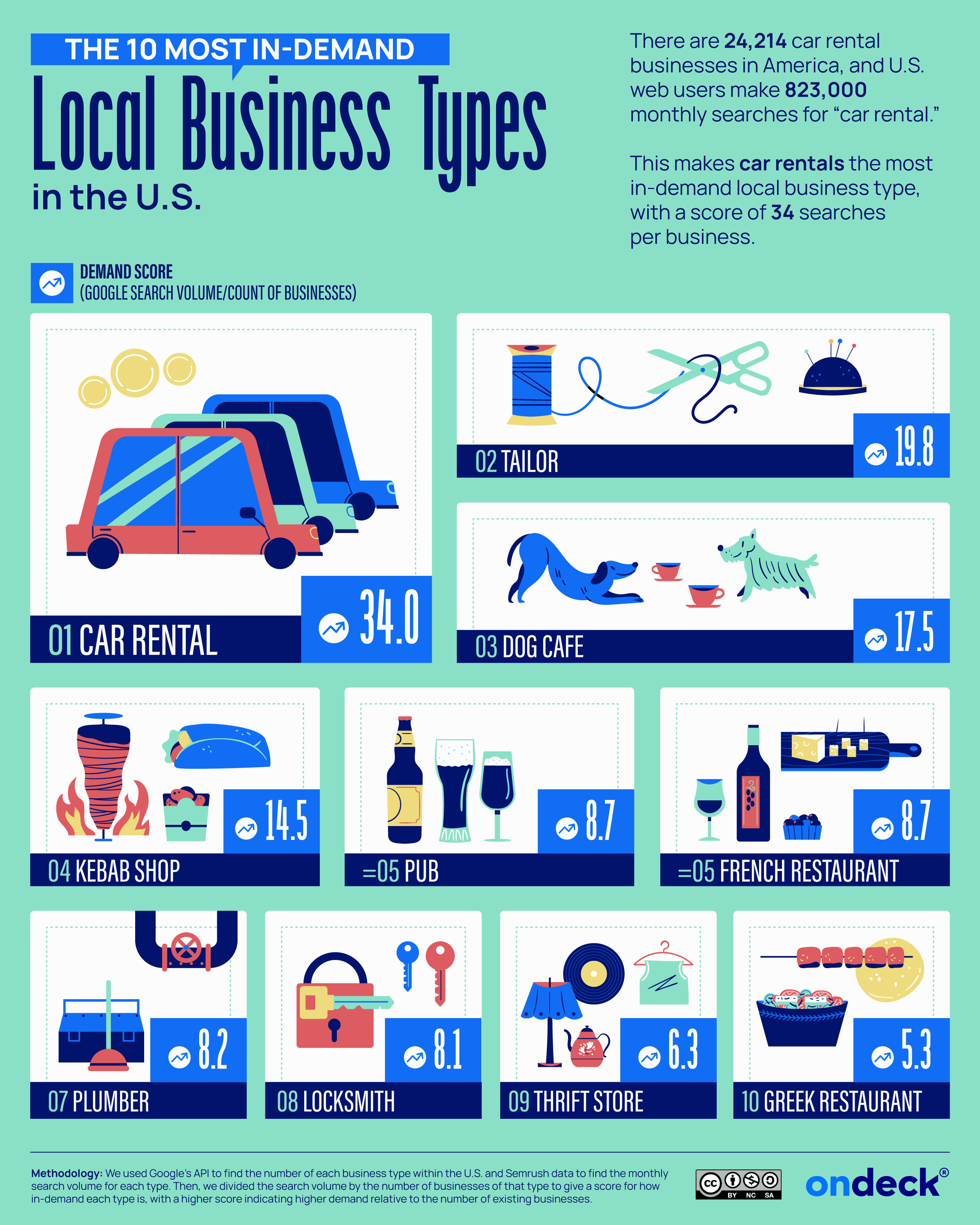
One key reason is the continued growth of the travel industry: from 2025 to 2030, airport transport and car rental services are projected to grow at a CAGR (compound annual growth rate) of 8.8%. Ultimately, the promise of convenience, flexibility and cost-effectiveness means that the car rental business is projected to thrive well into the next decade.
The number one in-demand local restaurant type nationwide is the kebab shop.
Mexican, Chinese, Indian, Korean and Greek restaurants all feature in our top 10 most in-demand local restaurants. Yet it’s the Middle Eastern street food that reaches the top spot, with kebab shops receiving 14.5 monthly web searches per business.
Between 2025 and 2033, the kebab shop market is expected to grow at a CAGR of 6.2%. In fact, the U.S. has already seen a significant expansion of franchise models in the kebab market, as Wally Sadat, co-owner of “The Kebab Shop,” can testify: “The Kebab Shop is a brand where we want to hit you with all of the senses … what you’re hearing, what you’re smelling, what you’re tasting, what you’re seeing,” says Sadat. The Kebab Shop has expanded to 19 locations since its debut in San Diego in 2008.
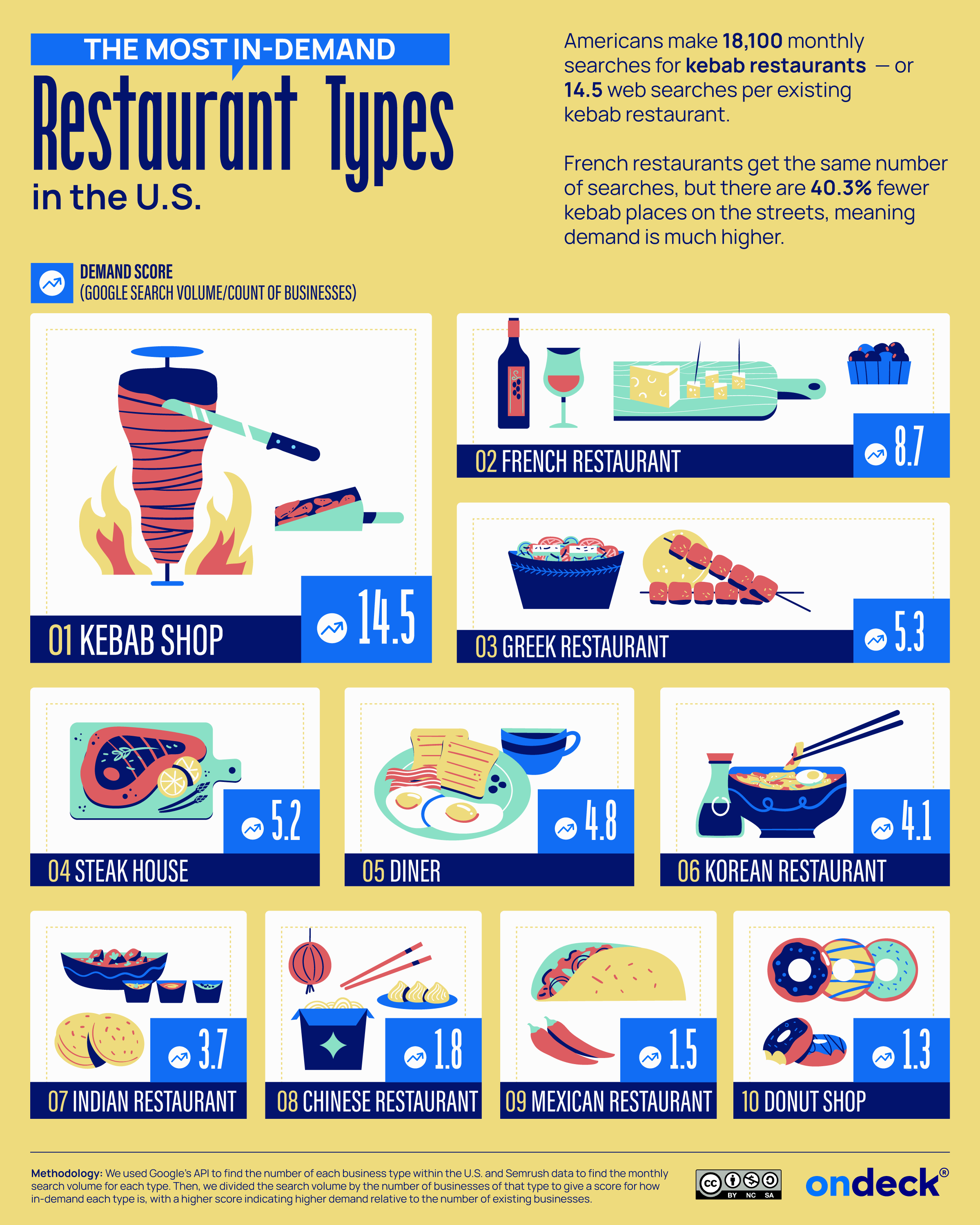
However, there are notably fewer kebab shops than French restaurants — the second-most in-demand restaurant type, with 8.7 monthly searches per business. French cuisine is a long-standing tradition in the U.S. In the mid-20th century, American chef, author and television personality Julia Child encouraged ordinary Americans to love French cooking. However, the novelty of the kebab on American soil and the relatively few kebab shops drive demand, potentially making it a safer bet for prospective restaurant owners.
Locksmiths are one of the most coveted local businesses in New York City.
When narrowing our research to major cities, we found that New Yorkers make almost 10,000 web searches for a locksmith — with fewer than 500 in operation. Our study revealed a healthy score of 21.5 monthly web searches per locksmith, meaning that setting up this type of business could pay dividends.
Compared to a big chain, a local locksmith may be more likely to know the city well, understand the urgency at stake and respond promptly and reliably to your call.

Yet while locksmiths are highly popular in New York City, so too are thrift stores, with a score of 24.2 monthly searches per business. Thrift stores also take the top spot in Boston (36.9), Philadelphia (18.3) and Seattle (35.7).
In 2025, the U.S. secondhand market was worth $56 billion, and that’s projected to rise to $61 billion in 2026. Sustainability and environmental concerns, economic pressures and the pure joy of treasure seeking are just a few reasons why thrift stores are flourishing. However, while IRL thrift stores are certainly in high demand, online secondhand stores account for over half of the market and are predicted to rise year-on-year.
Diners are the most sought-after local restaurant type in Philadelphia.
A staple of American society for over 100 years, diners provide comfort, warmth and familiarity. We found that, despite there being the same number of steak houses as diners in the city (60), residents make 12 monthly searches per diner compared to 6.5 searches per steak house.

Due in no small part to the COVID-19 Pandemic, Philadelphia has lost at least eight much-loved diners in the last few years alone. American diner expert Randy Garbin agrees that “the situation has changed dramatically.”
Yet while some diners may have closed their doors, cravings remain high across the U.S.: diners also take the top spot in our study in New York City (25.6), Boston (21.7), Chicago (11.4) and Seattle (20).
Three tips to set up a thriving local business.
For a local business to be sustainable, there has to be a continual and growing community need. Our study has provided insight into the most in-demand types of business across the U.S., but what else should you do to ensure your new business is both popular and profitable? With solid planning and research, you can help safeguard your business as a sustainable and lucrative venture while ensuring it is of real value to your local community.
1. Conduct market research in your local area
Use existing sources, such as consumer statistics and economic indicators, to find general and quantifiable knowledge of the current market. Similarly, the U.S. Census Bureau has an invaluable tool to help you understand key demographics and trends in your neighborhood.
2. Get to know your community and its needs
Carry out questionnaires and/or surveys, or simply spend quality time in your local community, to get a sense of individual tastes and interests. This can then help you refine and tweak your plan.
3. Use competitive analysis
Identify your competition by service and market sector to see how your business can gain a distinct competitive edge. Questions to ask include: what are the strengths and weaknesses of the current landscape? What might be your window of opportunity for entering the market? Likewise, what barriers might you face?
4. Match your business idea to your existing skill set
Consider the expertise, qualifications, and experience you already bring to the table when evaluating potential business ideas. A strong alignment between market demand and your own capabilities not only reduces startup costs — such as training and hiring — but also gives you a natural competitive advantage. Ask yourself: “Where does community need intersect with what you do best?” That overlap is often where the most sustainable and fulfilling small businesses are built.
Methodology
To determine which are the most in-demand businesses and restaurant types in the U.S. and for major cities, we compared the count of businesses by type to the monthly Google search volume for that type. A higher search volume relative to the number of businesses indicates more demand, and a lower relative search volume indicates less demand.
Firstly, we retrieved the count of each business type and restaurant nationally and for nine major cities using Google’s API. Next, we sourced the monthly search volume for each business type and restaurant using Semrush data. Finally, we divided the total search volume by the number of businesses to obtain the relative demand for each business/restaurant in each location.