This CEO Just Raised $110 Million to Make Banks Agent-First
Enterprise AI has spent the last two years proving it can summarize documents, answer questions and automate repetitive work. Banking has spent the same two years asking a different question: can artificial intelligence be trusted to make decisions that carry financial, regulatory and legal consequences?
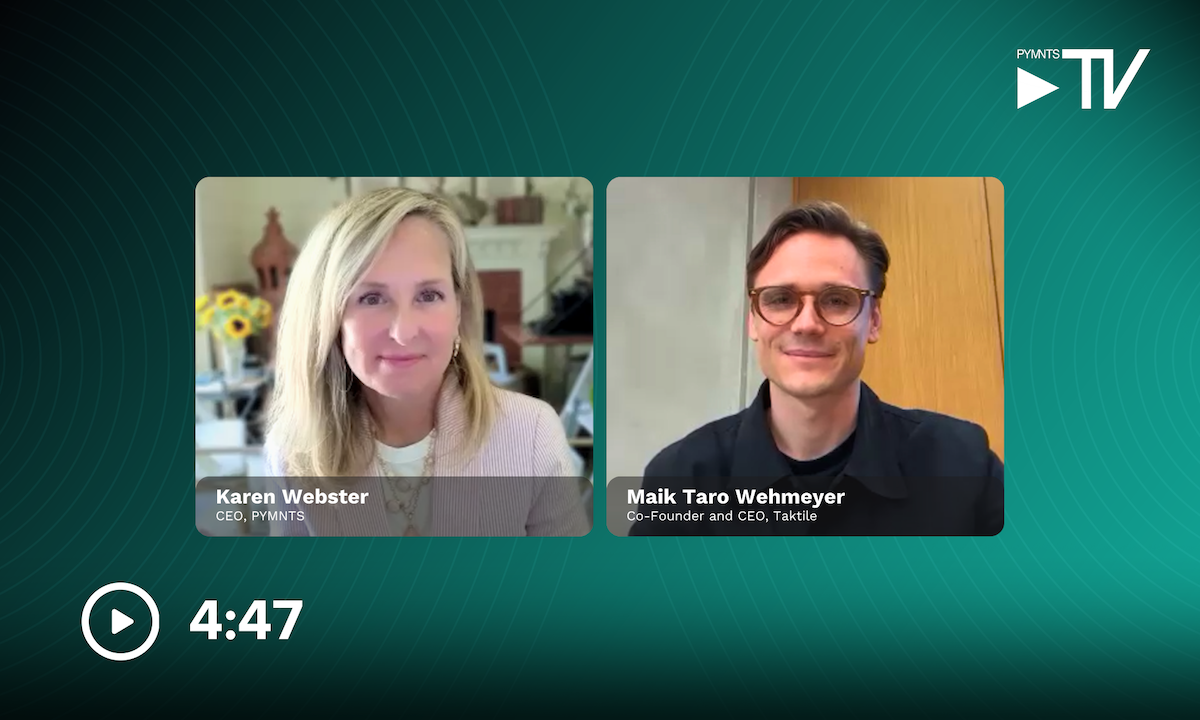
That threshold, as Maik Taro Wehmeyer, co-founder and CEO at Taktile, told PYMNTS CEO Karen Webster, is beginning to move.
“The models have not been good enough to be ready for mission critical decisions for financial services,” he said. “2026 is the year where AI will come to financial services.”
Fresh off a $110 million funding round led by Goldman Sachs Alternatives, Taktile is betting that the market for autonomous financial decision-making is arriving faster than many executives realize. The company’s platform deploys AI agents designed specifically for regulated financial institutions, helping banks automate some of their most complex operational workflows while maintaining regulatory oversight.
Wehmeyer believes the financial services industry is moving toward an “agent-first” future where conversational AI becomes the primary interface for opening accounts, applying for loans and interacting with financial institutions.
The wager is less about replacing humans than about redefining how institutions interact with AI.
AI’s Real Inflection Point Is Better Risk Decisions, Not Better Models
Despite the hype and headlines surrounding AI, many enterprise executives still remain reluctant to grant AI agents access to core enterprise systems, let alone authorize them to make high-stakes decisions. This is especially true inside highly regulated industries like banking.
Webster opened the discussion by asking the central question facing companies building enterprise AI today: “Are you betting on a market that exists today or one that you see evolving and accelerating?”
For Wehmeyer, the answer was unequivocal. Instead of simply assisting employees, AI can now autonomously complete sophisticated workflows across complex financial areas like commercial lending, insurance claims management and business underwriting that previously demanded experienced analysts.
“We are betting on the market where that will be possible,” he said, acknowledging that while thousands of banks remain cautious, a growing group has already moved beyond experimentation into production.
Using AI solutions, a small business loan that once required weeks of manual underwriting could potentially be approved within minutes, while insurance claims that historically took months can be evaluated within hours using drone imagery and AI-powered damage assessments.
“I think many people by now confuse AI transformation with cost savings,” Wehmeyer said, noting that the larger competitive advantage instead now comes from AI’s ability to dramatically compress decision times.
“If I’m a small business owner and I’m asking for a loan, and I get the answer not within 14 days … but within five minutes, how great is that?” he added.
For businesses operating under cash flow pressure, decision speed often becomes as valuable as the capital itself. As a result, competitive differentiation shifts from who offers financial products to who delivers financial certainty fastest. That distinction transforms AI from productivity software into operational infrastructure.
Leadership Matters More Than Institution Size for AI Readiness
One surprising lesson emerging from Taktile’s customer base is that AI readiness bears little relationship to organizational size. While some of the industry’s largest banks remain hesitant to embrace autonomous AI, certain community banks and credit unions have become aggressive adopters after completing broader cloud modernization efforts.
That has a leveling effect. AI models capable of underwriting a commercial loan or clearing a KYB check were, until recently, the province of the largest institutions with the R&D budgets and technical teams to build them. Taktile puts that same decisioning power in the hands of smaller banks and credit unions. A community institution can now compete for the same customers, deposits and small business relationships as a national bank, without standing up a data science organization to do it.
For the smaller FI, that’s the difference between watching bigger rivals compress a two-week loan decision to five minutes and being able to do it themselves. Speed of decision becomes a product a $2 billion-asset credit union can offer as readily as a $2 trillion-asset bank.
As Webster observed, organizations must adapt not only business models but also employee behavior.
“The technology is great,” she said. “It’s the change management, getting people comfortable with this powerful technology.”
That reflects an often-overlooked reality of enterprise AI adoption. Deploying autonomous systems requires more than technology investment. It demands organizational willingness to redesign decision-making processes, redefine employee responsibilities and accept new operating models.
“This is not only about what’s possible,” Wehmeyer said. “The question is how fast can you get access to it?”
To reduce adoption barriers, Taktile has created its own research organization, Taktile Labs, dedicated to benchmarking AI performance against human experts across financial use cases. Taktile Labs functions as the company’s evidence engine. It publishes ongoing data on how model performance is evolving across underwriting, KYB, fraud and claims, giving institutions a running read on where artificial intelligence has closed the gap with human analysts and where it has not yet. For a risk officer being asked to hand a decision to a machine, that shift from vendor assertion to measured, published benchmarks is often what moves the conversation forward. The company also encourages customers to operate AI in “shadow mode,” allowing institutions to compare AI recommendations against existing human workflows before giving systems operational authority.
That gradual transition reflects a broader shift occurring across enterprise AI. Organizations no longer ask whether AI works. Instead, they are asking whether it performs consistently enough to withstand audits, regulatory scrutiny and executive accountability.
The Agent-First Bank Is Already Taking Shape
Looking further ahead, Webster posed a provocative question: could banks eventually become infrastructure behind AI agents rather than primary customer interfaces?
“I will expect banks being very, very agentic first and API first,” Wehmeyer said.
Humans will likely remain involved for the largest and most consequential decisions, particularly where regulators require oversight. But routine financial interactions increasingly may occur between intelligent software systems rather than people.
“The technology will be there,” Wehmeyer said. “The question is … when is the regulator going to be ready for it?”
That observation captures the broader reality facing enterprise AI. The technology race is increasingly giving way to a trust race. The organizations that define the next decade of AI may not simply build the smartest models. They will be the ones that convince institutions those models deserve a seat at the decision-making table.
Watch the full PYMNTS “Monday Conversation” interview with Taktile CEO Maik Taro Wehmeyer to hear more about:
- Why enterprise AI’s biggest barrier is no longer capability but trust.Wehmeyer says recent advances in AI models have made autonomous underwriting, KYB and insurance claims decisions technically possible, but widespread adoption now depends on proving those systems can earn the confidence of banks, regulators and executives.
- How competitive pressure — not just cost savings — is accelerating AI adoption in banking.The discussion explores why faster loan approvals, real-time underwriting and dramatically shorter claims processing are becoming strategic differentiators that improve customer experience while helping financial institutions compete for businesses and consumers.
- Why the winners in financial AI will combine specialized software with organizational transformation. Wehmeyer argues that success requires more than powerful models, emphasizing that industry-specific expertise, regulatory-ready infrastructure, rigorous benchmarking and hands-on change management are becoming the real moats as banks move AI agents into production.