The Emergence of Gold in a Multipolar World

Fundamentally, a dollar rally is applying downward pressure on gold, but it’s also building strength behind the curtain. A stronger dollar increases debt-servicing costs for foreign borrowers, tightens global market liquidity, raises overall funding costs, and frequently forces traders to unwind leveraged positions and carry trades. In effect, this volatility encourages central banks to aggressively diversify their reserves, which opens the path for gold exposure.
As Paul Wong, managing partner and market strategist at Sprott Inc., observed in Sprott Precious Metals Report, “Gold is becoming the reserve asset of a multipolar world.”
Key Takeaways:
- A strong dollar tightens global liquidity and raises foreign debt costs, which paradoxically incentivizes central banks to diversify away from sovereign currencies and increase gold allocations.
- Gold acts as a neutral “outside money” asset with no counterparty or political risk, functioning as a strategic reserve anchor as central bank holdings shift toward historic highs.
- Investors can access this secular trend through Sprott ETFs for bullion exposure or large-cap miners.
See More: Sprott’s Schoffstall on Rare Earth Portfolio Drivers & More
The Dollar Paradox and Reserve Diversification
As Wong noted, the underlying paradox of the modern monetary system is that “the stronger the U.S. dollar becomes, the greater the incentive for countries to find alternatives to it.” As opposed to the dollar being replaced by another single currency, Wong explained that “the most likely outcome is not the replacement of the dollar with a single reserve currency but the gradual emergence of a more diversified or multipolar system.”
With those forces in play, gold occupies a singular position in this shifting framework as “outside money.” Amid escalating geopolitical friction, central banks view gold as not just an inflation hedge, but more as a monetary hedge and strategic reserve collateral.
“Unlike sovereign currencies, it carries no political allegiance,” Wong said. “Unlike government bonds, it has no counterparty risk. Unlike bank deposits, it cannot be frozen or sanctioned if held domestically.”
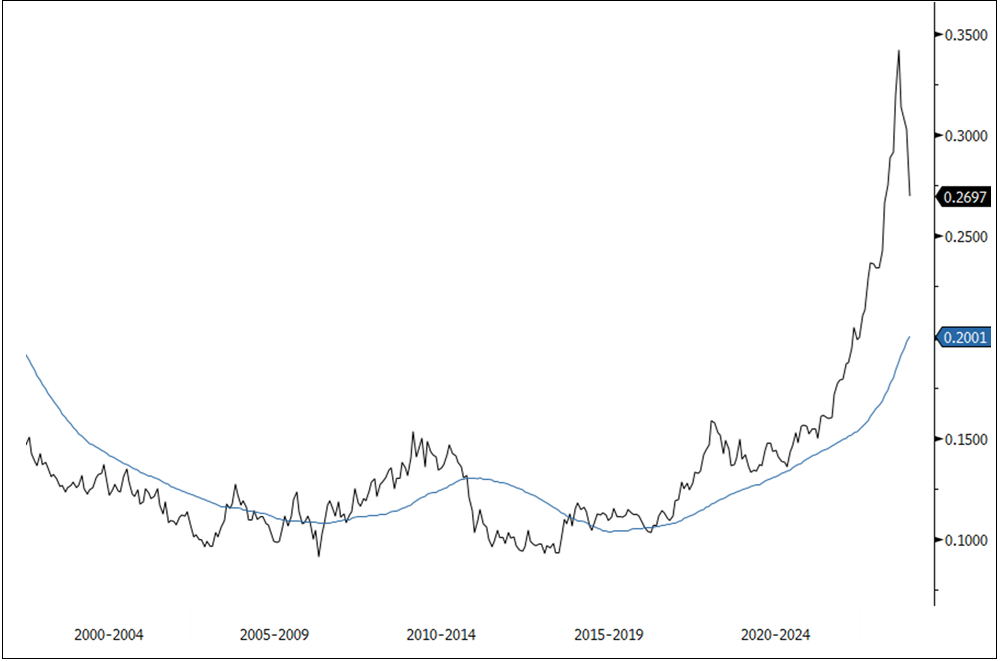
Wong cited that central bank gold allocations surged from an average of ~12% of total world reserves since 2000 to a recent high of ~34%, before settling near 27%. This structural shift underscores a secular trend of gold returning as the primary neutral anchor in a fragmented global economy.
Figure 2. IMF: Gold as % of Total World Reserves with 4-YR Moving Average
Source: Bloomberg. Data as of 6/30/2026.
2 Options For Gold Exposure
Any current weakness in gold offers retail investors to buy the pullbacks in preparation for the long-term trend for gold’s potential upside. That said, Sprott offers both the Sprott Physical Gold Trust (PHYS) and the Sprott Gold Miners ETF (SGDM).
PHYS provides access to pure-play gold exposure while adding a degree of flexibility. Through PHYS, investors avoid the logistics of storing gold, but carry the option to convert their shares to bullion for a more tangible investment feel.
Another option for exposure is indirectly via miners, but rather than choosing individual mining stocks, SGDM adds broad-based exposure. That eschews the overconcentration risk inherent in shares of single companies. SGDM seeks investment results that correspond generally to the performance of the Solactive Gold Miners Custom Factors Index. This index tracks the performance of large-cap gold companies that trade on Canadian and U.S. exchanges.
For more news, information, and analysis, visit the Gold/Silver/Critical Minerals Channel.
Disclosures
An investor should consider the investment objectives, risks, charges, and expenses carefully before investing. To obtain a Prospectus, which contains this and other information, contact your financial professional or call 888.622.1813. Read the Prospectus carefully before investing, which can also be found by clicking one of the links below.
Past performance is no guarantee of future results. One cannot invest directly in an index.
The Sprott Rare Earths Ex-China ETF and the Sprott Active Metals & Miners ETF are new and have limited operating history.
Funds that emphasize investments in small/mid-cap companies will generally experience greater price volatility. Diversification does not eliminate the risk of investment losses. ETFs are considered to have continuous liquidity because they allow an individual to trade throughout the day. A higher portfolio turnover rate may indicate higher transaction costs and may result in higher taxes when Fund shares are held in a taxable account. These costs, which are not reflected in annual fund operating expenses, affect the Fund’s performance.
Sprott Asset Management USA, Inc. is the Investment Adviser to the ETFs. ALPS Distributors, Inc. is the Distributor for the ETFs and is a registered broker-dealer and FINRA Member. ALPS Distributors, Inc. is not affiliated with Sprott Asset Management USA, Inc. or VettaFi.
Exchange Traded Funds (ETFs): SETM, LITP, URNM, URNJ, COPP, COPJ, NIKL, SGDM, SGDJ, SLVR, GBUG, METL, and REXC
Physical Bullion Funds: PHYS, PSLV, CEF, and SPPP.
Gold and precious metals are referred to with terms of art like store of value, safe haven and safe asset. These terms should not be construed to guarantee any form of investment safety. While “safe” assets like gold, Treasuries, money market funds and cash generally do not carry a high risk of loss relative to other asset classes, any asset may lose value, which may involve the complete loss of invested principal.
