Survey: Zoning, Land Use Flexibility & Starter Homes

Among those who expressed an opinion, some 74% are in favor of permitting additional housing near retail, dining, and employment centers. An estimated 64% advocate for the development of new communities featuring smaller lot sizes, while roughly 58% endorse the inclusion of smaller-lot residences, duplexes, townhomes, and single-family houses within current single-family residential areas.
The comprehensive survey findings indicate that support was most robust when reforms were presented in the context of starter homes, accessible ownership, gradual transitions, and residences located near employment opportunities.
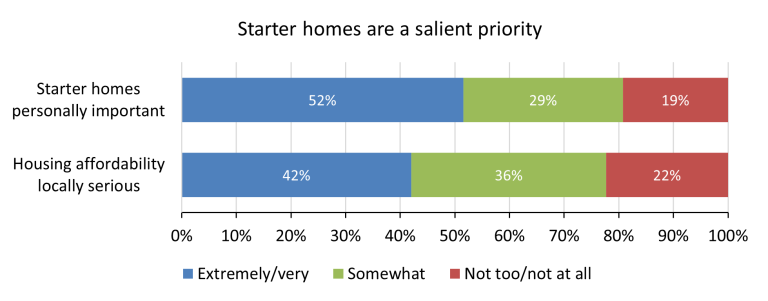
The most significant substantive conclusion is that starter homes are regarded as a high priority. Among those respondents who expressed an opinion, 52% indicated that having more affordably priced starter homes in their community is extremely or very important, while 81% believe it is at least somewhat important. Furthermore, Americans perceive housing affordability as a critical issue in their localities, thereby establishing a solid political basis for a supply agenda focused on starter homes.
The survey further elucidates the type of housing development that Americans prefer. Generally, respondents express a preference for more affordable starter homes, particularly those that individuals can own; smaller, low-rise residences spread throughout various neighborhoods; gradual transformations; housing primarily constructed by homeowners and small builders instead of larger developers; increased flexibility for property owners; and the allowance for additional housing construction as a more effective means to reduce costs. Equally important, respondents show the most favorable response to initiatives that facilitate the construction of starter homes, enabling first-time buyers and young families to afford homes within their communities.
Collectively, these findings suggest a housing agenda that is smaller in scale, focused on ownership, gradual in implementation, and centered on supply—rather than one that emphasizes large buildings, rental-only developments, or an increase in government programs.
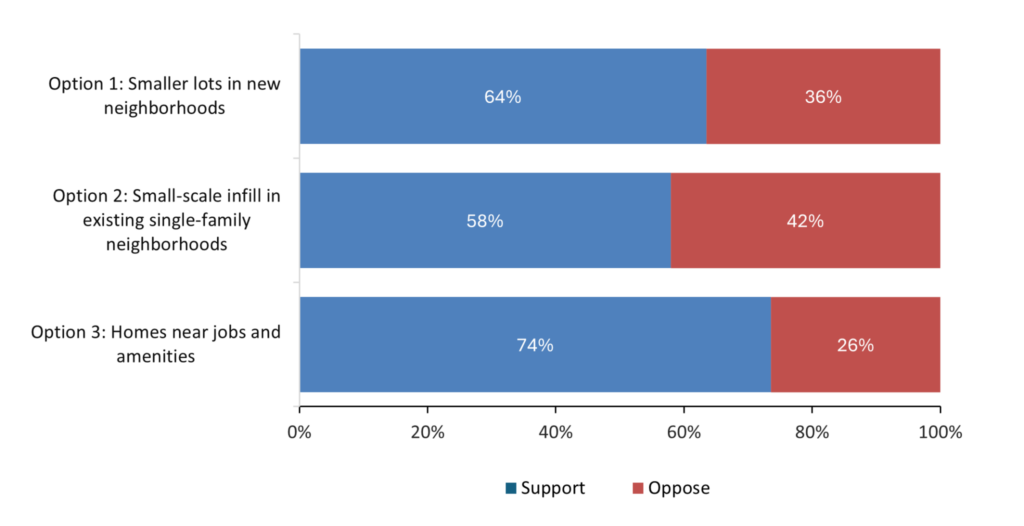
Note: Percentages are weighted and rounded to the nearest whole number. Results exclude not sure/skipped.
Measuring the State of the U.S. Market
The survey evaluated three reform alternatives aligned with the AEI Housing Center’s Playbook agenda: flexibility in lot sizes for new subdivisions; adaptability in dwelling types and lot splits for existing properties; and the option to construct homes in proximity to employment centers. These options were articulated in straightforward terms within the survey as permitting smaller lots in new developments, enabling smaller-lot residences and compact homes such as duplexes or townhomes in established single-family neighborhoods, and allowing residential construction in areas currently restricted from housing, particularly near shops, restaurants, and workplaces.
Support is favorable across all three categories; however, the most robust baseline finding pertains to permitting residential development in and around locations with retail, dining, and employment opportunities that presently prohibit housing. Among those respondents who expressed an opinion, 74% are in favor of this reform, while 26% are against it.
Among the three primary reforms evaluated, Americans demonstrated the highest initial support for residential developments close to employment centers. This reform is straightforward to articulate: it advocates for the construction of additional homes in areas where individuals already work, shop, and engage in leisure activities. It links the availability of housing to convenience, access to employment, and the more effective utilization of commercial or underutilized land.
In addition to addressing the three fundamental housing reforms, the survey inquired about the wider housing priorities and preferences of respondents. The findings provide insight into which housing policies are most appealing to the public. The most definitive outcome of the survey indicates that starter homes are a significant priority. Among those who expressed an opinion, some 52% of Americans consider it extremely or very important to increase the availability of affordably priced starter homes in their community, while 81% believe it is at least somewhat important.
Participants also perceive housing affordability as a significant issue in their locality. Among those who expressed an opinion, some 42% believe that housing affordability in their region is extremely or very serious, while an additional 36% consider it somewhat serious. These findings establish a political basis for a supply agenda focused on starter homes: respondents are not merely concerned about affordability in general; many desire more accessible starter homes within their own neighborhoods.
The results of the preference survey indicate a distinct trend: Americans are not primarily advocating for large structures or exclusively rental developments. Respondents show a greater openness to housing expansion when it is focused on ownership, characterized by a light-touch approach, gradual implementation, and practicality.
When inquired about their preferred outcome for additional housing in their neighborhood, some 57% opted for more affordably priced starter homes, particularly those that can be owned. In contrast, only 4.6% selected smaller rental units, such as studios or one-bedroom apartments. A significant portion (38%) favors a combination of both options, yet the stark difference is evident: ownership-focused starter homes outnumber rental-only options by a ratio of 12:1.
Participants also expressed a preference for increased flexibility in local land-use regulations. Seventy-seven percent believe that property owners should have greater autonomy to construct various types of residences on their land, whereas 23% contend that local authorities should impose strict controls on the types of homes permitted. This suggests an additional compelling perspective: housing reform as a means of enhancing property-owner flexibility, rather than merely focusing on zoning deregulation. This perspective aligns with recent reform initiatives like Texas SB 15, which aimed to broaden opportunities for starter homes by permitting more adaptable lot sizes and affordable, modest housing.
Further, participants showed a clear preference for smaller, more widely distributed changes. Seventy-eight percent favor smaller, low-rise residences in various neighborhoods rather than larger structures concentrated in fewer locations. Some 83% opt for smaller, more accessible homes over larger ones, even if this results in a reduced number of homes being constructed. Furthermore, roughly 85% prefer housing primarily developed by individual homeowners and small builders instead of larger development firms. Additionally, 60% favor gradual, minor adjustments over more rapid actions to tackle housing shortages, although subsequent reports indicate that this inclination is significantly stronger among conservatives compared to liberals.
To read more, click here.