San Antonio sets bond sale for airport expansion plan

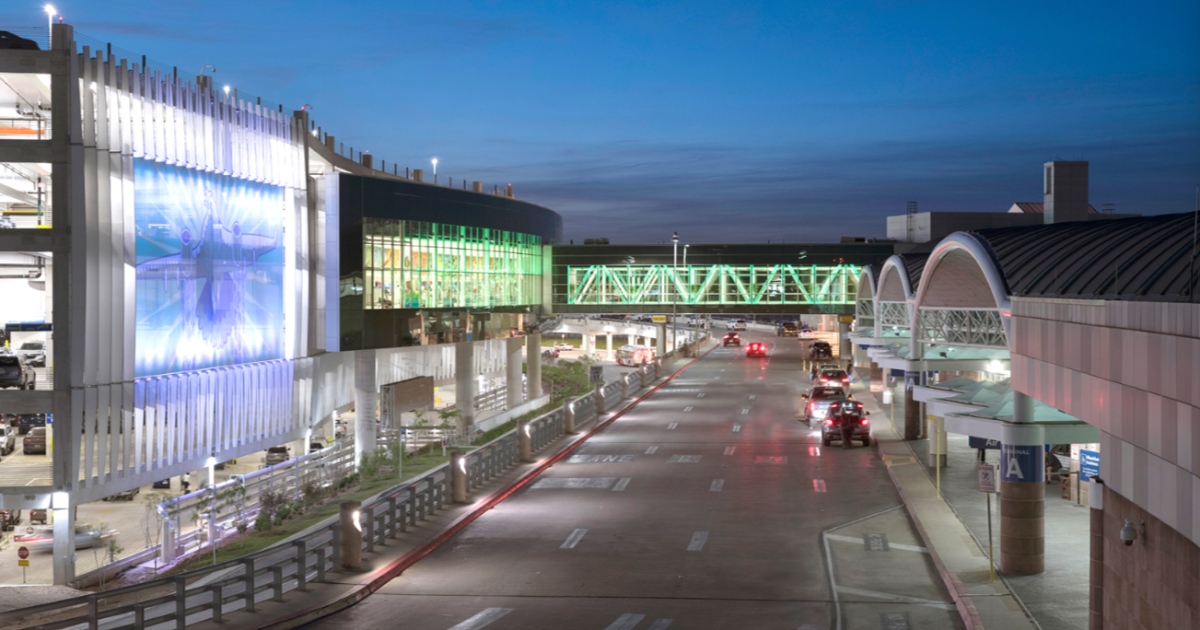
San Antonio International Airport
San Antonio, Texas, is bringing its biggest-ever airport system revenue bond issue to the municipal market this week with a $943.9 million deal that includes the first long-term financing for a capital program that will add a third passenger terminal.
Processing Content
The fiscal year 2025-2032 San Antonio International Airport capital improvement plan, which totals about $2.59 billion, will accommodate passenger volume that is expected to grow from 10 million in 2019 to 14.5 million by 2040, according to an investor presentation.
Airports Director Jesus Saenz said the master planning effort was crafted with the region’s quickly rising population in mind.
“It is really matching and preparing the overall airport asset for the future growth as we expand and add 18 additional gates in the new terminal,” he said.
Other Texas airports are also bringing big bond issues to the market. In April, Austin sold
San Antonio’s general airport revenue bond issue, which is scheduled to price on Tuesday, will raise about $396.2 million in new money for the CIP, while refunding some outstanding debt, according to the city’s chief financial officer, Troy Elliott.
The deal aims to replace interim CIP financing – $452.77 million of airport system inferior lien revenue bonds privately placed with Bank of America last year — with long-term, fixed-rate debt, as well refinancing callable Series 2012 and 2015 bonds for an anticipated present value savings of about $3.1 million, he said.
In conjunction with the deal, the master ordinance was amended, giving the bonds a first lien on the airport’s net instead of gross revenue, which secured past issues, to “more align with industry standards,” according to Elliott.
An estimated additional $1.33 billion of bonds would be issued to finance the CIP, with the city eyeing the sale of $930.6 million of GARBs and nearly $103 million of passenger facility charge bonds in 2027, followed by smaller debt issuances in 2028 and 2029, he added.
Ahead of the deal, Moody’s Ratings lowered the airport’s senior lien GARB rating to A2 with a stable outlook from A1 with a negative outlook, while Fitch Ratings and S&P Global Ratings assigned A-plus ratings with stable outlooks to the bonds.
Moody’s said the downgrade was due to “the substantial increase in leverage associated with the airport’s capital program and the resulting pressure on financial metrics.”
“Total debt is projected to increase significantly through the end of the decade, with debt outstanding rising above $2 billion and leverage metrics peaking at elevated levels, including adjusted debt per origin and destination enplanement exceeding $400 for a sustained period,” Moody’s rating report said, adding that current “strong” debt service coverage is projected to decline materially to around 1.2 to 1.3 times.
Moody’s revised its outlook to negative from stable last year, citing the anticipated increase in leverage, as well as construction risk from the capital plan, which the rating agency now says “has been well mitigated at this stage with about 96% of the (terminal development program) under contract and $66 million in remaining contingency.”
S&P said the San Antonio City Council took steps to mitigate risk from the capital program, including the creation of an operating contingency fund with an initial $45 million balance and an initial $10 million capital renewal and replacement contingency fund.
“Overall, we view these financial policies as fiscally prudent and believe they provide additional mitigation to address unanticipated fluctuations in revenue or expenses or other substantial disruptions,” S&P’s rating report said.
In its latest muni market report, CreditSights noted a big increase in the airport’s outstanding first-lien GARBs with the upcoming issue and that net revenue debt service coverage is projected to fall from 6.54 times in fiscal 2026 to 1.25 times in fiscal 2030 through 2035.
“The primary credit challenge is execution and leverage: delivering a billion-dollar terminal on budget, while growing passenger revenue fast enough to service more than 10 times the prior debt load with only thin projected covenant cushion,” the report said.
To prevent debt service coverage from falling below a covenant level of 1.25 times, the airport has a rolling debt service coverage account funded with an initial $44 million and a backstop from airlines that was included in their use and lease agreement for the airport, the investor presentation noted.
Elliot said the 10-year base agreement with a five-year, one-time extension signed by 10 of its carriers, provides strong cost recovery and underscores airlines’ support for the airport. Airlines serving the airport include Southwest, Delta, American, and United. Spirit Airlines, which ceased operations at all airports in May, had a 4.9% market share in San Antonio.
“We think that through all these different pieces, that all these elements combined provide a strong financial framework and really enhance the security for the investors,” Elliott said.
Fitch said the use and lease agreement supports stable financial performance and that its rating reflects the airport’s primarily origin and destination traffic base, supported by favorable carrier diversification and a strong, growing service area.
The deal comes just months after a dispute was resolved between the airport and Southwest, its biggest carrier with a market share of 34.4% in fiscal 2025.
Disagreements over gates, rates, and charges led to a lawsuit Southwest filed against the city in federal court in 2024 and a complaint filed with the Federal Aviation Administration in 2025. In May,
Moody’s said the resolution clarifying gate assignments and resolving outstanding payment obligations “eliminates a source of operational uncertainty and brings the airport’s largest carrier into the airport use and lease agreement as a signatory airline.”
Elliott said the agreement “puts us in a better position with the market investors to have this behind us.”
The bonds, which are subject to the alternative minimum tax, are structured with serial maturities from 2027 through 2060, according to the POS.
Lead managers for the deal are RBC Capital Markets and Ramirez & Co. and co-managers are Cabrera Capital Markets, Drexel Hamilton, Loop Capital Markets, Morgan Stanley, SAMCO Capital Markets, and Siebert Williams Shank.
Hilltop Securities and Estrada Hinojosa are co-municipal advisors and McCall Parkhurst & Horton and Kassahn and Ortiz are co-bond counsels.
Separately, Fitch on Thursday upgraded its rating for approximately $113.5 million of outstanding customer facility charge revenue bonds the airport issued for a consolidated rental car facility to A-minus with a stable outlook from BBB-plus.