Not reporting bank interest or LTCG in your ITR? Avoid these 2 common tax filing mistakes
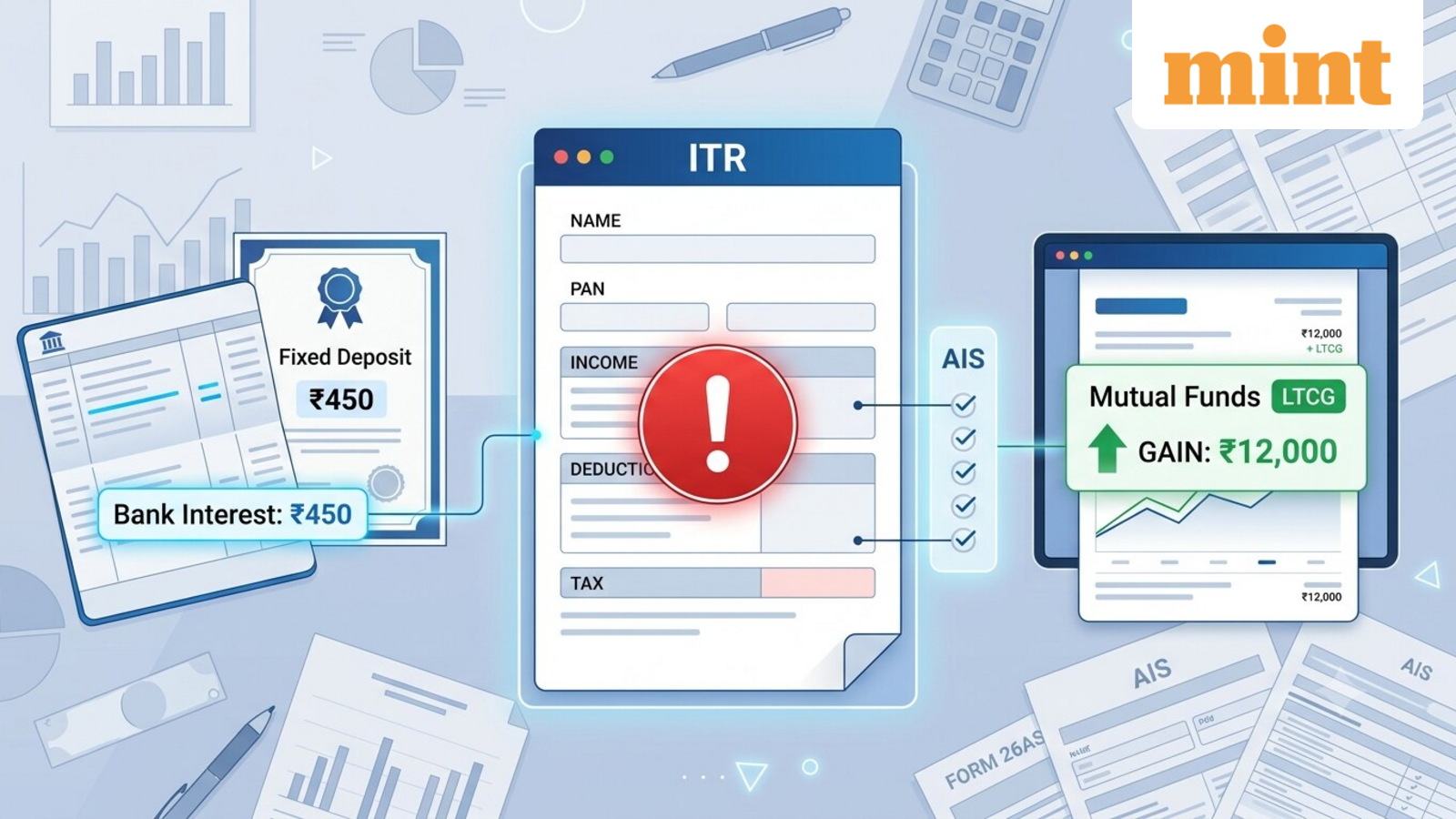
Many taxpayers assume that income on which TDS has already been paid, or long-term capital gains (LTCG) of up to ₹1.25 lakh, need not be reported in their Income Tax Return (ITR).
However, such assumptions can create mismatches between the Income Tax Department’s records and the taxpayer’s return, thereby increasing the chances of notices or adjustments.
According to Siddharth Maurya, Managing Director, Vibhavangal Anukulkara Pvt. Ltd., taxpayers should treat the Annual Information Statement (AIS) as a reconciliation tool rather than merely a reference document.
Every income item reflected in AIS, Form 26AS and the Taxpayer Information Summary (TIS) should be verified against personal records before filing the return.
Mistake 1: Not reporting bank interest because TDS was already deducted
One of the most common mistakes is assuming that the income on which TDS has been deducted does not need to be disclosed in the ITR.
“Many taxpayers think that income on which Tax Deducted at Source (TDS) has already been deducted need not be reported in the ITR. This misunderstanding is responsible for several notices and adjustments under Section 143(1)(a),” said Maurya.
He explained that TDS is only a mechanism for the advance collection of taxes and does not determine a taxpayer’s final tax liability or remove the obligation to disclose income.
“As a general rule, interest from savings accounts, fixed deposits, recurring deposits and other bank deposits remains taxable according to the applicable income tax slabs, subject to eligible deductions under Sections 80TTA and 80TTB,” he mentioned.
He pointed out that banks report interest income to the Income Tax Department, and the details are reflected in the taxpayer’s AIS and Form 26AS.
“If this income is not reported in the ITR, the automated system compares the return with the AIS. Any mismatch can result in an adjustment under Section 143(1)(a),” he added.
Maurya advised taxpayers to:
- Reconcile bank interest shown in AIS, Form 26AS and bank interest certificates.
- Report the income under “Income from Other Sources”.
- Claim the TDS credit separately while computing the final tax liability.
Mistake 2: Not reporting LTCG because it is tax-free
Another common mistake is not reporting long-term capital gains (LTCG) from shares and equity funds if they are below the tax-exempt limit of ₹1.25 lakh in a financial year.
“While the gains may be exempt from tax, the transaction is not exempt from reporting,” he noted.
He explained that mutual fund registrars, depositories and other reporting entities share transaction details with the Income Tax Department. As a result, every redemption is reflected in the taxpayer’s AIS.
“If the ITR does not disclose the capital gain, the transaction can create a mismatch during return processing,” he said.
Maurya suggested taxpayers should report every redemption by disclosing:
- Sale value
- Purchase value
- Holding period
- Whether the gain is short-term or long-term
- Capital gain, even if the final tax payable is nil because it falls within the exemption limit
Why is reconciling AIS important?
Maurya said taxpayers should carefully compare the information available in AIS, Form 26AS and TIS with their own financial records before submitting the return.
“If there is any discrepancy in the AIS, taxpayers should report it on the income tax portal with supporting evidence. However, if the information reflected in the AIS is correct, it must also be disclosed in the ITR—even if the income is exempt, falls below the taxable threshold, or has already been subjected to TDS,” he concluded.
Disclaimer: This is only for informational and educational purposes. Please consult a qualified tax expert for the latest tax laws and regulations.