Macro Tailwinds Power a Strong First Half for Midstream
As we cross the halfway mark of 2026, the energy space has already experienced a dramatic shift in the macro landscape. Supply disruptions in the Middle East turned a looming oil supply glut into a severe shortage with depleted global inventories, benefiting U.S. energy companies across the value chain. Amid significant swings in oil and equities broadly, MLPs and midstream managed to outperform the S&P 500 and kept pace with the energy benchmark in 1H26. Midstream names also largely beat 1Q26 earnings estimates, with select companies raising EBITDA guidance for the full year. Learn more below about the key topics impacting MLPs and midstream in 1H26.
Key Takeaways
- Midstream had a strong first quarter and showcased its defensiveness in the second quarter. The sector held onto early gains as oil prices pulled back.
- Surging liquefied natural gas (LNG) export demand and power needs are driving record midstream backlogs and benefiting natural gas infrastructure companies.
- Midstream operators are rapidly building new pipeline takeaway capacity, which is starting to resolve Permian natural gas bottlenecks this year.
Midstream Defends Gains Amid Oil Price Swings
Energy was the best-performing sector in 1Q26 and the worst-performing sector in 2Q26, yet midstream stood out for its defensiveness. The Alerian MLP Infrastructure Index (AMZI) and Alerian Midstream Energy Select Index (AMEI) rose 0.9% and 0.8% on a total-return basis in the second quarter, holding on to their first-quarter gains of 17.2% and 23.4% respectively. By contrast, oil prices fell 31.5% in 2Q26 after a 76.6% gain in 1Q26, and the broader Energy Select Sector Index (IXE) retreated 12.5% following a 37.9% first-quarter gain.
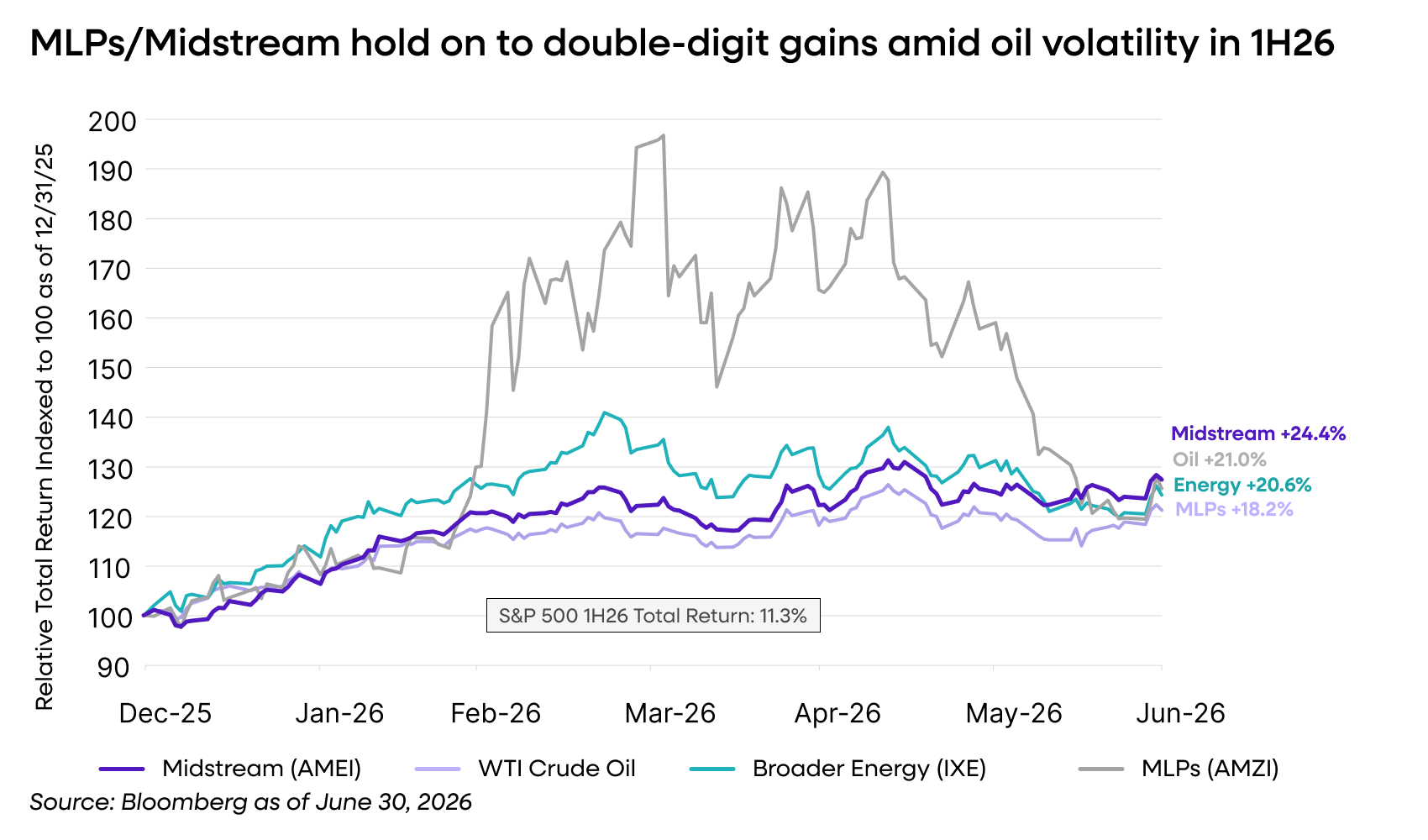
Energy infrastructure companies’ defensiveness stems from the support of their fee-based business models, which provide some insulation from commodity price swings. Despite its 2Q26 weakness, the broader energy sector was the second best-performing sector in the first half of 2026, after information technology. Looking further ahead, the crude futures curve for 2027 shifted about $10 per barrel higher since the war began, resulting in a constructive production outlook for oil, natural gas, and natural gas liquids (NGLs).
North American Energy Export Demand Accelerates
Middle Eastern supply disruptions have reinforced the global appeal of North American energy exports, including liquefied natural gas (LNG), crude, and NGLs. Besides triggering over 1.3 billion barrels of oil supply losses, the closure of the Strait of Hormuz cut off approximately 20% of global LNG supplies, mostly from Qatar, while also disrupting flows of NGLs including ethane, an industrial feedstock, and liquefied petroleum gas (LPG), widely used for cooking and heating.
This dynamic has paved the way for rapid export capacity expansions, and LNG companies have signed numerous long-term sales and purchase agreements with counterparties in Europe and Asia. The largest announcement this year came from LNG exporter Venture Global (VG), which sanctioned CP2 Phase 2, a multi-billion dollar project expected to make the company the largest U.S. LNG exporter.
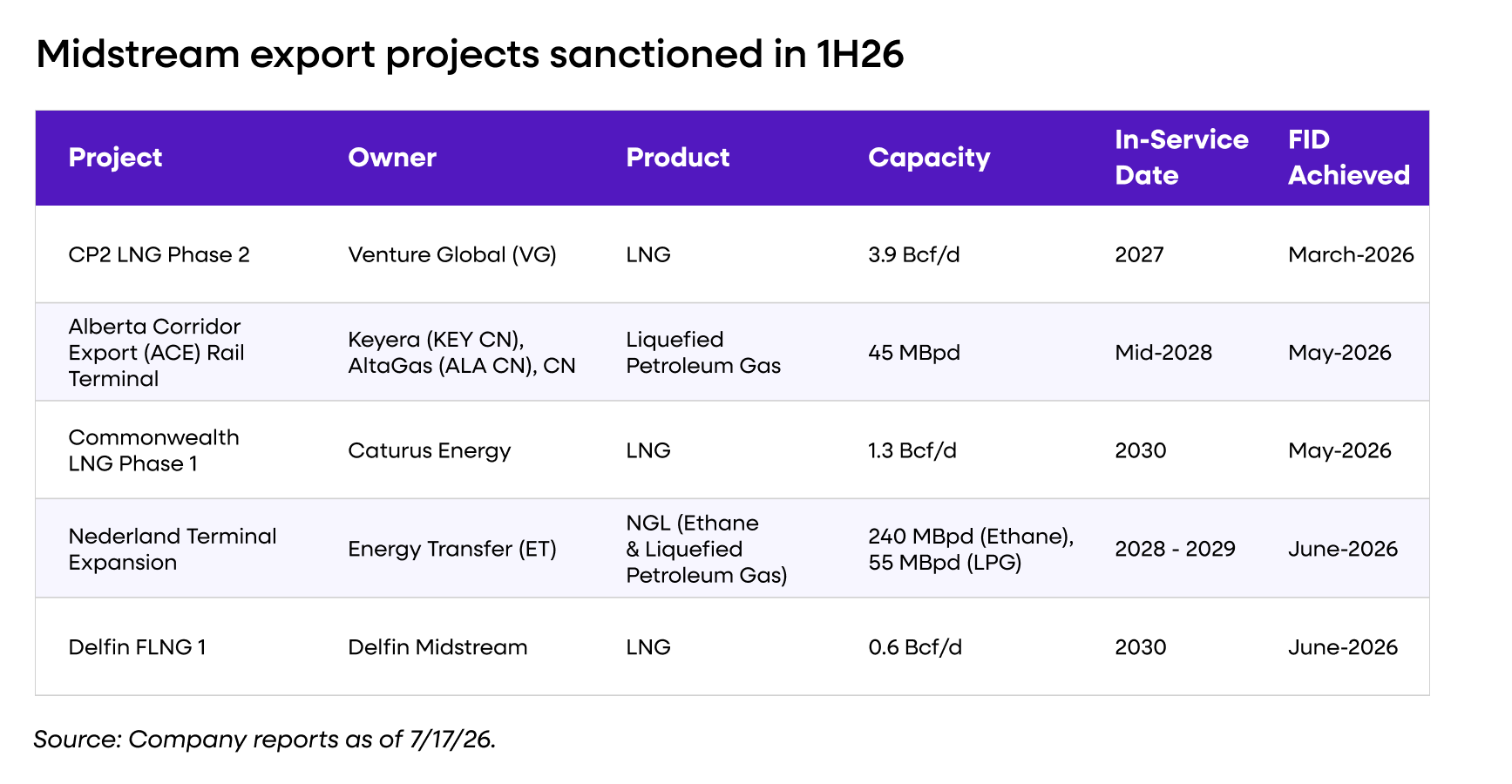
Besides major new projects, VG and Cheniere Energy (LNG) have also announced bolt-on expansions for massive existing export terminals. Cheniere Energy Partners (CQP) expects to sanction a major expansion project to its Sabine Pass export terminal in early 2027, while Cheniere Energy is seeking to greenlight its CCL Expansion Phase 1 in mid-to-late 2027. A few LNG projects are also advancing in Canada.
On the liquids side, Energy Transfer (ET) is expanding its Nederland NGL terminal, and a joint venture including Canadian operator Keyera (KEY CN) is building the Alberta Corridor Export (ACE) rail terminal to expand LPG export capacity. Meanwhile, Enterprise Products Partners (EPD) is expediting Phase 2 of its Neches River NGL marine terminal expansion.
Power Demand Helps Drive Record Backlogs for Natural Gas Infrastructure Companies
Alongside LNG, growing power needs in North America, including for data centers, is driving record backlogs for natural gas infrastructure companies. While this demand has been a tailwind for a couple of years, major developments this year include:
The multi-billion-dollar backlogs for natural gas infrastructure names, spanning both projects under construction and future project pipelines, support a multi-year runway for highly visible, fee-based EBITDA growth. As a result, many midstream names focused on these opportunity sets have been able to raise their long-term guidance.
Permian Natural Gas Projects Coming Online
In the Permian Basin, a surge in associated natural gas production has resulted in severe, longstanding pipeline bottlenecks. This excess supply is largely driven by rising gas-oil ratios (GORs) as the basin matures and its production mix gets gassier. Highlighting this trend, EPD expects natural gas and NGL production growth in the Permian to be 1.6x that of crude oil production growth. This gassier production mix, combined with steady rig activity, forced the West Texas Waha natural gas price benchmark into negative territory for months.
Fortunately, pipeline infrastructure relief is arriving. The natural gas price benchmark for West Texas (Waha) recently switched into positive territory after trading consistently in negative territory for months, coinciding with the start-up of Kinder Morgan’s Gulf Coast Express Expansion. The expansion serves as the basin’s first major relief valve for takeaway constraints. Additional relief is imminent, with several critical long-haul projects slated to come online over the next year.
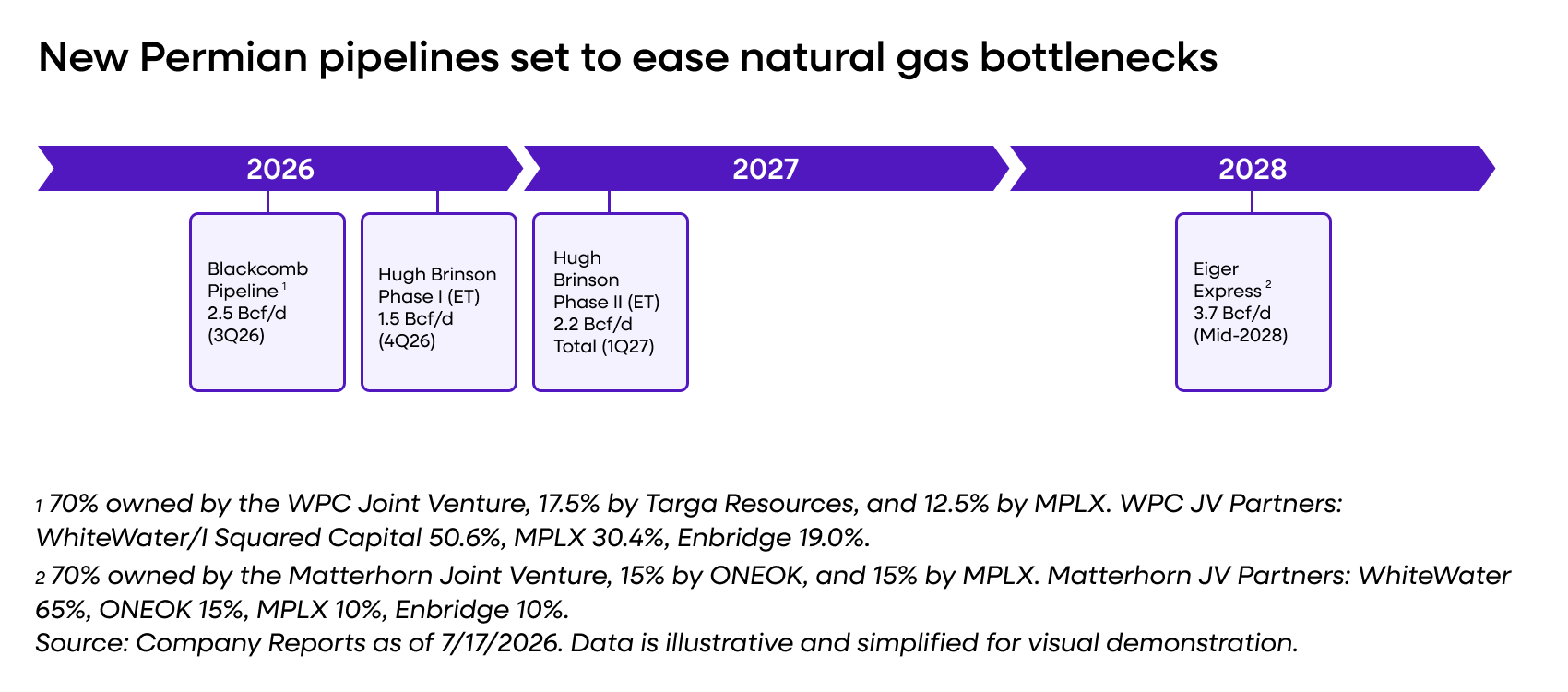
As can be seen above, ET’s Hugh Brinson Pipeline and the joint venture backed Blackcomb Pipeline are both expected to start up in 2H26, and most planned natural gas pipeline capacity additions in 2026 and 2027 originate in Texas. By alleviating takeaway constraints, this incoming capacity will create a positive runway for continued production growth from the basin into 2027.
Bottom Line
Midstream enters the second half of 2026 in a much stronger position than it started the year, bolstered by a constructive production outlook for 2027. Natural gas infrastructure momentum shows no signs of slowing, as companies execute on massive opportunities tied to surging LNG and data center power demand. Moving forward, investors should monitor upcoming final investment decisions (FIDs) on export facilities and power-adjacent infrastructure, as well as broader trends in capital allocation. As earnings season kicks off in late July and early August, watch for potential upside to full-year EBITDA guidance alongside updates on dividend growth and share repurchases.
Looking for midstream insights in your inbox? Subscribe here to keep a pulse on midstream investing through our weekly updates.
AMZI is the underlying index for the Alerian MLP ETF (AMLP) and the ETRACS Alerian MLP Infrastructure Index ETN Series B (MLPB). AMEI is the underlying index for the Alerian Energy Infrastructure ETF (ENFR) and the Alerian Energy Infrastructure Portfolio (ALEFX).
Related Research:
U.S. Oil Production Outlook & Midstream Implications
Midstream: Robust Gas Backlogs Drive Growth Visibility
Surging U.S. Power Needs Drive Gas Infrastructure Opportunity
WMB Analyst Day: Power & Pipe to Drive Robust Growth
Midstream and Rising Canadian Production & Exports
Midstream Prepares for More Permian Natural Gas
vettafi.com is owned by VettaFi LLC (“VettaFi”). VettaFi is the index provider for AMLP, MLPB, ENFR, and ALEFX, for which it receives an index licensing fee. However, AMLP, MLPB, ENFR, and ALEFX are not issued, sponsored, endorsed or sold by VettaFi, and VettaFi has no obligation or liability in connection with the issuance, administration, marketing or trading of AMLP, MLPB, ENFR, and ALEFX.
For more news, information, and analysis, visit the Energy Infrastructure Content Hub.