Latin America’s best bank for D&I 2026: BBVA

BBVA treats diversity as a business objective and nowhere is that discipline tested more thoroughly than across its Latin American operations, where a single group framework is executed market by market. That combination – common targets set centrally, delivery tailored locally – makes it the region’s best bank for diversity and inclusion.
The framework dates to 2020, when BBVA folded diversity and inclusion into its strategic priorities, reinforced in 2022 by group-wide guidelines that give every market a common standard while leaving room for local initiative. Governance is where the approach bites.
The chair and chief executive review promotion data each quarter to track female progression, and 5% of executives’ long-term variable pay is tied to increasing women in management. Measurement has grown more granular still: recruitment is now tracked application by application, area by area, on a weekly basis.
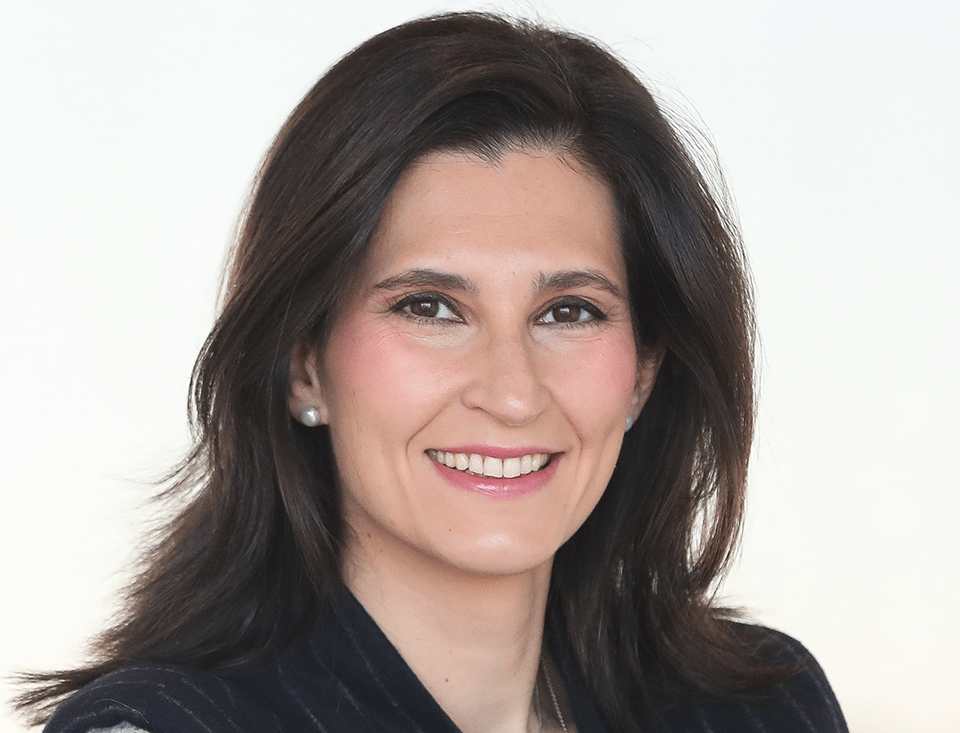
Having the numbers allows us to have a different conversation with recruitment teams – not just ‘we don’t hire enough women’, but ‘why and what needs to change’
Cristina Gabriel
“Having the numbers allows us to have a different conversation with recruitment teams – not just ‘we don’t hire enough women’, but ‘why and what needs to change’,” says Cristina Gabriel, BBVA’s chief diversity, equity and inclusion officer.
The bank has paired this with process changes such as the Rooney Rule, which requires a diverse shortlist of candidates, and formal interview panels; on more than half of occasions, it found, a panel changed the initial hiring decision.
Local execution across the region
Those principles translate into concrete programmes across BBVA’s largest Latin American markets. In Mexico, the bank runs an ambitious drive to recruit people with disabilities into its branches, having adapted its corporate headquarters with audible signage and tactile flooring to support employees who are blind or have low vision; in 2025 it held five employment fairs dedicated to disability recruitment. In Argentina, branch staff have been trained to serve customers in sign language.
BBVA Colombia has taken the lead on ethnic diversity, an issue few banks in the region address directly. It has introduced a self-identification process to understand how many employees belong to ethnic groups and factor them into career development. It created an employee resource group chaired by the country chief executive and built a programme to attract talent in ethnically diverse regions while also giving those employees visibility as role models.
These regional efforts sit within a wider strategy spanning gender, LGBTQI+ inclusion, disability and generational diversity, each supported by employee resource groups that feed lived experience back into policy. At group level, the model is delivering measurable results: women held 36.1% of management roles by the end of 2025, having exceeded a 35% target the year before.
What sets BBVA apart in Latin America is the fit between an accountable central framework and genuine local ownership. By tying incentives to outcomes, measuring in detail and letting each market address the forms of diversity that matter most to it, the bank has built an inclusion model that is both consistent across borders and rooted in the realities of the region.