How Top Middle Market Companies Use Virtual Cards Differently
Virtual cards are gaining a second job inside corporate finance departments.
Beyond helping companies pay suppliers, the cards can give CFOs more control over timing, visibility and short-term funding. New PYMNTS Intelligence data show that the most efficient growth corporates are far more likely to recognize that broader role.
The report, “The 24-Day Advantage: What Top-Performing CFOs Know About Working Capital,” examines three years of data from companies generating $100 million to $1 billion in annual revenue. It finds that the strongest performers use working capital with a clear purpose. These firms plan financing before they need it, connect more suppliers to payment systems and move cash through the business faster.
Virtual cards fit into that playbook because they can combine payment execution with financing flexibility. Like a well-timed relay handoff, the tool can keep cash moving without forcing a company to surrender control of the process.
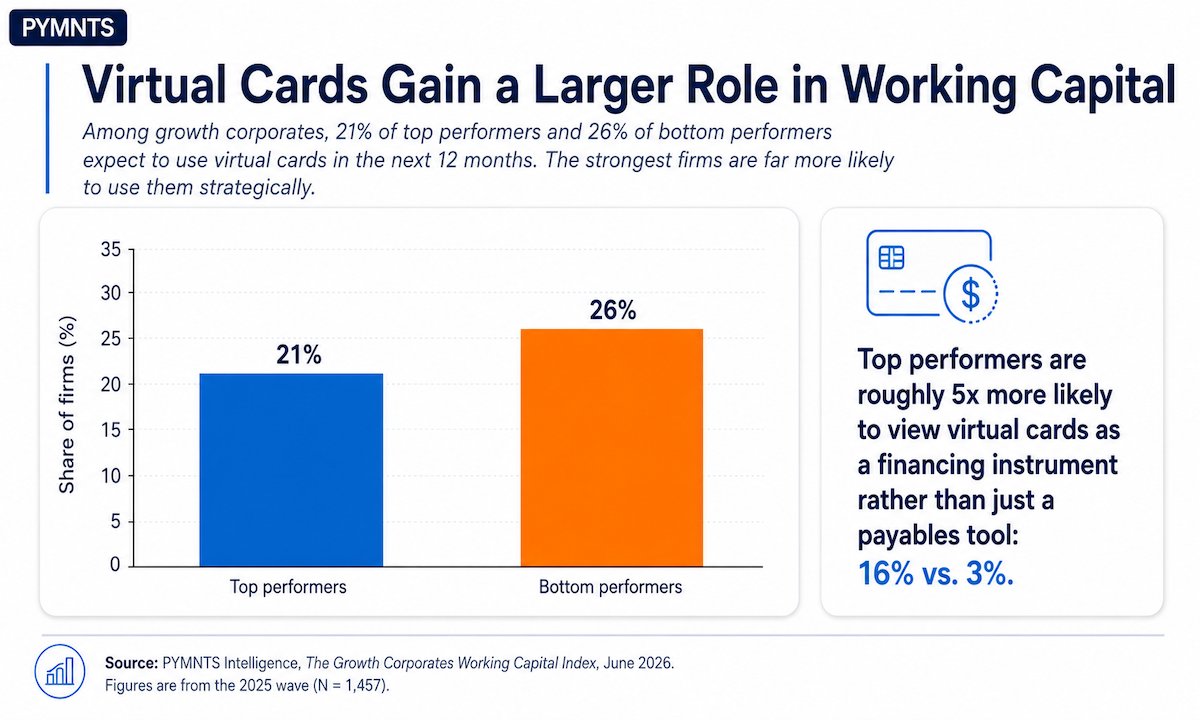
- 16% of top performers view virtual cards as a financing instrument, compared with just 3% of bottom performers. That makes the strongest companies roughly five times as likely to see the cards as more than an accounts payable tool.
- 21% of top performers say they are very or extremely likely to use virtual cards during the next 12 months. The share rises to 26% among bottom performers, suggesting that interest is spreading even when the strategy behind it differs.
- 29% of top performers expect to use corporate cards, compared with 23% of bottom performers. Top performers also show greater interest in working capital loans and non-bank credit facilities, pointing to a more deliberate financing mix.
The broader report shows why that discipline can pay off. Top performers convert cash in 24.2 days, compared with 44.4 days for bottom performers. They also use working capital primarily to fund planned growth, while weaker firms rely on it more often for emergencies.
Virtual cards will not close that gap on their own. Still, the findings suggest they can become a useful part of a larger system built around predictable cash flow, stable suppliers and financing arranged before pressure arrives.
At PYMNTS Intelligence, we work with businesses to uncover insights that fuel intelligent, data-driven discussions on changing customer expectations, a more connected economy and the strategic shifts necessary to achieve outcomes. With rigorous research methodologies and unwavering commitment to objective quality, we offer trusted data to grow your business. As our partner, you’ll have access to our diverse team of PhDs, researchers, data analysts, number crunchers, subject matter veterans and editorial experts.