‘House of the Dragon:’ How Does Ormund Hightower Die in the Book?
Warning: Spoilers ahead for “House of the Dragon” season three, episode four, and the book “Fire & Blood.”
There are plenty of Targaryens vying for power in “House of the Dragon,” but the silver-haired dragonlords are not the only threats in Westeros.
HBO’s tentpole “Game of Thrones” prequel depicts the Dance of the Dragons, which finds Rhaenyra Targaryen (Emma D’Arcy) pitted against her half-brother, Aegon II Targaryen (Tom Glynn-Carney), in a brutal war of succession.
Aegon II — along with his three younger siblings, Aemond (Ewan Mitchell), Helaena (Phia Saban), and Daeron (Benjamin Evan Ainsworth) — was born to the late King Viserys and Alicent Hightower. Naturally, his claim to the Iron Throne is supported by House Hightower, a noble family from the Reach with a strong connection to the Faith of the Seven.
“House of the Dragon” has already featured several prominent Hightowers, including Alicent (Olivia Cooke), her father Otto (Rhys Ifans), and her brother Gwayne (Freddie Fox).
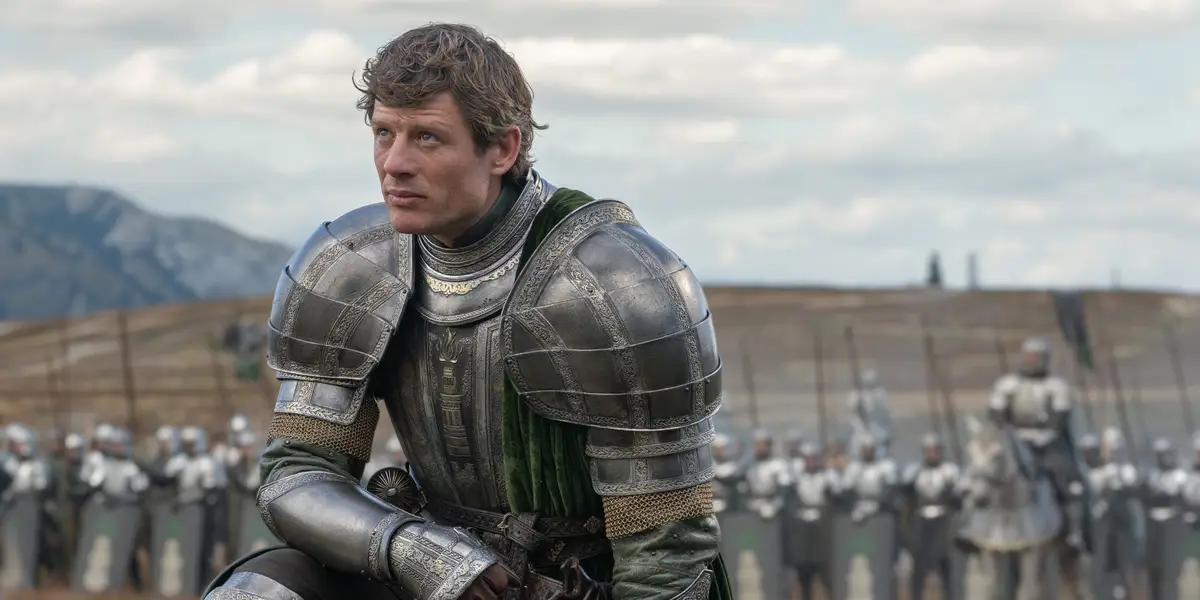
In season three, Alicent’s cousin Ormund (James Norton) is introduced as another key player in the ongoing schism.
Ormund is the head of House Hightower and commands their impressive army. In season three, episode three, “Rhaenyra Triumphant,” Ormund is ordered — under threat of three massive dragons — to surrender and bend the knee to the realm’s new queen. He does, albeit deceptively.
Ormund and the Hightower army — strengthened by his ward, Daeron Targaryen, and the prince’s dragon, Tessarion — go on to seize control of Tumbleton, a market town near King’s Landing. From his unassuming perch, Ormund continues devising schemes to overthrow Rhaenyra and cement his family’s influence.
Theo Whiteman/HBO
In the fourth episode of season three, viewers learn even more about Ormund as Rhaenyra scrounges for dirt on her enemy.
According to Alicent, Ormund “sees himself as a scholar” who “despises the ignorant and uncouth.” He studies histories, collects tapestries, and has a strong “sensitivity to odors.” According to Gwayne, he’s a “stiff-necked windbag” who always has a “canny plot” up his sleeve.
During his hostile stay at Tumbleton, Ormund is revealed to have a devious military mind, a vicious temper, and, indeed, a secret plot: to crown the teenage Daeron as the next king of Westeros, leap-frogging both of his older brothers.
Ormund raised Daeron after the prince was sent to live in Oldtown as an infant. He believes Daeron is more of a Hightower than a Targaryen — and that he’s more reliable than any of his siblings, who were all raised in King’s Landing.
“You are a good boy. You speak kindly, and you say your prayers. I have raised you in the light of the Seven, and the Father smiles upon you,” Ormund tells Daeron. “But there is a taint in your blood. The Targaryens are a savage race, poor in intellect, but rich in cunning. With dark spells, they created abominations to subdue what was rightfully ours. We are the superior men.”
“The gods have put you to divine purpose, my boy,” he adds. “You will restore our ancient order.”
Ormund is poised to throw a wrench in Rhaenyra’s reign, especially if his story is faithful to the source material, George R. R. Martin’s “Fire & Blood.” Keep reading to find out Ormund’s fate in the book.
Ormund’s takeover of Tumbleton proves consequential and deadly
Kevin Baker/HBO
Even as Rhaenyra claims the Iron Throne in the book, Aegon II and Aemond (with his massive dragon Vhagar) remain at large, while the Hightowers continue to resist the queen in the Reach. As Martin writes, “No war can be counted as won whilst foes remain unconquered.”
Prince Daeron the Daring, as Ormund styles him, becomes known as the greatest threat to Rhaenyra’s reign, advancing on King’s Landing with an army of 20,000 men.
Lord Corlys Velaryon, the Hand of the Queen, urges Rhaenyra to pardon the great houses that still oppose her — including Hightower, Lannister, and Baratheon — if they agree to swear fealty to her instead. He also encourages her to send her half-brothers to the Wall to live out their days as Sworn Brothers of the Night’s Watch. Rhaenyra’s husband, Prince Daemon, argues the opposite. He says that pardoning traitors and oathbreakers will only encourage future rebellions.
Rhaenyra tends to agree with Daemon, though she decides to “steer a middle course.” She agrees to offer pardons to Houses Baratheon and Lannister, but only after Aegon’s line has been vanquished. Rhaenyra sends Daemon to find and kill Aemond, and two of her newly recruited dragonriders, Ulf White and Hugh Hammer, to kill Daeron.
In what came to be known as the Battle of Tumbleton, about 6,000 of Rhaenyra’s loyalists — including the Northern soldiers known as the Winter Wolves — sack the town. Although Rhaenyra’s men are greatly outnumbered by the Hightower’s host, they assume that Ulf and Hugh are arriving soon from King’s Landing to assist with their dragons, Silverwing and Vermithor.
Ormund is killed in the chaos that ensues. Legend says he was slain by Lord Roderick Dustin, aka Roddy the Ruin, after the Northerner cut through hundreds of foes to find him.
Under normal circumstances, Ormund’s death may have turned the tide in Rhaenyra’s favor. Without their commander, the Hightower’s host is scattered, their banners toppled.
Instead, Ulf and Hugh ignore Rhaenyra’s orders and wreak havoc with dragonflame.
The book’s fictional historians disagree as to why Ulf and Hugh suddenly decide to burn civilians and soldiers alike — whether it’s fear of facing Daeron (unlikely, as both Silverwing and Vermithor are older and bigger than Tessarion), fear of facing Ormund’s large army (unlikely for similar reasons), disenchantment with Rhaenyra (fairly likely), or straight-up greed (most likely). It seems Ulf and Hugh realized they could seize power for themselves, and chose to prove it with fire and blood.
“As neither man could read nor write, we shall never know what drove the Two Betrayers (as history has named them) to do what they did,” the book says, though whatever the reason for Ulf and Hugh’s treason, the result is the same: “Tumbleton, that prosperous market town, was reduced to ash and embers.”