Different fund categories, same stocks? These equity mutual funds have up to 79.4% portfolio overlap
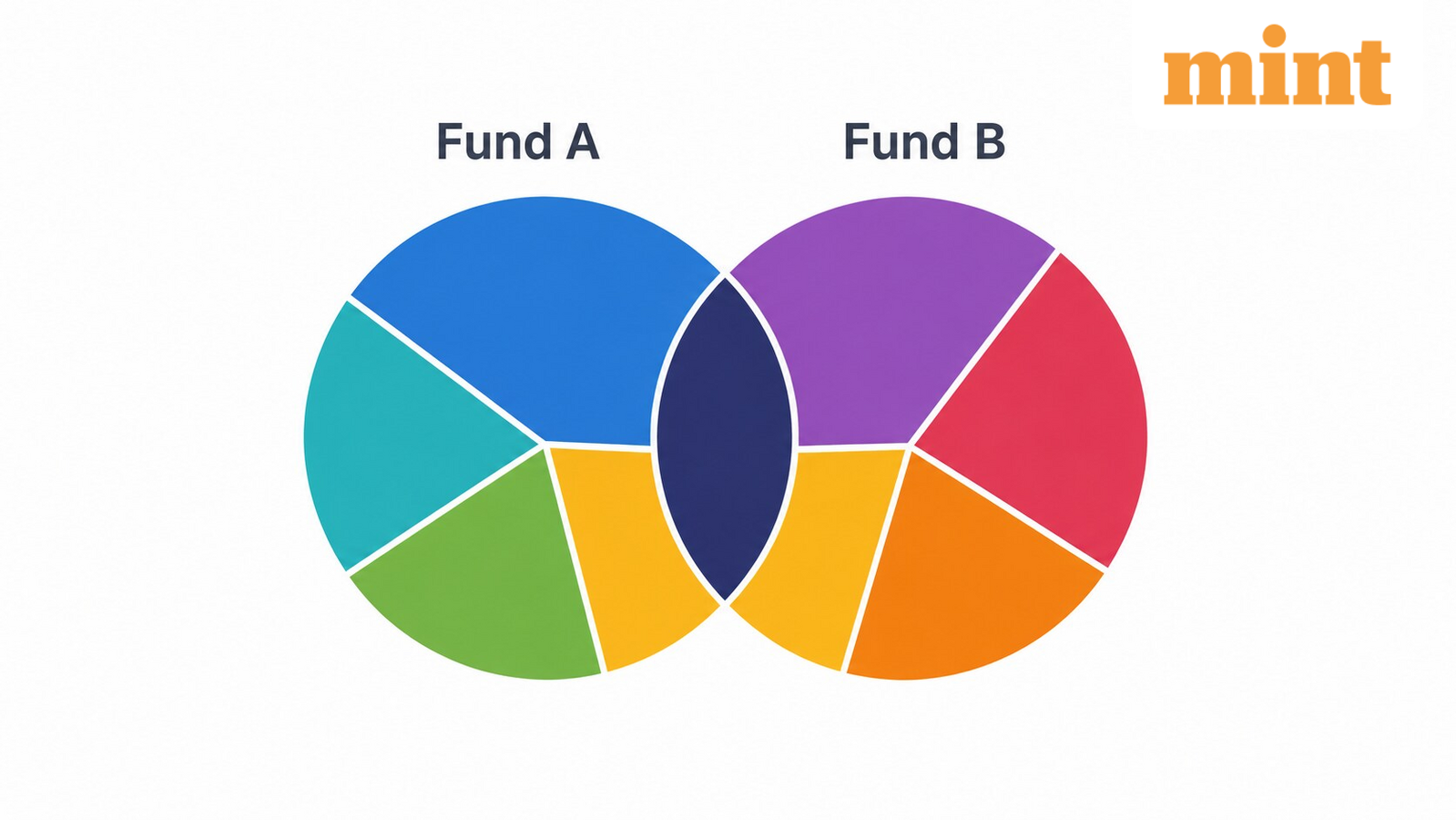
Many investors diversify their equity mutual fund investments across categories such as flexi cap, large & mid cap, multi cap, and large cap funds. However, investing in different categories does not necessarily mean gaining exposure to a wider set of stocks.
A Value Research analysis has found that several equity mutual funds with different investment mandates have significant portfolio overlap. In one instance, two funds from the same asset management company (AMC) share 79.4% of their holdings, suggesting that category labels alone may not accurately reflect the extent to which the portfolios differ.
Which equity funds have the highest portfolio overlap?
According to the Value Research study, Bank of India Large & Mid Cap Fund and Bank of India Multi Cap Fund have the highest portfolio overlap at 79.4%.
Several other fund pairs also show substantial overlap despite belonging to different categories. These include:
| Fund A | Fund B | Portfolio overlap (%) |
| BOI Large & Mid Cap Fund | BOI Multi Cap Fund | 79.4 |
| Canara Robeco Flexi Cap Fund | Canara Robeco Large Cap Fund | 74.9 |
| Helios Flexi Cap Fund | Helios Large & Mid Cap Fund | 74.3 |
| Baroda BNP Flexi Cap Fund | Baroda BNP Large & Mid Cap Fund | 74.2 |
| JioBlackRock Flexi Cap Fund | JioBlackRock Large Cap Fund | 70.9 |
| Axis Large & Mid Cap Fund | Axis Multi Cap Fund | 68.4 |
*Source: Value Research, Data as on 30 June, 2026, Excluding passive and ELSS funds
Why do different fund categories look so similar?
Although SEBI has prescribed different investment mandates for each equity fund category, there is considerable room for fund managers to invest in similar stocks.
- Flexi cap funds can invest across large-cap, mid-cap and small-cap stocks without fixed allocation limits.
- Large & mid-cap funds must invest at least 35% each in large-cap and mid-cap stocks, but have flexibility with the remaining allocation.
- Multi-cap funds are required to allocate at least 25% each to large-, mid-, and small-cap stocks, with the remaining 25% invested freely.
What does high portfolio overlap mean?
A high portfolio overlap does not mean two funds will deliver identical returns. Differences in stock weightages, market-cap allocation, portfolio construction and rebalancing can lead to significantly different performance over time.
- The BOI Large & Mid-Cap Fund has allocated 40.05% to large-cap stocks, 40.57% to mid-cap stocks, and 19.38% to small-cap stocks. The BOI Multi-Cap Fund has 32.31% in large caps, 32.46% in mid caps, and 35.23% in small caps, giving it higher exposure to smaller companies.
- The BOI Large & Mid-Cap Fund owns 55 stocks, while the BOI Multi-Cap Fund holds 64, with 52 stocks common to both. For example, HDFC Bank accounts for 5.75% of the large & mid-cap fund compared with 4.89% in the multi-cap fund.
- Other major common holdings include Reliance Industries, Aurobindo Pharma, FSN E-Commerce Ventures, Kotak Mahindra Bank, etc.
- Despite a 79.4% overlap, their return profiles differ. The BOI Large & Mid Cap Fund has delivered 15.12% annualised returns over the last three years and 5.84% over the past one year, while the BOI Multi Cap Fund has generated 20.05% annualised returns over the last three years and 10.97% over the past one year.
Disclaimer: This is purely for educational/ informational purposes and should not be taken as any sort of investment advice. Always consult a SEBI-registered advisor before making any investment decisions.