Cyprus vs Poland for CFD Brokers: The Tax Edge May Not Pay Until Profit Nears EUR 3 Million
Cyprus cut its corporate tax advantage over Poland to four percentage points at the start of 2026, just as Poland recorded record growth in retail brokerage accounts. The two developments put a familiar question back in front of CFD brokers deciding where to license an EU entity.
Cyprus increased its corporate income tax rate from 12.5% to 15% on January 1, 2026.
A lower rate matters only after the company generates taxable profit. Before that, payroll, premises, regulatory staffing and technology decide which jurisdiction costs less.
Modeling by FM Intelligence, the group’s research and data unit, indicates that a Cyprus-based CFD broker may need approximately EUR 3 million in annual pre-tax profit before the tax advantage offsets the location’s higher modeled operating costs.
It is not a statutory threshold but the output of a crossover calculation using an estimated EUR 140,000 annual operating-cost difference.
Both Licenses Start at EUR 750,000 for a Market Maker
Regulatory capital is not where the two jurisdictions diverge. The EU Investment Firms Directive sets initial capital according to the services a firm performs.
A firm that executes client orders and may hold client money generally starts at EUR 150,000. One authorized to deal on its own account, including a CFD market maker, starts at EUR 750,000.
Both figures apply in Poland and Cyprus alike.
Under the Investment Firms Regulation, an established Class 2 firm must hold own funds equal to the highest of its permanent minimum requirement, one quarter of relevant fixed overheads and its K-factor requirement.
At EUR 4 million of qualifying annual fixed overheads that requirement is EUR 1 million before K-factors. For the modeled 30-person brokerage it points to roughly EUR 800,000 to EUR 1.4 million, even without a license to deal on own account.
Client money, orders handled and counterparty exposure can lift it further. Those figures are modeled and not observed, and two brokers holding the same license can face different requirements.
One-off costs separate the two countries more than capital does. FM Intelligence puts the Polish application fee near EUR 4,500 against EUR 7,500 to EUR 12,000 in Cyprus, where the process runs about eight to 12 months.
On capital the two sit close to parity, so the decision moves to operating costs and distribution.
Four Tax Points Against EUR 140,000 of Additional Annual Cost
The simplest version of the tax argument compares 15% in Cyprus with Poland’s standard rate of 19%.
At the same EUR 2 million pre-tax profit, the Cypriot company pays EUR 300,000 of corporate tax against EUR 380,000 in Poland. Cyprus saves EUR 80,000, roughly the annual gross cost of one senior compliance or risk hire.
Identical pre-tax profit, though, assumes away the additional cost of operating there.
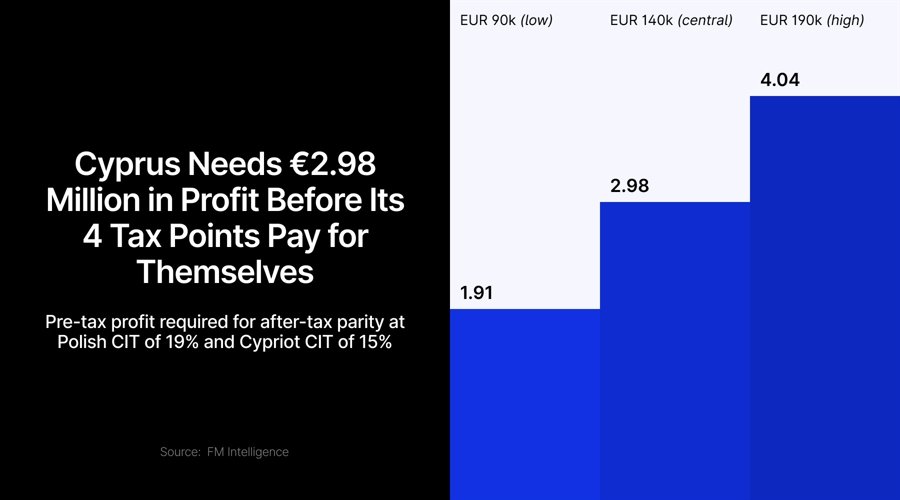
The Polish after-tax result is 81% of pre-tax profit. The Cypriot result is 85%, minus that additional cost. Setting the two equal puts the crossover at 21.25 times it.
| Additional annual Cyprus cost | Pre-tax profit needed for parity |
|---|---|
| EUR 90,000 | EUR 1.91 million |
| EUR 140,000 | EUR 2.98 million |
| EUR 190,000 | EUR 4.04 million |
The EUR 3 million figure is an FM Intelligence scenario, not false precision. Technology contracts, office selection and management compensation can move the annual difference materially.
It also excludes the cost of an artificial structure. A Cypriot investment firm managed in practice from Warsaw can raise questions about tax residence, permanent establishment, controlled foreign company rules and transfer pricing.
Marcin Wenus, Invest Cuffs Foundation
“The strongest argument for Poland is often the one nobody puts in a spreadsheet,” Marcin Wenus, President at Invest Cuffs Foundation, commented. “If your management, your developers and your first clients are already in Warsaw, a Polish license reflects where the business actually operates, and that is far easier to defend to a regulator or a tax authority than a Cypriot entity run remotely.”
Poland’s Financial-Sector Labor Cost Is 34% Lower
Eurostat’s 2025 data put hourly labor cost across financial and insurance activities at EUR 28.2 in Poland and EUR 42.6 in Cyprus. On that measure Poland was approximately 34% cheaper.
Across the whole economy the difference was smaller, at EUR 19.1 in Poland against EUR 21.7 in Cyprus.
The sector figure should not be applied mechanically to a 30-person brokerage. It covers financial services and insurance, not CFD firms alone.
Role-level evidence shows a similar but less uniform gap. Cyprus recruitment data places a head of compliance or MLRO at approximately EUR 65,000 to EUR 95,000 annually and a risk manager around a EUR 57,000 median.
Polish reports place a compliance manager around PLN 23,000 per month as the most frequently offered level, although definitions and seniority are not identical.
Employer contributions narrow the difference without closing it, at approximately 20.5% in Poland, subject to contribution caps, against approximately 15.4% in Cyprus.
“Poland rarely wins on tax, and it does not need to,” Wenus added. “What it offers is a deep bench of technology, AML and back-office staff at roughly two-thirds of the Cypriot cost, which matters far more than four points of corporate tax for a firm that has not yet reached scale.”
Office space is not a differentiator. Warsaw prime central space ran EUR 24 to EUR 28 per square meter per month against EUR 15 to EUR 30 in Limassol, according to Cushman and Wakefield.
EUR 800 per Client, or 12,500 Clients, to Clear the Threshold
Unit economics make the threshold concrete. Assume 10,000 active clients and EUR 5 million of annual operating costs.
Earning EUR 3 million before tax then requires EUR 8 million of net revenue, or EUR 800 per active client. At EUR 400 per client the same business loses EUR 1 million and needs 12,500 active clients to cover the cost base.
XTB reported record revenue but a 25% decline in net profit in 2025. Its PLN 777.4 million of profit before tax was equivalent to approximately EUR 183.4 million at the European Central Bank’s 2025 average exchange rate, or 61 times the central threshold.
CMC Markets generated GBP 84.5 million of statutory profit before tax in FY2025, approximately EUR 98.6 million. Both write business through multiple regulated entities, so neither discloses the profit of a single Cyprus Investment Firm or Polish brokerage house.
iFOREX is the more informative middle-market example. The CFD group reported USD 49.1 million of revenue and 28,141 active clients in 2025.
Its adjusted profit before tax was USD 1.6 million, below the modeled crossover, against USD 6.0 million a year earlier, while the reported result was a USD 3.2 million loss after IPO and share-based-payment costs.
NAGA’s EUR 62.4 million of 2025 revenue produced EUR 3.7 million of audited EBITDA, which precedes depreciation, interest and tax and cannot be read as pre-tax profit.
Client acquisition moves the arithmetic faster than tax does. iFOREX’s average acquisition cost rose from USD 401 to USD 695 in 2025.
Applied to its 13,579 new clients that is roughly USD 4 million of extra acquisition cost, about fifty times the EUR 80,000 the tax gap yields at EUR 2 million of profit.
Cyprus Serves 3.6 Million Cross-Border Clients, Poland About 370,000 Actives
A four-point tax advantage is small relative to an interruption in distribution.
Admirals said that lower trading activity in core European markets and a temporary pause in EU client onboarding reduced its 2025 trading income. It reported a EUR 17.2 million net loss and 29,455 active clients.
Cyprus still has the stronger cross-border infrastructure. ESMA’s 2024 cross-border review indicated that 79 Cyprus-based firms served approximately 3.6 million cross-border retail clients, roughly one-third of the EEA total identified in the exercise.
FM Intelligence’s analysis of the same dataset showed complaints against cross-border brokers rose 46%.
“eToro has had a presence in Cyprus for many years and we don’t see that changing,” an eToro spokesperson said. “Europe remains our biggest market and our Cyprus office is a key operational hub for eToro. We have over 250 staff in Cyprus, a mixture of local and global talent.”
Poland has the larger domestic growth story. KNF’s official 2025 Forex study identified approximately 370,000 active clients across the reported population, while KDPW recorded more than 2.85 million securities and brokerage accounts by May 2026.
An earlier FM Intelligence analysis set out the licensing and cost matrix for Poland, without testing where the Cypriot rate starts to pay for itself.
The two counts use different definitions and describe different advantages: Cyprus as an export hub, Poland as a growing domestic market.
Poland also retains an experienced-retail-client regime that can permit 1:100 leverage on selected instruments for qualifying Polish residents. Standard EU retail limits remain 1:30 on major currency pairs, falling to 1:2 for cryptoasset CFDs.
Cyprus Wins Only After the Business Does
The decision sets a cheaper operating base with a large technology and domestic-client pool against a denser brokerage ecosystem with four points of corporate tax.
For a Polish-led broker whose management, developers and first clients remain in Poland, the local structure can be cheaper and easier to defend. For an export-led group that moves decision-making to Cyprus, the premium may be justified before the tax saving is counted.
The Polish leverage treatment is the less durable part of that case. FinanceMagnates.com previously reported that KNF was widening its review of CFD firms, including cross-border providers.
In the central FM Intelligence scenario, the crossover sits near EUR 3 million of annual pre-tax profit. XTB and CMC Markets clear it without difficulty. iFOREX, NAGA and Admirals show why a smaller broker cannot assume that it will.
Cyprus cut its corporate tax advantage over Poland to four percentage points at the start of 2026, just as Poland recorded record growth in retail brokerage accounts. The two developments put a familiar question back in front of CFD brokers deciding where to license an EU entity.
Cyprus increased its corporate income tax rate from 12.5% to 15% on January 1, 2026.
A lower rate matters only after the company generates taxable profit. Before that, payroll, premises, regulatory staffing and technology decide which jurisdiction costs less.
Modeling by FM Intelligence, the group’s research and data unit, indicates that a Cyprus-based CFD broker may need approximately EUR 3 million in annual pre-tax profit before the tax advantage offsets the location’s higher modeled operating costs.
It is not a statutory threshold but the output of a crossover calculation using an estimated EUR 140,000 annual operating-cost difference.
Both Licenses Start at EUR 750,000 for a Market Maker
Regulatory capital is not where the two jurisdictions diverge. The EU Investment Firms Directive sets initial capital according to the services a firm performs.
A firm that executes client orders and may hold client money generally starts at EUR 150,000. One authorized to deal on its own account, including a CFD market maker, starts at EUR 750,000.
Both figures apply in Poland and Cyprus alike.
Under the Investment Firms Regulation, an established Class 2 firm must hold own funds equal to the highest of its permanent minimum requirement, one quarter of relevant fixed overheads and its K-factor requirement.
At EUR 4 million of qualifying annual fixed overheads that requirement is EUR 1 million before K-factors. For the modeled 30-person brokerage it points to roughly EUR 800,000 to EUR 1.4 million, even without a license to deal on own account.
Client money, orders handled and counterparty exposure can lift it further. Those figures are modeled and not observed, and two brokers holding the same license can face different requirements.
One-off costs separate the two countries more than capital does. FM Intelligence puts the Polish application fee near EUR 4,500 against EUR 7,500 to EUR 12,000 in Cyprus, where the process runs about eight to 12 months.
On capital the two sit close to parity, so the decision moves to operating costs and distribution.
Four Tax Points Against EUR 140,000 of Additional Annual Cost
The simplest version of the tax argument compares 15% in Cyprus with Poland’s standard rate of 19%.
At the same EUR 2 million pre-tax profit, the Cypriot company pays EUR 300,000 of corporate tax against EUR 380,000 in Poland. Cyprus saves EUR 80,000, roughly the annual gross cost of one senior compliance or risk hire.
Identical pre-tax profit, though, assumes away the additional cost of operating there.
The Polish after-tax result is 81% of pre-tax profit. The Cypriot result is 85%, minus that additional cost. Setting the two equal puts the crossover at 21.25 times it.
| Additional annual Cyprus cost | Pre-tax profit needed for parity |
|---|---|
| EUR 90,000 | EUR 1.91 million |
| EUR 140,000 | EUR 2.98 million |
| EUR 190,000 | EUR 4.04 million |
The EUR 3 million figure is an FM Intelligence scenario, not false precision. Technology contracts, office selection and management compensation can move the annual difference materially.
It also excludes the cost of an artificial structure. A Cypriot investment firm managed in practice from Warsaw can raise questions about tax residence, permanent establishment, controlled foreign company rules and transfer pricing.
Marcin Wenus, Invest Cuffs Foundation
“The strongest argument for Poland is often the one nobody puts in a spreadsheet,” Marcin Wenus, President at Invest Cuffs Foundation, commented. “If your management, your developers and your first clients are already in Warsaw, a Polish license reflects where the business actually operates, and that is far easier to defend to a regulator or a tax authority than a Cypriot entity run remotely.”
Poland’s Financial-Sector Labor Cost Is 34% Lower
Eurostat’s 2025 data put hourly labor cost across financial and insurance activities at EUR 28.2 in Poland and EUR 42.6 in Cyprus. On that measure Poland was approximately 34% cheaper.
Across the whole economy the difference was smaller, at EUR 19.1 in Poland against EUR 21.7 in Cyprus.
The sector figure should not be applied mechanically to a 30-person brokerage. It covers financial services and insurance, not CFD firms alone.
Role-level evidence shows a similar but less uniform gap. Cyprus recruitment data places a head of compliance or MLRO at approximately EUR 65,000 to EUR 95,000 annually and a risk manager around a EUR 57,000 median.
Polish reports place a compliance manager around PLN 23,000 per month as the most frequently offered level, although definitions and seniority are not identical.
Employer contributions narrow the difference without closing it, at approximately 20.5% in Poland, subject to contribution caps, against approximately 15.4% in Cyprus.
“Poland rarely wins on tax, and it does not need to,” Wenus added. “What it offers is a deep bench of technology, AML and back-office staff at roughly two-thirds of the Cypriot cost, which matters far more than four points of corporate tax for a firm that has not yet reached scale.”
Office space is not a differentiator. Warsaw prime central space ran EUR 24 to EUR 28 per square meter per month against EUR 15 to EUR 30 in Limassol, according to Cushman and Wakefield.
EUR 800 per Client, or 12,500 Clients, to Clear the Threshold
Unit economics make the threshold concrete. Assume 10,000 active clients and EUR 5 million of annual operating costs.
Earning EUR 3 million before tax then requires EUR 8 million of net revenue, or EUR 800 per active client. At EUR 400 per client the same business loses EUR 1 million and needs 12,500 active clients to cover the cost base.
XTB reported record revenue but a 25% decline in net profit in 2025. Its PLN 777.4 million of profit before tax was equivalent to approximately EUR 183.4 million at the European Central Bank’s 2025 average exchange rate, or 61 times the central threshold.
CMC Markets generated GBP 84.5 million of statutory profit before tax in FY2025, approximately EUR 98.6 million. Both write business through multiple regulated entities, so neither discloses the profit of a single Cyprus Investment Firm or Polish brokerage house.
iFOREX is the more informative middle-market example. The CFD group reported USD 49.1 million of revenue and 28,141 active clients in 2025.
Its adjusted profit before tax was USD 1.6 million, below the modeled crossover, against USD 6.0 million a year earlier, while the reported result was a USD 3.2 million loss after IPO and share-based-payment costs.
NAGA’s EUR 62.4 million of 2025 revenue produced EUR 3.7 million of audited EBITDA, which precedes depreciation, interest and tax and cannot be read as pre-tax profit.
Client acquisition moves the arithmetic faster than tax does. iFOREX’s average acquisition cost rose from USD 401 to USD 695 in 2025.
Applied to its 13,579 new clients that is roughly USD 4 million of extra acquisition cost, about fifty times the EUR 80,000 the tax gap yields at EUR 2 million of profit.
Cyprus Serves 3.6 Million Cross-Border Clients, Poland About 370,000 Actives
A four-point tax advantage is small relative to an interruption in distribution.
Admirals said that lower trading activity in core European markets and a temporary pause in EU client onboarding reduced its 2025 trading income. It reported a EUR 17.2 million net loss and 29,455 active clients.
Cyprus still has the stronger cross-border infrastructure. ESMA’s 2024 cross-border review indicated that 79 Cyprus-based firms served approximately 3.6 million cross-border retail clients, roughly one-third of the EEA total identified in the exercise.
FM Intelligence’s analysis of the same dataset showed complaints against cross-border brokers rose 46%.
“eToro has had a presence in Cyprus for many years and we don’t see that changing,” an eToro spokesperson said. “Europe remains our biggest market and our Cyprus office is a key operational hub for eToro. We have over 250 staff in Cyprus, a mixture of local and global talent.”
Poland has the larger domestic growth story. KNF’s official 2025 Forex study identified approximately 370,000 active clients across the reported population, while KDPW recorded more than 2.85 million securities and brokerage accounts by May 2026.
An earlier FM Intelligence analysis set out the licensing and cost matrix for Poland, without testing where the Cypriot rate starts to pay for itself.
The two counts use different definitions and describe different advantages: Cyprus as an export hub, Poland as a growing domestic market.
Poland also retains an experienced-retail-client regime that can permit 1:100 leverage on selected instruments for qualifying Polish residents. Standard EU retail limits remain 1:30 on major currency pairs, falling to 1:2 for cryptoasset CFDs.
Cyprus Wins Only After the Business Does
The decision sets a cheaper operating base with a large technology and domestic-client pool against a denser brokerage ecosystem with four points of corporate tax.
For a Polish-led broker whose management, developers and first clients remain in Poland, the local structure can be cheaper and easier to defend. For an export-led group that moves decision-making to Cyprus, the premium may be justified before the tax saving is counted.
The Polish leverage treatment is the less durable part of that case. FinanceMagnates.com previously reported that KNF was widening its review of CFD firms, including cross-border providers.
In the central FM Intelligence scenario, the crossover sits near EUR 3 million of annual pre-tax profit. XTB and CMC Markets clear it without difficulty. iFOREX, NAGA and Admirals show why a smaller broker cannot assume that it will.