Chart Highlights AI Cheating Scandal at Brown University
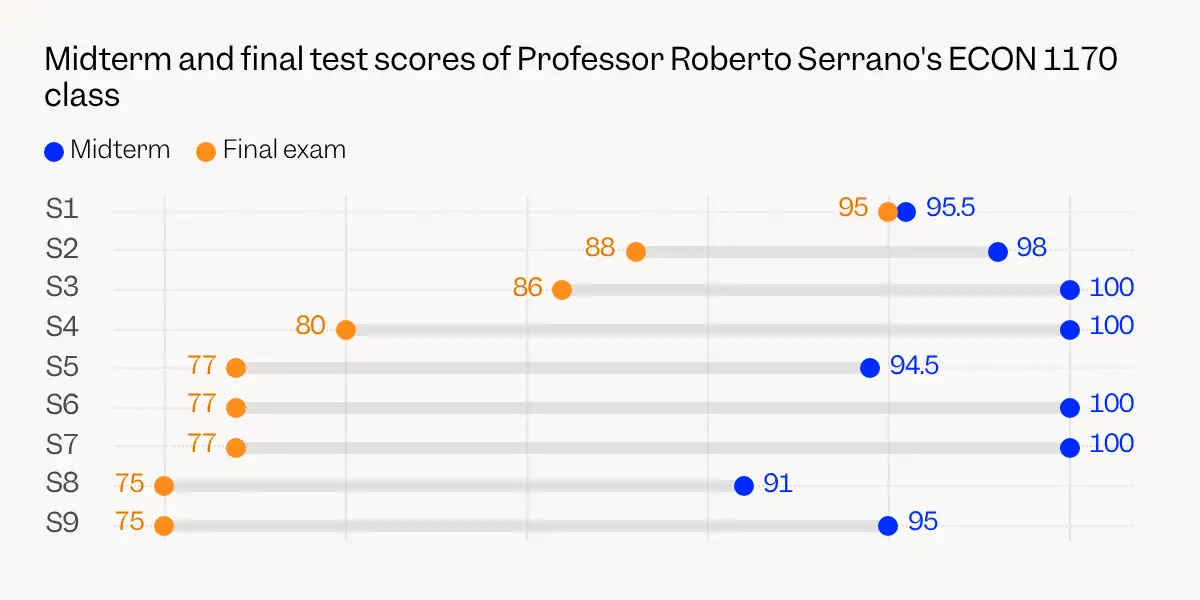
Roberto Serrano’s class scored curiously well on the take-home midterm exam. When he suspected widespread AI cheating and made their final exam in-person, their grades tanked.
The Brown University professor teaches welfare economics and social choice theory. The midterm was administered from home after a shooter killed two students in December.
“The problem with this technology is that the cost of cheating has basically gone down to zero,” he told Business Insider. “It’s very easy for students to succumb to the temptation.”
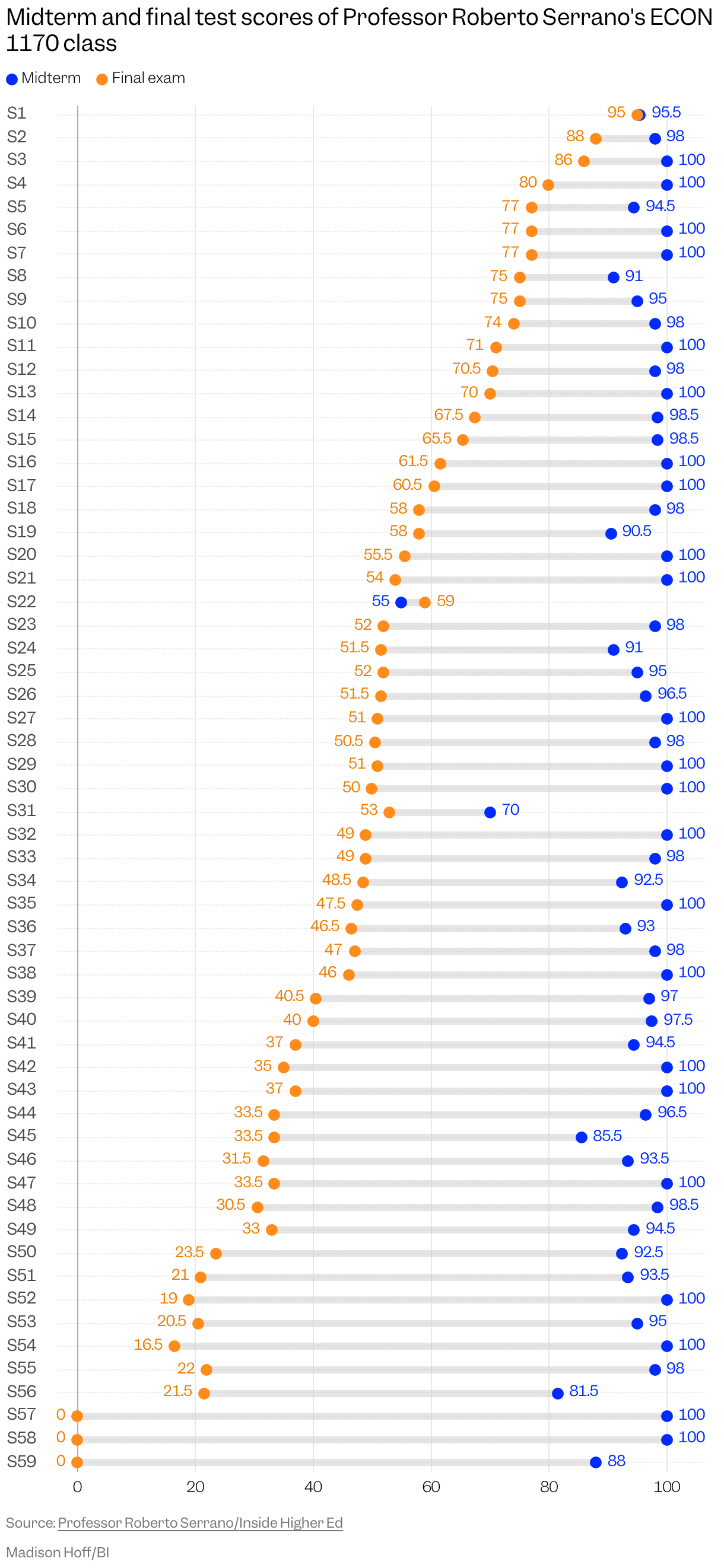
When he told students that the final exam would be in person, many previously high-scoring students dropped out. Others who scored in the high 90s on the midterm scored in the 50s on the final.
A chart of the data, which was first publicized by Inside Higher Ed, shows each student’s grades:
Brian E. Clark, Brown’s VP for news and strategic campus communications, wrote to Business Insider that Serrano shared details with the university’s standing committee on the academic code on July 8. The committee “move forward according to its procedures.”
“Brown treats every allegation of academic integrity with the utmost seriousness,” Clark wrote.
The scandal has drawn interest across the internet, and particularly among those who work in tech. Y Combinator cofounder Paul Graham posted on X about it; two Google DeepMind staffers also shared their thoughts.
Serrano wasn’t shocked that the score changes drew interest — but he was surprised by the scale. “I’m a little overwhelmed,” he said.
He said he’s received “hundreds of emails,” many from Brown alums. His colleagues, who are off campus for summer break, have also been texting him about it.
Some of those commenting online applauded the student who was consistently high-scoring: first a 95.5, then a 95. Serrano said this was an “excellent student” that he knew “very well.”
Others shouted out the consistently low-performing student: first a 55, then a 59. “I admire that person,” Serrano said.
X.com/@TomGlassAI
More debated the merits of this generation coming into the workforce. Can students who cheat on exams with AI be trusted to do hard work? Some argued that the consistent scorers are the ones who’d make the best workers.
Serrano agreed. “Since I’m a big defender of integrity, yes, I would hire that person,” he said.
University professors continue to debate how to rebuff AI-driven cheating. Last year, teachers told Business Insider that they were crafting assignments that were more difficult to complete with a chatbot.
Serrano’s grade distribution isn’t a perfect study, of course. There are other reasons there could be variance in test scores, like the final being harder than the midterm, and it hasn’t been definitively proven that there was mass cheating with AI, though the university is investigating.
But the incident does demonstrate just how much of a headache concerns of AI cheating have become for instructors. Serrano himself said he plans never to administer a take-home exam again and will also eliminate the homework portion of his students’ grades.
He advised other educators to think critically about their own AI policies, too.
“It’s certainly a wake-up call to the professors,” he said. “We need to pay attention to this.”