Canadian Wildfire Smoke Map: See Where Homeowners Are Most Affected
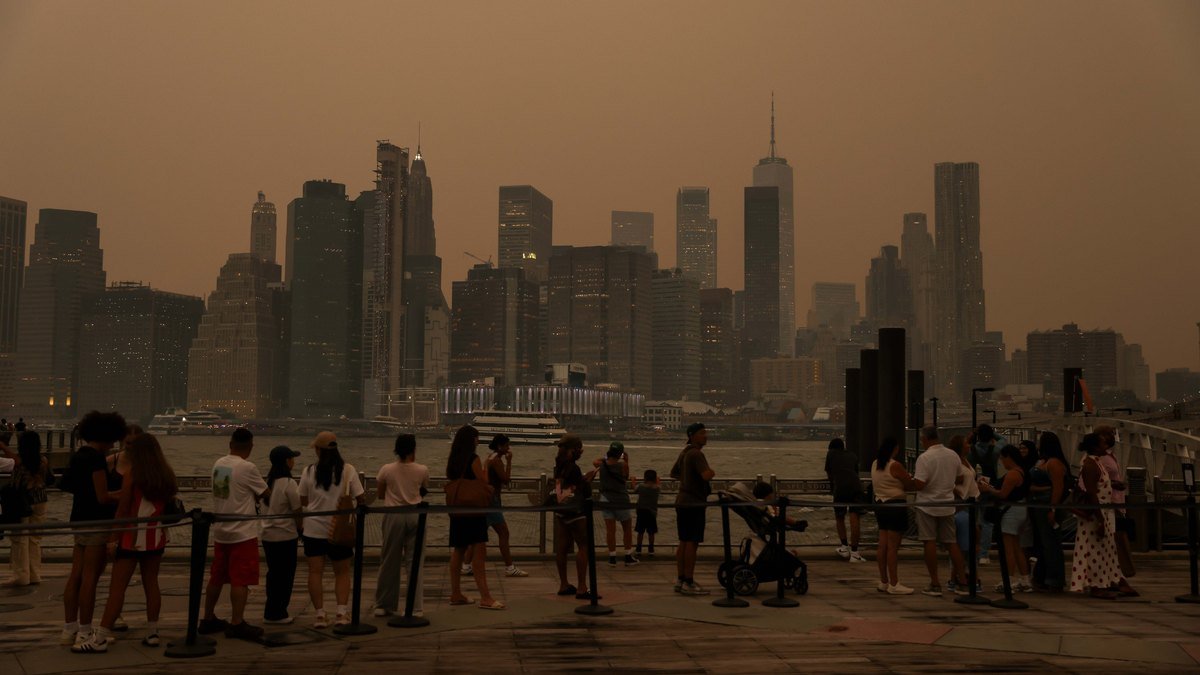
The air quality in much of the northern United States remains at dangerous levels as dense wildfire smoke from Canada continues to travel across the border.
The National Weather Service (NWS) notes in its latest reports that the smoke will darken skies across North America, with satellite maps capturing an impact that reaches the Upper Midwest and Canada, across the Great Lakes, through southern Ontario and New England, and down to New York City.
According to forecasters, the densest smoke will move south throughout the day, and it may even dip as far south as Maryland.
Currently, some of the largest active wildfires are burning in west-central Ontario, consuming thick forests and releasing an incredible amount of particulate matter.
This means that air quality alerts will stay in effect for much of the country, and places like Manhattan will continue to be blanketed in a cloudy, orange haze.
Canadian wildfire smoke map: who is impacted?
The NWS has placed more than 17 states under active Air Quality Alerts, stretching from Minnesota to New Hampshire and down into Virginia.
In looking at the maps from the Environmental Protection Agency (EPA), homeowners in states like Minnesota, Michigan, and New Jersey are heavily impacted by the current trajectory of the smoke.
In fact, Detroit and Minneapolis recorded the worst air quality in the world among major cities, with extremely hazardous conditions this week, according to ABC News.
Detroit reached an air quality index (AQI) around an astronomical 600. The most dangerous level, classified as “hazardous,” begins at an AQI of 300 or above.
This smoke is expected to continue moving east through the Northeast, but it will also push farther south, affecting areas through Ohio, Virginia, Washington, DC and Baltimore.
How to keep your household safe, with or without A/C
In these extreme smoke situations, it is crucial to limit the amount of time you spend outdoors. It is highly recommended that you forego outdoor activities like landscaping, exercise, and home renovations until the thick smoke has fully passed.
“Keep windows closed overnight to prevent smoke from getting indoors,” recommends the NWS, adding that residents should run “central air conditioning with MERV-13 or higher rated filters” if possible. Homeowners can use these high-powered air filters to effectively clean the air inside their homes.
However, if you do not have a central air system or high-efficiency filters, the EPA has a guide to create an easy DIY alternative using a standard box fan and a furnace filter. According to the EPA, these cheap, homemade filters can be surprisingly effective at capturing fine particles.
To create your own DIY air filter, follow these simple steps:
1. Attach the filter: Place the furnace filter onto the back of a standard box fan.
2. Secure it: Use clamps, duct tape, or bungee cords, making sure to seal all four sides tightly.
3. Position the fan: Ensure that the fan is oriented to blow air outward and upward into the room.
4. Turn it on: Once you turn it on, the box fan will suck air through the filter, catching particles.
Remember to replace the furnace filter once it becomes visibly dirty to maintain clean indoor air.
Get real estate news in your inbox