Best Private Student Loans for Trade School of July 2026
You can receive federal student loans for trade school as long as you are a regular student, meaning you’re enrolled or accepted for enrollment at an institution for the purpose of obtaining a degree, certificate or other recognized education credential.
Private student loans fill an important role in trade school financing. If you have good credit, private student loan rates can be lower than those for federal loans. Your program or chosen institution may not be accredited, or it might not be accredited with a recognized agency. Private student loans can also fill the gap if your education costs exceed federal borrowing caps.
It’s important to understand that private student loan providers will want you to have an established credit history or a willing cosigner. Some have shorter repayment terms than federal student loans, and you may be required to begin repayment while you’re in school. For private student loans, you’ll contact and prequalify with individual lenders, then choose the most competitive loan.
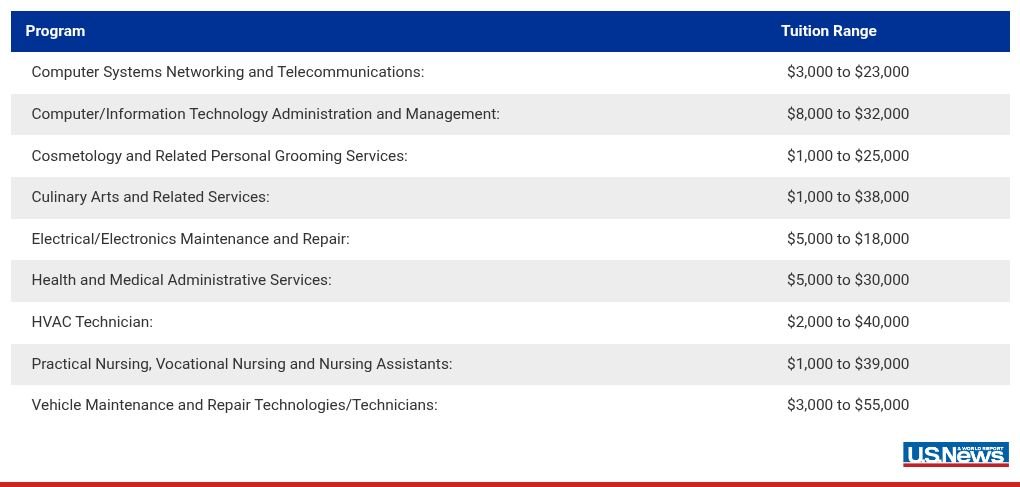
The cost of vocational programs varies widely among institutions and courses. Here are average costs for some popular programs according to the U.S. Department of Education’s College Affordability and Transparency List. Keep in mind that more expensive programs might feature lower student-to-instructor ratios, cutting-edge equipment, or include room and board. Public community or technical colleges may be cheaper than private for-profit trade schools. Location also impacts school costs.
It’s important to make sure that the training cost includes everything you need to start working in your chosen career. “Trade programs largely depend on the field and school, but likely range between $10,000 and $30,000. Specialized programs like HVAC, welding or cosmetology sometimes require additional equipment and certification fees as well,” said Michael Feazel, the co-founder and CEO of roofing technology company Roof Maxx, in an email. Feazel’s company hires many trade school grads, and he is himself a graduate of DeVry Institute of Technology.
“Financial aid is available for many accredited schools,” Feazel said, “but there are quite a few that are nonaccredited, so in certain cases, students are ineligible for Pell Grants or federal loans. If ineligible, that leaves private loans, payment plans, employer sponsorships – which is very common in trade school, or local workforce grants as primary options.”
Many regulated state-licensed trade schools are not traditionally accredited, said Ryan Woodward, CEO of National Technical Institute, a state-approved trade school with campuses in Las Vegas, Phoenix and Houston, specializing in HVAC, plumbing and electrical training. These schools often have partnerships with private student loan providers. Students can, however, use any lender they choose.
Private student loan lenders vary in what they offer, who they lend to and what they charge. And there are additional considerations specific to student loans, so it’s up to you to do some homework before borrowing.
Fees, Interest Rates and APR
The cost of your loan includes up-front fees, other charges and the interest rate. The annual percentage rate incorporates all of those items so you can compare loans with different rates and costs more easily. When comparing total costs, the loan with the lowest APR is the cheapest – as long as you compare loans with the same repayment term – five-year loan to five-year loan, for instance. If cash flow is tight, or you plan to repay your loan early, you might want to limit your choices to those without up-front charges.
Cosigner Requirements and Release
Another consideration is whether you’ll be required to apply with a cosigner and what conditions must be met to release this person from the loan obligation.
Grace Period and Deferral
Find out whether you have to repay the loan while you’re still in school or if you can defer repayment or make interest-only payments until you graduate. If deferral is on the table, ask about the grace period – how long you have after graduating before you must begin repayment.
Hardship Help
Find out if loan forbearance or deferral is an option if you experience financial difficulty in the future.
Fortunately, there’s a lot of information available online. Check customer reviews on sites like Trustpilot to understand other borrowers’ experiences with the lender. You can also get valuable insight from editorial reviews on comparison sites, which compile customer reviews, information about the lender and its offerings, and complaint data from agencies like the Consumer Financial Protection Bureau.
Ways to Pay for Trade School
There are several paths for paying for vocational programs, Woodward said. Your school may offer its own financing. “States allow NTI to offer internal financing at zero interest if you can pay it off within 12 months.”
Many trade school students use the GI Bill to fund their education, said Woodward, and others obtain assistance from school partnerships with local employers. Some companies offer students jobs while in their program or even help pay off their loans. “Students should ask their schools,” Woodward said. “If they do, we’ll help direct them to their funding.”