ASML Stock: Next Stop $3,000?
ASML Holding (ASML 1.83%) reported another beat-and-raise quarter, blowing expectations out of the water with second-quarter 2026 net sales of 9.3 billion euros ($10.6 billion), 54% gross margin, and net income of 2.9 billion euros ($3.3 billion). When ASML reported first-quarter results in April, it expected second-quarter net sales of 8.4 billion to 9 billion euros ($9.6 billion to $10.3 billion) and gross margin of 51% to 52%.
It gets even better. When ASML reported 2025 year-end results in January, it projected full-year 2026 net sales of 34 billion to 39 billion euros ($38.8 billion to $44.6 billion) and a gross margin of 51% to 53%. Now, ASML is forecasting 43 billion to 45 billion euros ($49.1 billion to $51.4 billion) in 2026 net sales and a gross margin of 54% to 56%.
Here’s how the upbeat guidance fits into ASML’s investment thesis, and why the artificial intelligence (AI) semiconductor stock has room to run above $3,000 per share and join the $1 trillion club.
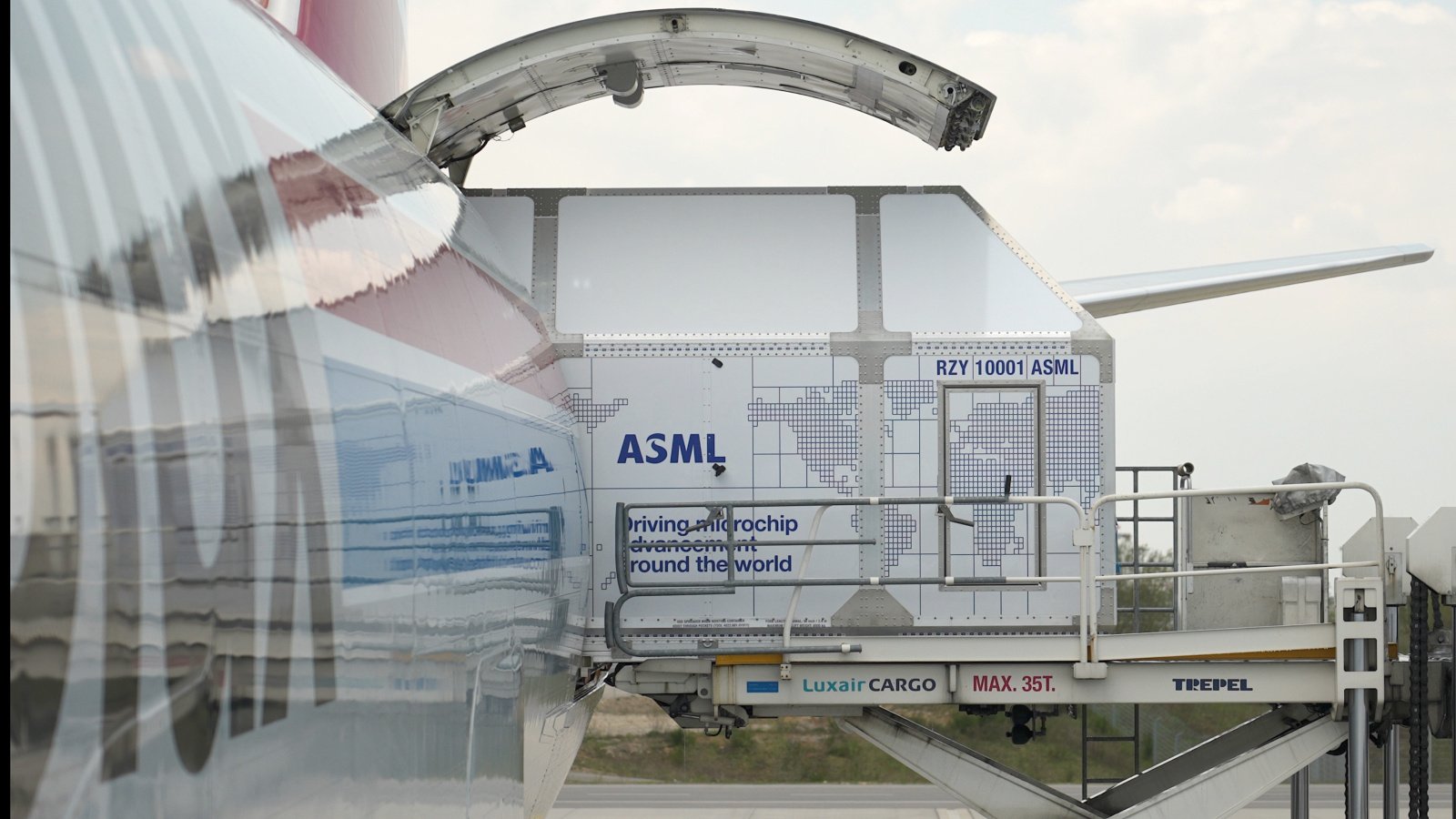
Image source: ASML.
ASML has a track record of underpromising and overdelivering
Given management’s notoriously cautious tone, raising guidance for the second consecutive quarter is particularly notable.
Just one year ago, when ASML reported second-quarter 2025 results, the stock tanked because management said it couldn’t confirm it would grow in 2025 because of macroeconomic and geopolitical uncertainty. After all, the report came amid trade tensions between the U.S. and China. As a Dutch company, ASML is highly vulnerable to U.S. trade policy.
The market mistook ASML’s reserved rhetoric for weakness when, in reality, management was simply communicating risks to investors. Those risks were overblown. ASML has continued to deliver even better growth than expected, and the stock has more than doubled over the past year.

Today’s Change
(-1.83%) $-33.26
Current Price
$1,782.01
Key Data Points
Market Cap
Day’s Range
$1779.18 – $1853.15
52wk Range
$683.48 – $1999.96
Volume
644
Avg Vol
1.9M
Gross Margin
52.73%
Dividend Yield
0.49%
The AI build-out is just getting started
ASML’s latest outlook is particularly encouraging, given management’s aversion to overpromising.
Based on stronger-than-expected order intake, ASML plans to add 30% to its 2026 low numerical aperture (Low-NA) capacity of around 65 units in 2027, and another 30% increase in 2028. It also plans a 30% increase in deep ultraviolet (DUV) immersion capacity to around 130 units in 2027 and another 30% increase in capacity for 2028 — all while continuing to invest in its high numerical aperture (High-NA) extreme ultraviolet (EUV) systems for next-generation AI chips.
ASML is the world’s leading manufacturer of semiconductor equipment for the lithography step of chip manufacturing, which involves printing designs on to silicon wafers. The bulk of ASML’s sales is still for DUV machines and servicing existing equipment. But ASML is perfectly positioned for the next upgrade cycle as fabs invest in new equipment, such as Low-NA and High-NA EUV systems. ASML sits at the top of the value chain, selling its equipment to chip manufacturers including Taiwan Semiconductor Manufacturing, Samsung Electronics, and Intel. So ASML’s decision to increase production is a vote of confidence in AI-driven chip demand.
The simplest reason to buy and hold ASML is that its systems are needed to produce both logic chips — graphics processing units, central processing units, custom AI application-specific integrated circuits — and memory chips, such as high-bandwidth memory, dynamic random-access memory, and AI NAND (flash) chips. This advantage makes ASML perfectly positioned to benefit from increased AI chip innovation and production, regardless of whether the bottlenecks stem from logic chips or the current memory chip shortage.
ASML is growing into its premium valuation
In its November 2024 investor day presentation, ASML said it had the opportunity to reach 2030 annual sales of 44 billion to 60 billion euros ($50.3 billion to $68.5 billion) on gross margin between 56% and 60%. The gross margin figures are higher because higher-margin EUV systems account for a larger share of sales.
But ASML’s updated 2026 guidance of 43 billion to 45 billion euros in sales means it’s on track to hit the low end of its 2030 net sales and gross margin guidance this year. Compared with 32.7 billion euros ($37.4 billion) in 2025 net sales and 52.8% gross margin, ASML is poised to grow revenue by a staggering 34.6% year over year while expanding margin. So while I initially predicted that ASML would join the $1 trillion club by 2030, I could see it reaching that milestone and surpassing $3,000 per share sooner than expected.
That said, there’s no denying ASML is priced for perfection at 48.5 times forward earnings. And the stock would probably tank if its growth were to slow. So investors should consider buying ASML only if they believe in the long-term growth of AI adoption and innovation, which would support the build-out of more advanced AI chip fabs, and, in turn, ASML’s High-NA machines.