South Korea’s Kospi index jumps more than 16% on a surge of chipmaking stocks
U.S. futures edged higher and oil prices slipped.
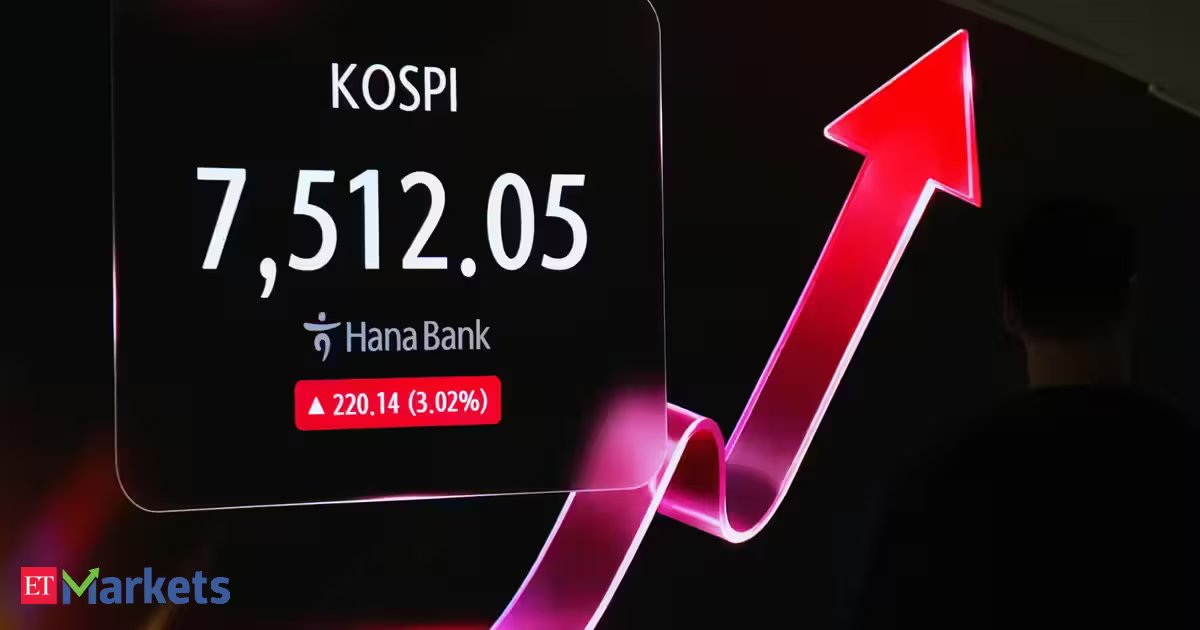
In early Asian trading, the Kospi surged at the open and ratcheted up, trading 16.5% higher before giving up some of those gains. By midday it was up 14% at 6,376.68. Shares of South Korean technology giant Samsung Electronics surged 21%, while memory chipmaker SK Hynix soared 24.6%.
The Kospi index had sunk more than 17% in the previous three days as investors dumped technology stocks in part over worries about an AI bubble and rising competition from chipmaking and AI rivals in China.
The rebound followed Microsoft’s report Thursday of stronger than expected profits for the last quarter. Microsoft’s shares soared 15.5% for its best day in nearly 18 years. The strong earnings were taken as a signal that big spending on AI is translating into profits.

Traders flooded back into the market to snap up shares in tech companies that had recently swooned over doubts that the huge investments will yield adequate returns.
Despite the big jump Friday, the Kospi remains well below the peak of over 9,000 that it hit in June.Tokyo’s Nikkei 225 climbed 4.4% in early Friday trading, to 64,572.25. Multinational investment holding company and OpenAI-investor SoftBank Group jumped 15%, while chip equipment maker Tokyo Electron rose nearly 11%.
“The market went from throwing AI stocks overboard to fighting for the remaining seats before most traders had finished writing the obituary,” Stephen Innes of SPI Asset Management said in a commentary.
The dollar fell sharply against the Japanese yen overnight due to suspected intervention in the market after weeks of it trading above 160 yen, near 40-year highs.
Japan’s Nikkei financial newspaper said the intervention was coordinated, with the Federal Reserve Bank of New York conduction what is known as a “rate check” in which it asks various banks to provide exchange-rate quotes for currency trades.
The Treasury Department did not respond to requests for comment. Japanese Finance Minister Satsuki Katayama also declined to comment.
After dropping more than 2.4%, the dollar bounced back early Friday, gaining 0.6% to 160.61 yen.
The Bank of Japan opted to keep interest rates unchanged Friday as it wrapped up a policymaking meeting. That was expected. Analysts said the suspected intervention may have been timed to pre-empt speculative moves linked to the central bank’s decisions.
“Intervention in support of the yen may not work any better now than it has previously, but the persistence of the Japanese authorities suggests to us that the yen will remain around the 160 level this year before staging a more sustained rebound next year,” Jonas Golterman of Capital Economics said in a commentary.
The Federal Reserve likewise kept its benchmark rate unchanged at its policy meeting this week. A gap between interest rate levels in Japan and the U.S. has been a key factor behind the yen’s weakness.
The euro fell to $1.1513 from $1.1524.
Elsewhere in Asian share trading, Taiwan’s Taiex surged more than 7%. Australia’s S&P/ASX 200 added 0.4%, to 8,997.50.
Hong Kong’s Hang Seng edged 0.1% higher, to 25,894,21, while the Shanghai Composite index advanced 0.6% to 3,828.00.
Oil prices traded lower as tensions between the U.S. and Iran keep the Strait of Hormuz, a key waterway for oil transport, largely closed.
Brent crude, the international standard, was down 1.3% to $85.76 per barrel. It was trading near $72 a barrel before the Iran war began in late February.
Benchmark U.S. crude was down 1.5% to $82.32 a barrel.
ING commodities analysts said Friday that there were signs of increased oil flows through the Strait of Hormuz, which helped ease the pressure on oil supply, with ship tracking data showing tanker crossings grew slightly, though the numbers were still limited.
On Thursday, Wall Street’s benchmark S&P 500 gained 1.7% to 7,437.63. The Dow Jones Industrial Average added 1.2% to 52,208.06. The technology-heavy Nasdaq composite rose 2.8% to 25,122.18.