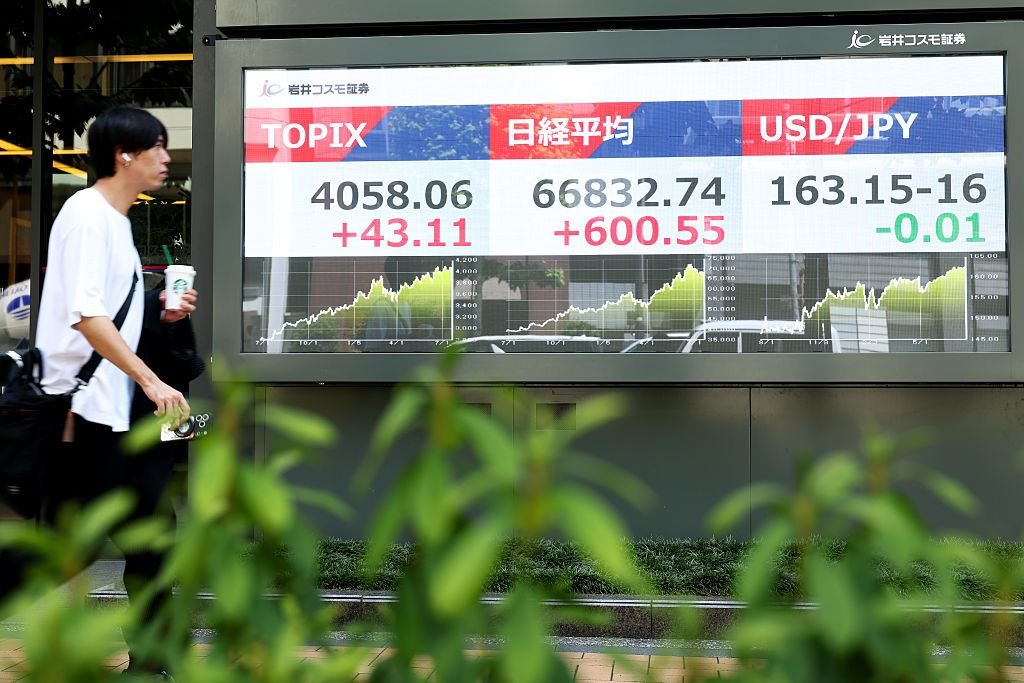
Japanese stocks ride the AI boom – can the rally last?
Investors in Japanese stocks – like investors everywhere – need to be alert to concentrated exposure to the AI story. Over the past few months, it has gone from important to indispensable.
Wherever you look, the stocks that are doing best are linked to AI demand, while those that are AI-agnostic or an “AI loser” are mostly lagging. The emerging markets index is now trading like an AI play, due to TSMC, Samsung Electronics and SK Hynix, but this is by no means the only example.
Among Japanese stocks, the top performers are firms such as Kioxia, a chipmaker that soared from ¥1,455 when it floated in December 2024 to a high of ¥112,700 in June. Other big hitters include tech conglomerate Softbank and firms involved in chipmaking and testing such as Advantest, Murata Manufacturing and Tokyo Electron.
Sign up to Money Morning
Don’t miss the latest investment and personal finances news, market analysis, plus money-saving tips with our free twice-daily newsletter
Don’t miss the latest investment and personal finances news, market analysis, plus money-saving tips with our free twice-daily newsletter
Implausible-sounding companies such as food-seasonings firm Ajinomoto and toilet manufacturer Toto have also been carried along: their core businesses make them leaders in materials that play a role in the chip-supply chain.
Japanese stocks have made a strong start to the year
“The result has been an unusually narrow, yet powerful market,” note Alex Bowles and Brett Moshal of the Japan equity team at asset manager Orbis. As of the end of June, the Topix index has made a strong start to the year (up 19%), yet only a third of Japanese stocks have beaten the benchmark. A basket of 67 AI companies accounts for 14 percentage points of that return.
This has been a headwind for any investors underexposed to AI, although Bowles and Moshal argue that it is also creating contrarian opportunities. They point to Nintendo, which has halved amid fears of a memory crunch hurting hardware sales in the short term, but also the threat that AI poses to its competitive advantage in game development. This is overdone given the strength of Nintendo’s intellectual property, they argue.
Foreign investors held back by a weak yen
Diversification between regions may not be much protection if the AI boom ends badly. That said, for now, the market is still doing well, and the drag for foreigners is the currency.
The yen keeps weakening and now stands at ¥163 to the US dollar and ¥218 to the pound. There has been little sign of this bottoming out, notwithstanding talk of “appropriate and bold action” by the finance minister this week. The result is that Japan has become one of the cheapest developed-market countries to live in, note Jim Reid and his team at Deutsche Bank. In purchasing power parity terms, with price levels measured on the basis that the US is 100, Japan now comes in at 60; in 2012 it was at 125.
In theory, the yen is deeply undervalued. Yet this has been near-consensus and it keeps sliding. Our exchange-traded fund (ETF) portfolio is invested in Japan through Vanguard FTSE Japan (LSE: VJPN) and this has done fine, but clearly a currency-hedged ETF would have done better. We are sticking with the unhedged position since we expect the yen to rally eventually – but iShares MSCI Japan GBP Hedged (LSE: IJPH) or UBS Core MSCI Japan hGBP (LSE: UB0D) are other options to cut the risk it falls further.

(Image credit: Future)
This article was first published in MoneyWeek’s magazine. Enjoy exclusive early access to news, opinion and analysis from our team of financial experts with a MoneyWeek subscription.