There Are 300 Ultra-High-Yield Dividend Stocks on Wall Street — but These 2 Are Arguably the Safest of the Bunch

With thousands of publicly traded companies and exchange-traded funds (ETFs) to choose from, there is no shortage of strategies to build wealth on Wall Street. But statistically speaking, buying and holding high-quality dividend stocks delivers some of the most attractive annualized returns.
As of the closing bell on July 10, approximately 300 stocks (minimum $300 million market cap and excluding ETFs) were sporting ultra-high dividend yields of at least 5%. Although some high-octane income stocks are more trouble than they’re worth, two super-safe and supercharged dividend stocks can be found among these ultra-high-yielders: Enterprise Products Partners (EPD 0.56%) and Realty Income (O 0.80%).

Image source: Getty Images.
Enterprise Products Partners: 5.9% yield
Oil and gas stocks are often known for their robust capital-return programs, as well as their heightened volatility when energy prices swing wildly. Enterprise Products Partners delivers an outsize annual yield that’s nearing 6%, but doesn’t have anywhere close to the same risk profile as oil and gas producers.
Enterprise is one of America’s largest midstream providers — effectively an energy middleman overseeing transmission pipelines, liquids storage, deepwater docks, and fractionators.
The beauty of midstream energy companies like Enterprise is that they typically secure long-term, fixed-fee contracts with upstream drillers. Regardless of whether oil and gas prices skyrocket or tumble, the fixed-fee nature of its contracts removes the effects of inflation and commodity volatility from the equation, resulting in highly predictable cash flow from operations.
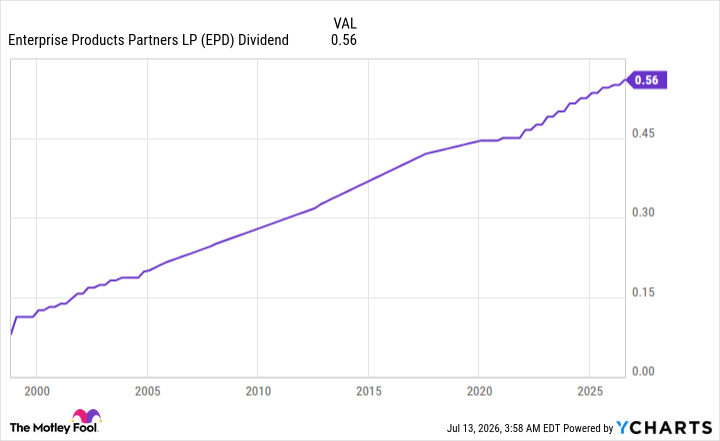
EPD Dividend data by YCharts.
Predictability is incredibly important for Enterprise Products Partners. Knowing how much cash flow it’ll generate one or more years in advance allows it to tackle new natural gas liquids projects and/or make bolt-on acquisitions.
Though Enterprise Products Partners has raised its payout for 27 consecutive years, it’s increased its quarterly distribution 83 times since going public in July 1998, including its latest distribution hike (announced on July 7).

Grocery stores are a key tenant for Realty Income’s commercial real estate portfolio. Image source: Getty Images.
Realty Income: 5.1% yield
If you think 83 separate dividend hikes are impressive since 1998, you’re going to love retail real estate investment trust (REIT) Realty Income. Since its initial public offering in October 1994, Realty Income has increased its dividend for 115 consecutive quarters and 135 times in total. On a combined basis, Enterprise and Realty Income have raised their payouts 218 times!
Unlike Enterprise, Realty Income doles out its dividend monthly. This is made possible by the company’s superior commercial real estate (CRE) portfolio, exceptional lease vetting, and reliance on triple-net leases (commonly called “NNN leases“).
In terms of CRE assets, Realty Income focuses on brand-name, stand-alone businesses capable of luring customers in any economic climate. Think grocery stores, dollar stores, convenience stores, and automotive service shops, to name a few. Businesses in recession-resistant industries rarely struggle to pay rent.
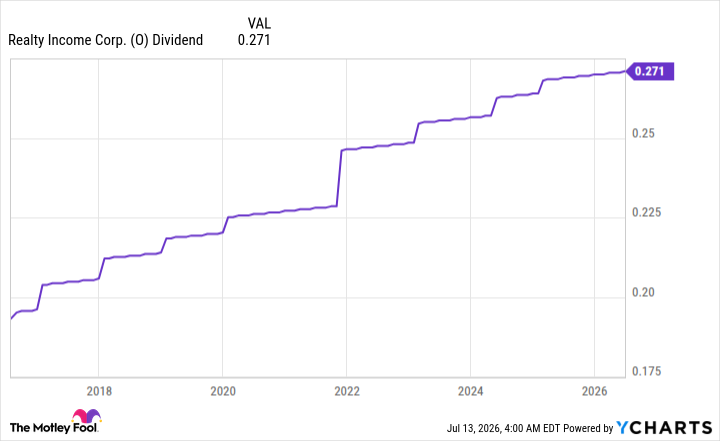
O Dividend data by YCharts.
Realty Income also closed out the March quarter with an occupancy rate of 98.9%, which is 450 basis points above the historical median occupancy rate of S&P 500 REITs since 2000. In other words, Realty Income’s tenants pay their bills and sign long-term leases.
Lastly, Realty Income relies on the triple-net lease structure. Whereas a landlord is typically responsible for property maintenance, insurance, and property taxes, NNN leases place the onus of these costs on the tenant. Though the landlord receives less in rent with an NNN lease, there are also no surprise expenses.