India’s CPI inflation is 4.38%, but your personal inflation could be higher. Here’s how to calculate it
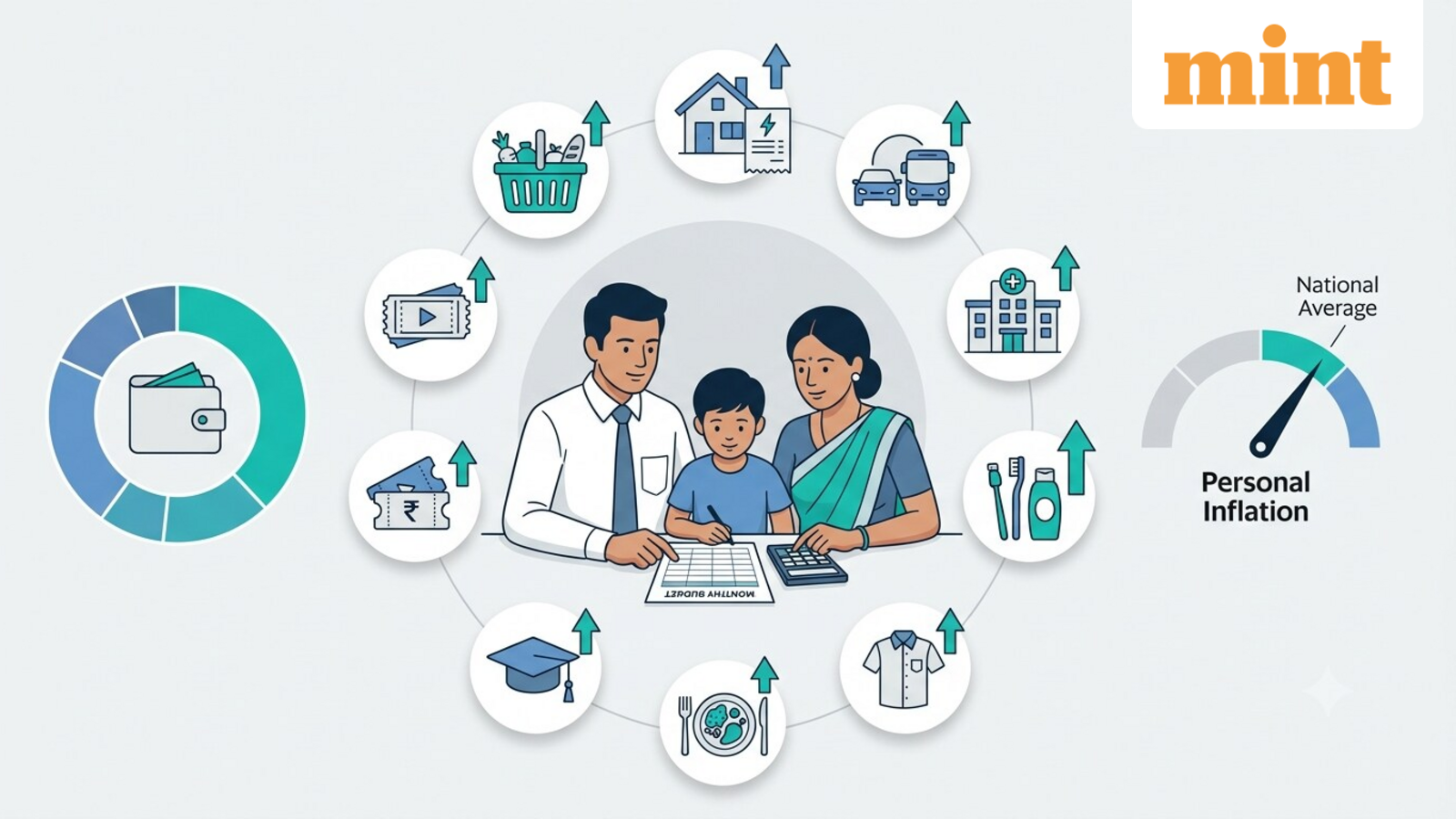
India’s CPI inflation stood at 4.38% in June 2026, but that may not reflect the actual rise in your cost of living.
Protima Dhawan, Director & Unit Head, Anand Rathi Wealth, said individuals should look beyond the headline CPI.
“Headline CPI is an important benchmark as it captures price movements across 12 different spending categories with different weights. However, it represents the average consumer, not every consumer. In reality, every household has its own inflation rate because spending patterns differ significantly,” she explained.
According to MoSPI data, food and beverages inflation rose 5.05% year on year in June, while inflation in the ‘Personal care and effects’ category stood at 16.72%..
This means that if you had spent ₹500 on personal care products in June 2025, you would have spent around ₹584 in June 2026 to buy a similar basket of personal care products.
So, let’s find out how to calculate the personal inflation rate using category-wise data.
How to calculate your personal inflation rate?
Explaining the framework, Dhawan said, “The simplest way to calculate personal inflation is to treat your monthly budget like a mini CPI basket.”
- First, list down where every rupee goes in a typical month, whether on housing, food, transport, healthcare, education, travel or lifestyle.
- Assign each category a weight based on its share of total monthly spending.
- Apply the latest inflation for each category/division and calculate the weighted average.
Personal Inflation Rate = (Individual Category Weight × Category Inflation Rate) added across all spending categories
| Category/ Division | Monthly Spending ( ₹) | Weight (%) | Inflation (June 2026) | Personal Inflation (%) |
| Personal care, social protection and miscellaneous goods and services | 20,000 | 20% | 16.72% | 3.34% |
| Restaurants and accommodation services | 2,000 | 2% | 6.91% | 0.14% |
| Food and beverages | 20,000 | 20% | 5.05% | 1.01% |
| Paan, tobacco and intoxicants | 2,000 | 2% | 4.83% | 0.10% |
| Transport | 10,000 | 10% | 4.31% | 0.43% |
| Education services | 15,000 | 15% | 3.34% | 0.50% |
| Clothing and footwear | 5,000 | 5% | 3.23% | 0.16% |
| Furnishings, household equipment and routine household maintenance | 2,000 | 2% | 2.19% | 0.04% |
| Housing, water, electricity, gas and other fuels | 20,000 | 20% | 1.99% | 0.40% |
| Recreation, sport and culture | 1,000 | 1% | 1.75% | 0.02% |
| Health | 2,000 | 2% | 1.42% | 0.03% |
| Information and communication | 1,000 | 1% | 0.43% | 0.00% |
| Total | 100,000 | 100% | 4.38% | 6.17% |
*Source: MoSPI, YoY Change
In the above example, an individual spends ₹1 lakh every month. Of this, 20% is spent on food and beverages, 20% on housing-related expenses, and 20% on personal care and miscellaneous items. The remaining amount is allocated across transport, education, clothing, healthcare, and other categories.
Based on these weights, the personal inflation rate is 6.17%, which is higher than India’s headline CPI inflation of 4.38% for June 2026.
Does everyone have the same personal inflation rate?
No two individuals or households experience the same inflation.
As Dhawan points out, “A HNI who spends more on healthcare, travel, education, personal care and lifestyle services may experience inflation that is much higher than the headline number. On the other hand, a retiree with limited discretionary spending and no education expenses may feel much lower inflation.”
Should personal inflation rate influence your investment decisions?
While a higher personal inflation rate highlights rising living costs, it should not determine how much of your income you invest.
According to Dhawan, “Personal inflation should not determine how much of your income you invest, but it should influence how much wealth you need to create.”
She adds, “As a thumb rule, individuals should aim to save and invest at least 30% of their income, irrespective of whether their personal inflation is 4% or 8%.” But a higher personal inflation rate means your future expenses are likely to grow faster, requiring you to build a larger investment corpus.
Disclaimer: This story is for educational purposes only. The views and recommendations made above are those of individual analysts or broking companies, and not of Mint. We advise investors to check with certified experts before making any investment decisions.
About the Author
Sheetal Goel is a Content Producer at Livemint, where she covers corporate developments, personal finance, business trends, markets, and SEBI-related updates. She focuses on simplifying complex financial concepts and presenting them in a clear, reader-friendly manner, thereby helping audiences better understand investment trends, personal finance, and market developments. Her writing focuses on making finance more accessible to everyday readers while maintaining clarity, accuracy, and relevance.
She holds a degree in Economics (Hons.) along with an MBA in Finance, which has helped her develop a strong foundation in financial analysis, market understanding, and business reporting. Before joining journalism, she worked with finance and broking firms, where she closely followed market developments, investment strategies, and evolving industry trends. This practical exposure strengthened her understanding of financial markets. She has also written content across multiple formats and platforms, including YouTube, LinkedIn, and Instagram.
Over time, she has developed expertise in covering market-linked stories, investor-focused topics, and regulatory updates in a simplified yet informative style. She also enjoys reading and listening to Hindi poetry, reflecting her appreciation for literature and creative expression beyond the world of markets and numbers.