My 4 Go-to Vanguard ETFs I Trust to Lead Me to the Retirement Promised Land

Your investments shouldn’t be a full-time job that you have to constantly monitor and stress over volatility. Ideally, you’d have a few trustworthy ETFs that cover a lot of ground and let do the heavy lifting for you over time. This is especially true for investments you plan to hold onto until retirement.
I try to keep my retirement investments as simple and straightforward as possible. I’m not looking for generational gains or “the next big thing” (though that would be greatly appreciated), but rather constant growth and compounding over time, and these four Vanguard ETFs are equipped to provide that possibility.

Image source: Getty Images.
1. Vanguard S&P 500 ETF
The Vanguard S&P 500 ETF (VOO +0.42%) is the staple of my portfolio, as my top holding. VOO typically holds around 500 of the largest publicly traded American companies, so investing in it is a bet on U.S. economic growth. Of course, many more companies make up the economy, but because of their size, these companies drive much of its direction.

Today’s Change
(0.42%) $2.89
Current Price
$691.39
Key Data Points
AUM
$1.7T
Dividend Yield
1.06%
Expense Ratio
0.03%
Top Holdings
NVDA
7.90%
AAPL
7.05%
MSFT
5.15%
VOO is diversified (even though it has become much more tech-heavy in recent years), contains blue chip stocks, is cheap (0.03% expense ratio), and most importantly, has proven results.
If you look at VOO’s returns since its September 2010 inception and over the past decade, it has averaged over 15% annual total returns in both timeframes. Past results don’t guarantee future performance, but the index is well positioned to continue producing attractive long-term returns.
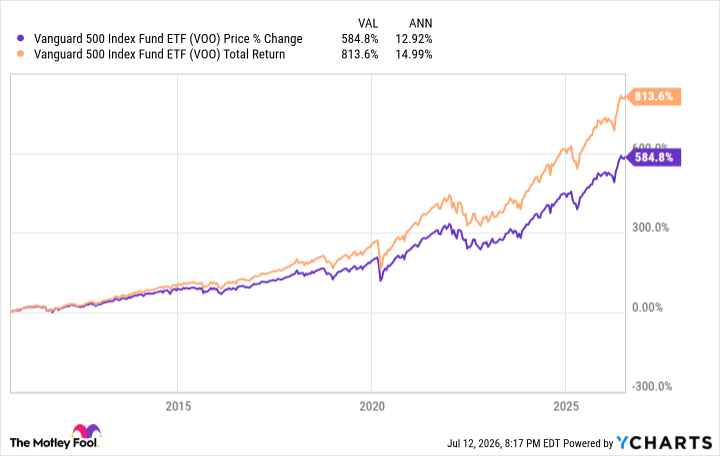
I wouldn’t invest expecting those same returns to continue, but even if VOO returns around 8% to 10% annually, that can be enough to help build wealth over time with enough consistency.
2. Vanguard Small-Cap ETF
S&P 500 companies account for most of the stock market’s value, but there are also many smaller companies that warrant investing in.
The Vanguard Small-Cap ETF (VB +0.18%) allows you to invest in 1,310 small-cap stocks (those with market caps between $250 million and $2 billion) at once, giving you exposure to the growth opportunities they present, without having to take on the individual risks that usually come with their stocks.
A Russell 2000 ETF is the more popular way to invest in small-cap stocks, but VB is cheaper and holds more of the “larger” small-cap companies.
Smaller companies are typically more volatile than larger companies because they’re more vulnerable to broader economic conditions, so I don’t allocate a large portion of my portfolio to VB. However, it’s nice to have some exposure because small-cap stocks tend to outperform large-cap stocks at certain times, as we’re seeing so far this year through mid-July.
3. Vanguard Mid-Cap ETF
The Vanguard Mid-Cap ETF (VO 0.05%) can serve as a middle ground between VOO and VB. Mid-cap companies (those with market caps between $2 billion and $10 billion) aren’t typically as resource-heavy as larger companies, but they’re much more likely to survive economic downturns than smaller companies.

Today’s Change
(-0.05%) $-0.04
Current Price
$80.80
Key Data Points
AUM
$219B
Dividend Yield
4.35%
Expense Ratio
0.03%
Top Holdings
STX
1.90%
WDC
1.79%
VRT
1.18%
VO is a bit smaller than VOO and VB, with “only” 288 companies, but it’s diverse from a sector standpoint. Its top five sectors are industrials (20.2% of the ETF), tech (18%), consumer discretionary (13.6%), financials (11.7%), and utilities (8.3%).
Since it hit the market in January 2004, VO has averaged 10.3% annual total returns, just slightly below the S&P 500’s 10.8% average over that span. I typically try to keep the amount of my portfolio dedicated to VO and VB relatively close, but still much less than VOO.
4. Vanguard Total International Stock ETF
Having a well-rounded portfolio means having stocks from across the globe, and the Vanguard Total International Stock ETF (VXUS +1.11%) does just that. It holds almost every non-American stock on the market (8,738 total), covering both developed and emerging markets.
This gives you exposure to the stability that developed markets tend to offer, as well as the high growth potential of emerging markets. Both have their own pros and cons, so owning pieces of both at once takes a lot of the thinking out of it. Here’s how VXUS is divided by region:
- Europe: 35.9%
- Pacific: 28.9%
- Emerging Markets: 26.3%
- North America: 8%
- Middle East: 0.9%

Vanguard Total International Stock ETF
Today’s Change
(1.11%) $0.93
Current Price
$84.71
Key Data Points
AUM
$652B
Dividend Yield
2.58%
Expense Ratio
0.05%
Top Holdings
2330.TW
3.98%
005930.KS
2.19%
000660.KS
1.86%
VXUS is a perfect complement to a portfolio full of American companies because it’s often insulated from U.S.-specific issues that could weigh down the market. A good example is when the U.S. market tumbled at the beginning of the Trump Administration’s tariff adjustments last year and again this year, as investors sought value outside the U.S. with inflated big tech valuations.
I generally try to cap my exposure to international stocks at 10% of my portfolio.