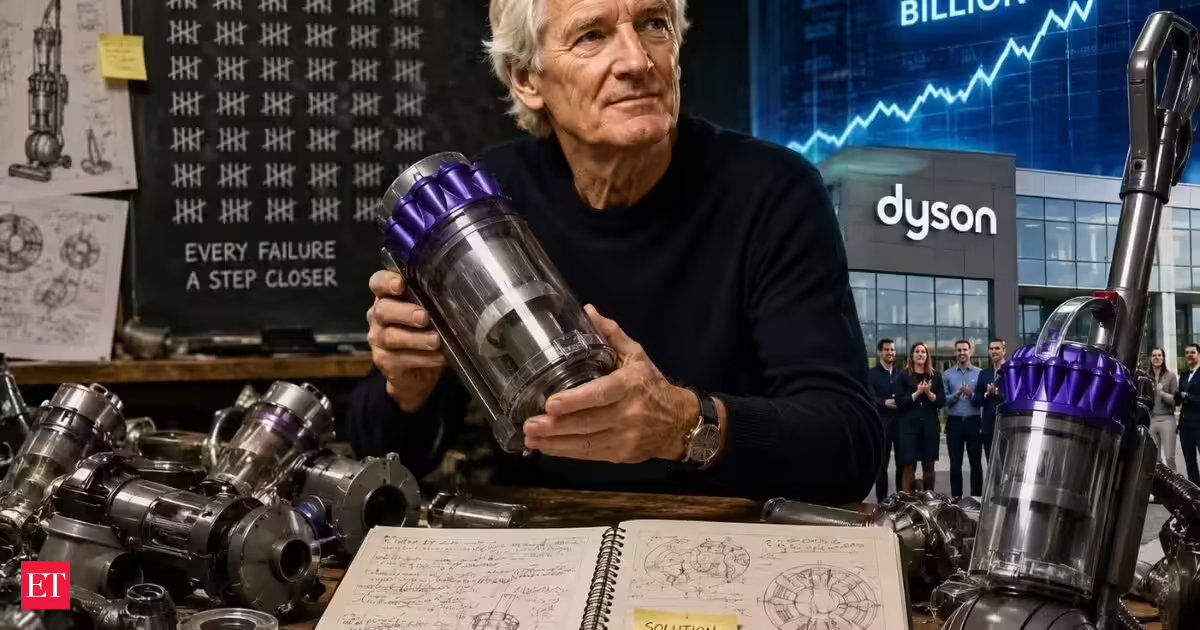
He failed 5,000 times, but never gave up, to make the right vacuum; now his net worth is $13 billion
Also Read: ‘We Must Act Now’: Eric Schmidt, Reid Hoffman, Joseph Stiglitz among 200 who just sounded an alarm on AI
That number, 5,127, has become something of a shorthand for stubbornness in engineering circles. But the real story sitting underneath it is less about the count and more about what Dyson chose to do with every failure along the way, and what he refused to do when people told him his finished product looked wrong.
Thousands Of Broken Prototypes Before One Finally Worked
Dyson’s starting point wasn’t ambition to invent something new. It was irritation with something old. Ordinary vacuum cleaners lost power as their bags filled with dust, and rather than shrug it off as a fact of life, he began picking apart why it happened at all.
That question turned into a workshop obsession. Model after model came off the bench, and model after model fell short, sometimes by a little, sometimes by a lot. Instead of treating each dud as proof he was on the wrong track, Dyson reportedly read each one as a clue. A weak seal here, a badly shaped cyclone there, every miss narrowed down what the eventual fix needed to look like.

By the time working prototype number 5,127 came together, the machine could hold its suction without a disposable bag at all, the feature that would go on to define the entire product line.
Retailers Wanted The See-Through Bin Gone. Dyson Said No.
Building the thing was only half the battle. Selling people on it was the other. One detail in particular made buyers nervous in the early days: a clear plastic bin that let anyone see exactly what the machine had just sucked off their carpet. Retailers reportedly pushed back hard, arguing shoppers wouldn’t want a front-row seat to their own household dirt and that the see-through design should be scrapped.Dyson’s team saw it the opposite way. To them, the transparent bin wasn’t a flaw to hide, it was proof the machine was doing its job, visible at a glance. So despite the pressure, they kept it exactly as designed.
It’s a small decision, but it says something about how Dyson has approached criticism throughout his career: listen, weigh it, and don’t let outside doubt override a idea before it’s even had a chance to be tested in the real world.
His Real Formula: Get Annoyed, Then Fix It
Ask Dyson where good ideas come from and the answer isn’t lightning-bolt inspiration, it’s low-grade daily annoyance. He has repeatedly pointed to the small, tolerated inconveniences of ordinary life, a gadget that half-works, a task that’s more fiddly than it should be, as the real starting line for invention.
Most people shrug those moments off. Dyson‘s argument is that they’re worth stopping for, because irritation is often the first sign that something has been designed badly, and badly designed things can usually be designed better.