Worst state economies in America in 2026
Most economists now seem to agree that the immediate threat of a recession has passed, but that does not mean there is not concern about inflation, geopolitical tensions or a bursting AI bubble knocking the economy off track. Some states are better situated to weather a downturn than others. Companies know that, so they look for states with stable economies when deciding where to set up shop.
States know it, too, so many continue to market themselves as economic havens.
“Companies can thrive in a world-class business environment with the most diverse economy in the nation,” Illinois’ economic development site proclaims.
“In Michigan, you’ll find a global network of leading companies across numerous industries,” its state site notes. “From Fortune 500 companies to fast-growing startups and hundreds of thousands of small businesses, companies of all sizes are driving economic opportunity in every corner of our state.”
CNBC analyzes every state’s marketing pitch as part of our annual America’s Top States for Business study. This year, we found the economy to be the second most frequently mentioned attribute (after infrastructure). So, under our methodology, the Economy category carries the second-heaviest weight in 2026—worth 16.6% of a state’s total score.
To measure each state’s economy, we consider job growth, economic growth, and the number of major companies headquartered in the state. We also measure each state’s fiscal health, including its budget situation, its long-term obligations and its debt ratings, as well as the health of the residential real estate market. We also consider the impact of tariffs, the potential impact of federal budget cuts, and small business survival rates.
Some states clearly deliver on their economic promises, but these are not those states. Here are America’s worst state economies in 2026.
10. Oklahoma
Downtown Oklahoma City.
Art Wager | Istock | Getty Images
Oklahoma is among the most dependent on federal funding, according to the National Association of State Budget Officers. More than 40% of state spending in Oklahoma comes from Washington, D.C., putting the state in the top 10 for reliance on the feds.
“That’s not rugged individualism; that’s a subsidy,” wrote Shiloh Kantz of the Oklahoma Policy Institute in August. “And it means that the hard fiscal choices some of our leaders brag about are possible only because someone else is footing the bill.”
It also leaves the Sooner State vulnerable to potential federal cuts.
Economic growth was moderate last year, which is leaving the housing market under some stress.
2026 Economy score: 172 out of 415 points (Top States grade: D)
Real GDP (2025): $213.5 billion (+1.5%)
Debt Rating and outlook (Moody’s): Aa1, Stable
Share of state spending from federal funds: 40.4%
International goods trade: $24.9 billion (9% of GDP)
Major corporations: Paycom Software, ONEOK, The Williams Companies
9. North Dakota
Oil well pumpjacks at work in the oil fields of North Dakota.
John Coletti | Photodisc | Getty Images
The days of North Dakota‘s oil frenzy back in the early 2000s and 2010s are long gone, and even the surge in oil prices at the start of the Iran war earlier this year was not enough to get companies to resume drilling in the Bakken Shale in a meaningful way. Economic growth in the Peace Garden State was the lowest in the nation last year. New business formations were also among the lowest. One thing the state did right was to build up its reserves during the flush times. The state could last nearly a year on its total fund balance if all else failed, according to the Pew Charitable Trusts.
2026 Economy score: 171 out of 415 points (Top States grade: D)
Real GDP (2025): $63.6 billion (+0.3%)
Debt Rating and outlook (Moody’s): Aa1, Stable
Share of state spending from federal funds: 34.5%
International goods trade: $14.5 billion (17.6% of GDP)
Major corporations: None
8. New Hampshire
Aerial view of Concord and the New Hampshire State House.
Ultima_gaina | Istock | Getty Images
New Hampshire‘s fiscal situation is anything but rock solid. The Granite State’s spending outpaces revenues, according to the most recent financial disclosures. New Hampshire’s public employee retirement systems are underfunded to the tune of more than $5.5 billion, among the worst pension gaps in the country. Job growth is tepid, and the survival rate for new businesses is among the lowest in the country, according to data provided to CNBC by business research firm Construction Coverage. The state’s economy is growing at a healthy pace, however, with the help of new residents fleeing higher taxes in neighboring states like Massachusetts.
2026 Economy score: 170 out of 415 points (Top States grade: D)
Real GDP (2025): $96.87 billion (+2.1%)
Debt Rating and outlook (Moody’s): Aa1, Stable
Share of state spending from federal funds: 39.4%
International goods trade: $17.2 billion (13.7% of GDP)
Major corporation: Iron Mountain
7. Alaska
Alaska oil pipeline, Alaska range.
Patrick J. Endres | Corbis Documentary | Getty Images
Alaska is heavily dependent on the federal government, which accounts for more than 45% of state spending. Only Louisiana (48.6%) and Indiana (46.3%) rely more on Uncle Sam. The Last Frontier also has among the largest percentages of federal employees in its workforce. Alaska did turn in solid economic growth last year, even before the surge in oil prices this past February. And optimism is growing as the Trump administration moves to expand drilling in the North Slope and pursues an 807-mile natural gas pipeline to deliver gas from Prudhoe Bay on the North Slope to the Kenai Peninsula and the world.
“Alignment of state and federal leadership means potential for major moves in Alaska’s mining and oil and gas development,” wrote state economist Karinne Wiebold in January, though the pipeline — and any economic windfall that comes with it — is still years away.
2026 Economy score: 169 out of 415 points (Top States grade: D–)
Real GDP (2025): $57.5 billion (+2.8%)
Debt Rating and outlook (Moody’s): Aa2, Stable
Share of state spending from federal funds: 45.3%
International goods trade: $9.8 billion (13.1% of GDP)
Major corporations: None
6. South Dakota
Mount Rushmore, South Dakota.
©Anitaburke | Moment | Getty Images
Economic growth was modest last year in South Dakota, but to hear state officials tell it, things are looking up — and they are not referring to the Mount Rushmore State’s most famous, lofty attraction. Earlier this year, in her first-quarter economic update, Secretary of State Monae Johnson pointed to nearly 4,000 new business filings in the quarter, “surpassing first-quarter filing totals from each of the previous six years.” She did not mention that the comparisons were relatively easy. According to Census data, South Dakota ranked 35th in new business formations per capita last year, growing only about 4% from 2024. Once businesses do get off the ground in South Dakota, however, they stand a good chance of surviving. The state ranks No. 15 in Construction Coverage’s small business survival index.
2026 Economy score: 168 out of 415 points (Top States grade: D–)
Real GDP (2025): $58.5 billion (+1.4%)
Debt Rating and outlook (Moody’s): Aaa, Stable
Share of state spending from federal funds: 42.4%
International goods trade: $4.88 billion (6% of GDP)
Major corporations: None
5. Kansas
Wichita, Kansas.
Cweimer4 | Istock | Getty Images
The housing market in Kansas is a study in contrasts. Inventory is tight, with around a two-month supply of homes on the market as of May, according to Redfin. Yet, price appreciation has been modest, and seller gains have been weak, according to ATTOM Data Solutions. It all means that the real estate market is not the economic engine it might normally be. One reason may be that the Sunflower State is not doing well in attracting workers, according to data from labor market analytics firm Lightcast. Job growth in the state is weak, though overall economic growth was reasonably good last year.
2026 Economy score: 162 out of 415 points (Top States grade: D–)
Real GDP (2025): $185.1 billion (+2%)
Debt Rating and outlook (Moody’s): Aa2, Stable
Share of state spending from federal funds: 27.4%
International goods trade: $29.4 billion (12.2% of GDP)
Major corporations: None
4. Louisiana
French Quarter, Jackson Square, New Orleans.
Andrey Denisyuk | Moment | Getty Images
Louisiana faces serious exposure to a pair of stiff headwinds in the economy: tariffs, and a shrinking federal government in a state that disproportionately relies on Washington. No state has more of its spending funded by the federal government. And with nearly one-third of the Pelican State’s GDP made up of international goods trade, Louisiana’s tariff costs have skyrocketed, according to Washington, D.C.-based research firm Trade Partnership Worldwide, which provided data to CNBC. Perhaps as a result, Louisiana has seen some of the weakest economic growth in the nation. Overall job growth has been strong but uneven. The latest forecast from Louisiana State University’s E.J. Ourso College of Business, through the first quarter of next year, calls for more job growth, “but employment in only 4 of the state’s metro areas is forecast to grow at a rate of 1% or greater.” The forecast calls for modest improvement in GDP, growing at a rate of about 1.5% into the beginning of 2027.
2026 Economy score: 160 out of 415 points (Top States grade: D–)
Real GDP (2025): $259.9 billion (+1.1%)
Debt Rating and outlook (Moody’s): Aa2, Stable
Share of state spending from federal funds: 48.6%
International goods trade: $109.4 billion (32.2% of GDP)
Major corporations: Pool, Entergy
3. West Virginia
Residential street in downtown Charleston, West Virginia.
Benedek | E+ | Getty Images
West Virginia is not handling the transition from a coal-centered economy to whatever comes next well. The Mountain State’s labor force participation rate is the lowest in the nation, even as prices rise — putting more and more everyday needs out of reach. Economic growth and job growth rank near the bottom. One potential bright spot — and maybe a lifeline — is the state’s housing market. Inventory is near optimum, affordability is good, and yet prices are appreciating well.
2026 Economy score: 146 out of 415 points (Top States grade: F)
Real GDP (2025): $83.2 billion (+0.5%)
Debt Rating and outlook (Moody’s): Aa2, Positive
Share of state spending from federal funds: 20.5%
International goods trade: $9.5 billion (8.7% of GDP)
Major corporations: None
2. Maryland
Baltimore, Maryland.
Kruck20 | Istock | Getty Images
Economic growth and job growth nearly flatlined in Maryland over the past year. The Old Line State’s deep connection with the federal government next door has a lot to do with that, as Gov. Wes Moore pointed out in his State of the State address in February.
“In just the last year, the federal government has fired around 25,000 Marylanders who have federal jobs in our state alone,” said Moore, a Democrat. “It’s the biggest federal job cut of any state in the country.”
But the Maryland Chamber of Commerce also blames “high costs, unpredictable taxes, and growing regulatory burdens.”
“If we want a stronger future, we must prioritize an economy that supports business investment, expansion, and long-term growth,” the organization said.
Whatever the reason, Maryland finds itself in a deep hole in 2026, with no easy way out of it.
2026 Economy score: 143 out of 415 points (Top States grade: F)
Real GDP (2025): $436.17 billion (+0.7%)
Debt rating and outlook (Moody’s): Aa1, Stable
Share of state spending from federal funds: 31.2%
International goods trade: $56.6 billion (10% of GDP)
Major corporations: McCormick and Company, Lockheed Martin, Marriott International
1. Rhode Island
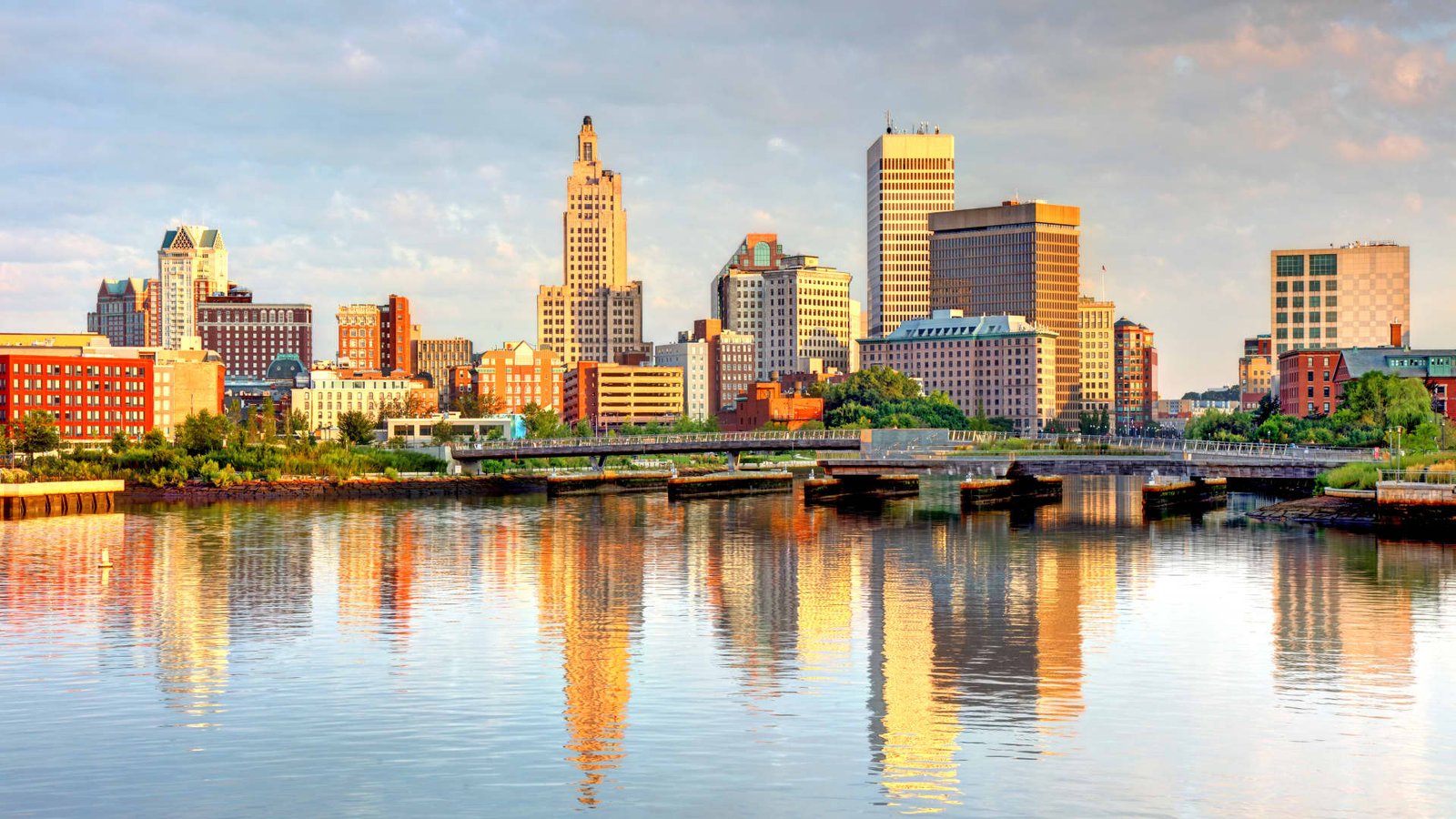
Providence, Rhode Island.
Denistangneyjr | Istock | Getty Images
To hear Rhode Island Gov. Dan McKee tell it, the state is about to have its moment. McKee, a Democrat, writes on a website devoted to what he calls the RI 2030 Plan that “National shifts in defense spending, the return of advanced manufacturing, and rapid technological innovation are aligning with Rhode Island’s long-standing strengths in defense, ocean technology, and the life sciences.”
But if, indeed, the Ocean State’s ship is about to come in, it is taking a long time getting there. In the meantime, economic growth was the ninth weakest in the country last year. Foreign direct investment was practically nonexistent, as were new business formations.
Rhode Island is also especially vulnerable to tariffs. Costs skyrocketed last year in a state where international goods trade makes up over 18% of nominal GDP.
2026 Economy score: 121 out of 415 points (Top States grade: F)
Real GDP (2025): $64.2 billion (+1.1%)
Debt rating and outlook (Moody’s): Aa2, Stable
Share of state spending from federal funds: 38.5%
International goods trade: $15.5 billion (18.5% of GDP)
Major corporations: Hasbro, Citizens Financial Group, CVS Health