85% of CFOs Say Automation Cuts Payments Friction
Security controls are designed to stop bad payments, but new data suggested the strongest systems may be the ones customers barely notice.
The PYMNTS Intelligence report “When Controls Slow Commerce: The Data Behind Middle-Market Payment Friction,” the latest installment of the 2026 Certainty Project, found that many firms still struggle to protect transactions without delaying them. The report was based on a survey of 60 chief financial officers at companies in the United States with annual revenue between $100 million and $1 billion. Only 43% said their firms were strong or very strong at processing payments quickly while maintaining effective fraud and security controls.
The findings showed that payments security works best when it operates like a well-timed traffic light, guiding commerce without bringing it to a standstill.
Key findings:
- Fraud or security controls caused payments delays that negatively affected customers or business partners at least occasionally during the past 12 months, according to 55% of CFOs.
- Execution failures, including incorrect or delayed payments, increased customer friction for 78% of CFOs. The same share cited gaps in visibility or communication around fees, timing and payments policies.
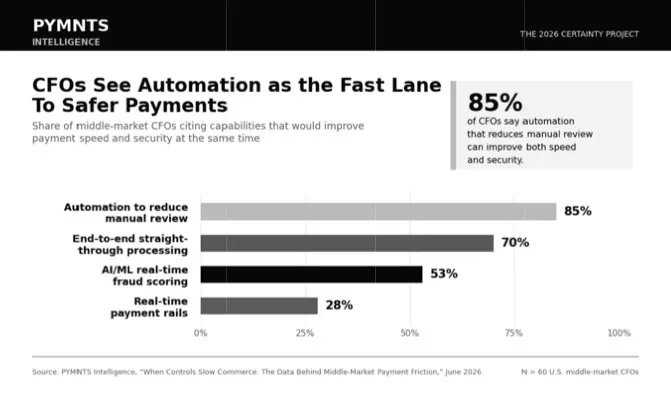
- The share of CFOs who said automation that reduces manual review would improve payments speed and security at the same time was 85%, making it the most widely cited remedy.
The financial effect grows as friction becomes more frequent. CFOs at firms with recurring payments delays estimated that delays, errors, fraud and the work required to resolve them consumed 1.92% of annual revenue. That was more than six times the 0.31% reported by firms with relatively little friction. For a middle-market company, that gap can represent millions of dollars that could otherwise support hiring, product investment or customer service.
The report also drew a direct line between payments reliability and customer retention. Among CFOs at recurring-friction firms, 44% said reliable and accurate payments were critical to keeping customers, compared with 4% at friction-light firms. Complex authentication also appeared more often at companies with recurring friction.
There is room for improvement, and CFOs appear to recognize the path forward. According to the report, 70% cited end-to-end straight-through processing as a way to improve speed and security together, while 53% pointed to real-time fraud scoring using artificial intelligence or machine learning. Many firms have also improved support training, added payments notifications and formalized service expectations.
The steps can help, but the data suggested that durable progress will come from upgrading the infrastructure behind the customer experience. Security does not need to become a speed bump when firms build controls directly into the payments flow.
For all PYMNTS B2B coverage, subscribe to the daily B2B Newsletter.
At PYMNTS Intelligence, we work with businesses to uncover insights that fuel intelligent, data-driven discussions on changing customer expectations, a more connected economy and the strategic shifts necessary to achieve outcomes. With rigorous research methodologies and unwavering commitment to objective quality, we offer trusted data to grow your business. As our partner, you’ll have access to our diverse team of PhDs, researchers, data analysts, number crunchers, subject matter veterans and editorial experts.