Buckle up Californians: November’s ballot will be a long read
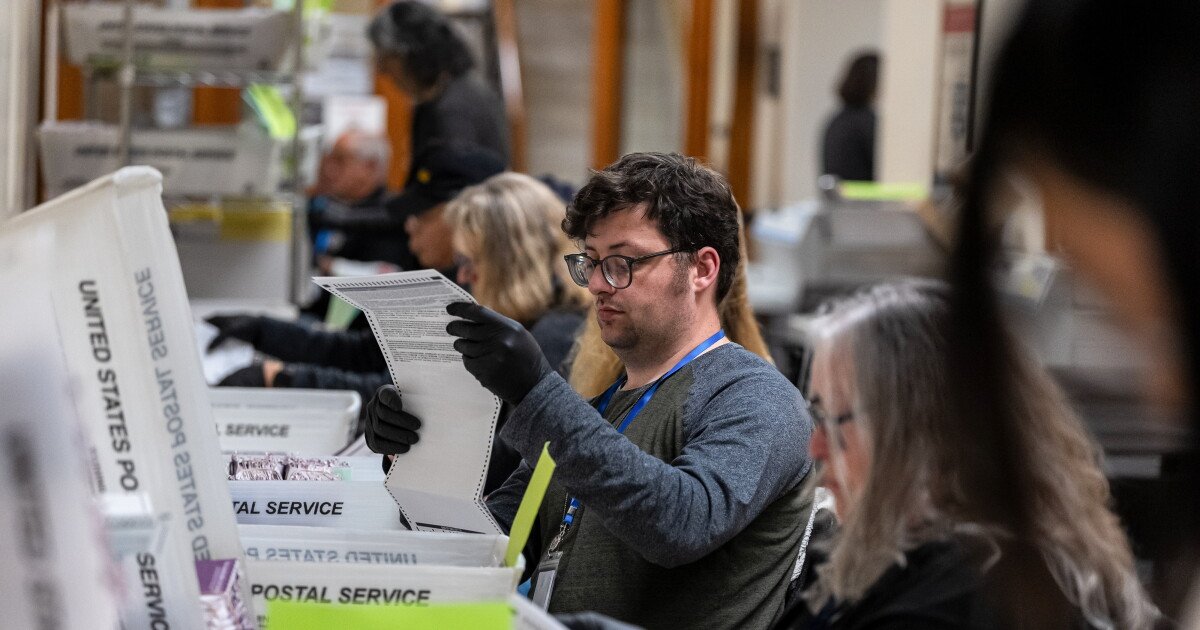

Bloomberg News
California ballots are notoriously long — likely a result of the popularity of voter initiatives — and this November’s ballot will be no exception.
Processing Content
The state’s November ballot presents voters with a comprehensive referendum on the state’s economic trajectory, its approach to infrastructure, and the underlying philosophy regarding who should shoulder the burden of funding the state’s massive public service requirements.
While headline-grabbing measures like the proposed Billionaire’s Tax and the Local Taxpayer Protection Act — the latter spearheaded by the Howard Jarvis Taxpayers Association — capture the majority of media attention and political energy, the slate of propositions facing the electorate is expansive and could carry profound implications for the state’s long-term fiscal health.
The sheer volume and complexity of these measures has prompted discussions about the state’s reliance on the
“Ballot box budgeting is a poor public finance practice that generally should be avoided,” said Marc Joffe, a public policy analyst. “We elect executive and legislative branch officials to set priorities through the budget process and should allow them the flexibility to do that.”
Proposition 3, a constitutional amendment, would provide permanent funding for schools and healthcare by extending existing high-income tax rates that were originally approved by voters in 2012 and are set to expire in 2031.
These rates, which affect personal income over approximately $360,000 for single filers and $721,000 for joint filers, are considered by supporters a vital step to prevent a “fiscal cliff” for essential services.
By making these tax brackets permanent, supporters say, the state would secure a stable revenue stream for education and healthcare, though critics contend that persistent high-income tax brackets reduce California’s economic competitiveness and could potentially drive wealth out of the state. The fiscal impact is significant, with estimates from the Legislative Analyst’s Office and the Department of Finance suggesting it maintains between $5 billion and $15 billion in annual state income tax revenues.
The debate over the state’s fiscal obligations reaches its most intense point with Proposition 40, widely known as the “
This initiative — deeply entangled in the political fallout of federal healthcare funding cuts proposed in the One Big Beautiful Bill Act signed by President Donald Trump in 2025 — seeks to
The campaign for the Billionaire’s Tax, heavily backed by groups such as the Service Employees International Union–United Healthcare Workers West (SEIU-UHW), frames the measure as a necessary emergency response to the federal cuts in H.R. 1, which
For proponents, the measure is a way to prevent a cascade of service cuts, layoffs, and patient care crises they argue disproportionately affect low-income Californians.
Opponents, however, including the Californians Against Tax Increases campaign, characterize the measure as a dangerous expansion of taxing authority that threatens all Californians.
They argue the tax, despite being marketed as a measure solely for billionaires, creates an administrative and legal framework — requiring sworn declarations of net worth for all taxpayers — that could eventually be used by politicians to expand wealth taxation to the middle class, retirement accounts, and home equity without voter approval.
“Affluent individuals supply a large proportion of California’s general fund revenue, which is likely to be impaired by relocations of billionaires and potential billionaires, fearful that the tax will not be a one-time affair,” Joffe said. “Because the SEIU-sponsored billionaire’s tax disproportionately funds Medi-Cal, it will have the unintended effect of reducing funds available for other state priorities, including K-12 and higher education.”
“What if Democrats in Washington succeed in reversing some or all of the H.R. 1 reductions? California would then have extra revenue going into the state’s healthcare system that might have a higher and better use elsewhere,” he said.
Business groups like the California Business Roundtable and the California Taxpayers Association argue this is a Trojan horse that will drive capital and taxpayers out of the state, ultimately leaving the remaining residents to shoulder a larger tax burden. The rhetoric surrounding the Billionaire’s Tax has become increasingly heated, with both sides leveraging polling data and economic arguments to frame their position as the only rational choice.
At the center of the housing debate, Proposition 1, the Veterans and Affordable Housing Bond Act of 2026, represents a significant legislative push to address the state’s persistent housing affordability crisis.
By authorizing $11.25 billion in general obligation bonds, the measure aims to provide a substantial infusion of capital, with $10 billion earmarked for affordable rental and ownership programs and an additional $1.25 billion specifically designated for veteran housing assistance.
Proponents argue this is a necessary lifeline for development, particularly as the state
However, fiscal conservatives raise concerns about the long-term debt obligations that such a massive authorization imposes on future state budgets, highlighting the persistent tension between the immediate need for infrastructure investment and the desire to maintain fiscal discipline.
Proposition 1 introduced in
The housing-related bond debate is further enhanced or muddied, depending on who you talk to, by Proposition 37, which would authorize up to $25 billion in bonds to fund a
Unlike Proposition 1, this measure targets the homebuyer directly, providing fixed-rate mortgages for up to 17% of the purchase price for homes priced below thresholds that vary by county, generally between $1 million and $1.5 million.
The mechanism is designed so bonds are repaid by mortgage payments rather than the state general fund, a feature that proponents argue limits direct state costs.
Yet, the sheer scale of the $25 billion bond issuance has sparked debate over the market-distorting effects of such interventions and whether they truly address the supply-side issues that drive California’s high cost of living, or if they risk inflating home prices further by increasing buyer leverage.
From the folks at the anti-tax Howard Jarvis Taxpayers Association, who brought the state Proposition 13, comes Proposition 41, a measure that would make it harder to pass local special tax increases.
HJTA President Jon Coupal said the proposal, which they are referring to as the Local Taxpayer Protection Act to Save Proposition 13, was driven by state court decisions the group believes undermined Proposition 13, California’s nearly 50-year-old property tax law.
Proposition 13, a constitutional amendment approved by voters in 1978, caps general property taxes at 1% of a property’s assessed value, restricts annual assessed value increases to a maximum of 2%, and requires a two-thirds majority for tax increases in the state Legislature.
The Local Taxpayer Protection Act would change the California constitution to require a two-thirds vote by residents for all local special tax increases, instead of a simple majority.
The act also limits fees what cities and counties can charge during property ownership transfers, known as real estate transfer taxes. It would cap these taxes at 0.11%.
Lawmakers and Gov. Gavin Newsom have tried unsuccessfully to negotiate with the proposal’s supporters to remove it from the ballot.
The initiative would require
State and local leaders worry about its impact on local government budgets, warning that the two-thirds threshold could effectively freeze their ability to fund infrastructure, public safety and social services. State leaders view what the anti-tax organization refers to as the “Upland loophole,” as a necessary democratic tool that allows a simple majority of citizens to address local needs through bond or tax measures.
HJTA views the Upland decision as a “loophole” circumventing the original intent of Proposition 13, said Coupal, who argues it creates an unfair inconsistency where government-proposed taxes face a higher bar than those proposed by citizens.
The California Supreme Court ruled in 2017 in California Cannabis Coal vs. City of Upland that local measures introduced by voter initiative could be presented in a special election. Despite the narrow scope, the decision sparked a much larger debate regarding whether local special taxes introduced by voter initiative are subject to the longstanding requirement in the California constitution that local special taxes must be passed with a two-thirds supermajority vote.
Lawmakers and the governor have filed a proposed state law to make changes to the real estate transfer tax with the hope HJTA would remove the measure from the ballot, but Coupal said his organization has no intent of backing down.
In a president’s message posted on HJTA’s website, Coupal wrote: “this measure deals only with taxes levied on real property or on property ownership and non-property-related special taxes (including sales taxes) passed under the Upland loophole. It does not deal with other kinds of taxes, or with fees, he wrote. “The court took issue with our previous initiative, because it applied to all taxes and fees.”
“We disagreed with their decision, but have written the Local Taxpayer Protection Act to Save Proposition 13 to stay within the boundaries set,” he said.

California Senator Monique Limon’s Office
In a June 23 press release, the organization announced “it will not pull its initiative from the November ballot despite intense political pressure to do so following a legislative deal to pass a statewide cap on real estate transfer taxes.”
Local government leaders, including Los Angeles Mayor Karen Bass, have warned that a two-thirds threshold could effectively freeze their ability to respond to local crises.
The volume and breadth of this year’s mix of initiatives and bond measures creates an overall vision of a state wrestling with its own governance and funding mechanisms — some of which Democrats have argued results from funding shifts at the federal level.
The involvement of powerful interest groups like SEIU-UHW, which has used the initiative process extensively —previously targeting the dialysis industry and now focusing on healthcare taxes and executive compensation caps —demonstrates how the ballot box has become an alternative legislative chamber.
When traditional legislation fails, these entities turn directly to the electorate, creating a cycle of costly, complex ballot battles that require voters to become de facto experts on niche fiscal policy, according to a recent
Business coalitions use their own financial resources to fight these measures and to introduce their own initiatives.
The cumulative effect of these measures is to place a heavy cognitive load on the average voter.
Whether it is deciding the merits of multi-billion dollar bonds
Public opinion polling, such as that conducted by PPIC, indicates voters are keenly aware of the economic instability facing the state, yet they remain deeply divided on the best path forward.
As Coupal wrote in a recent message on the organization’s website, the struggle over the initiative process is far from over, and the outcome of the November election stands as a critical juncture, not only for the specific policies on the ballot, but for the very future of how California governs itself.