Proposal to overhaul fair lending rules draws housing industry backlash
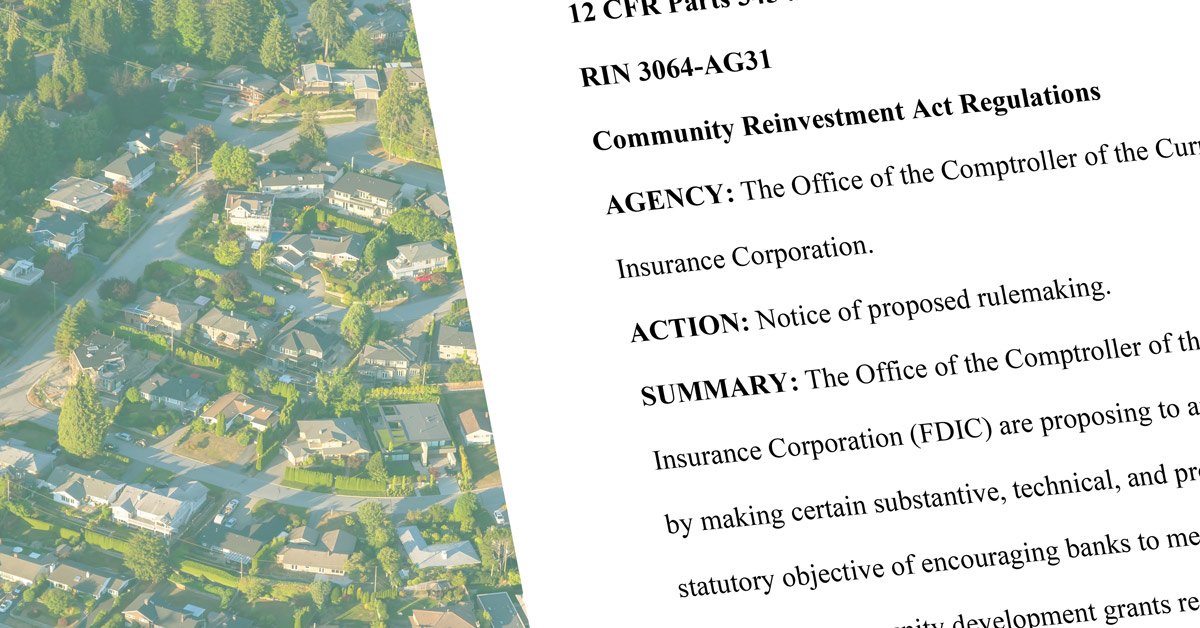
The Trump administration is moving to overhaul fair lending rules that were enacted in 1977’s Community Reinvestment Act (CRA) to prevent redlining and incentivize banks to reinvest in the communities they serve.
The Federal Deposit Insurance Corp. (FDIC) and Office of the Comptroller of the Currency (OCC), two of the three federal regulators tasked with implementing the law, announced the notice of proposed rulemaking on Friday.
In a summary, the regulators said the proposal is intended to ensure funds “are not diverted to activist causes or consumed by excessive operating costs,” according to reports from Bloomberg and the Associated Press.

The Federal Reserve, the third regulator with CRA oversight, was not part of the proposed rule. A Scotsman Guide source with direct knowledge said that the Fed had not been made aware of the proposal until last Friday.
“They weren’t even given paper. The regulators didn’t even trust the Fed enough to give them a leave behind,” the source said.
The Fed declined to comment. The FDIC and OCC did not return voicemails left Friday afternoon.
OCC Comptroller Jonathan Gould posted on social media that the CRA was “an onerous tax on community banks that failed to drive investment into the very regions they were meant to serve.” He added the proposed reforms “will help ensure the CRA is no longer used as a social credit score for banks, nor as a funding mechanism for activist NGO networks under the guise of community development.”
Democratic members of the Senate Committee on Banking, Housing, and Urban Affairs said the administration “is trying to gut another critical tool for building more housing, driving investment into communities, and combatting redlining. This proposal would make America’s housing crisis worse. Republicans should join Democrats in pushing back.”
Housing and community development groups quickly framed the proposal as a retreat from CRA’s core purpose: pushing regulated banks to meet credit needs in communities that have historically faced disinvestment, particularly in low- and moderate-income neighborhoods.
The National Community Reinvestment Coalition (NCRC) said in a statement that the proposal would “drastically weaken banks’ obligation to meet the credit needs of low- and moderate-income communities.”
Jesse Van Tol, NCRC’s president and CEO, said that instead of helping working-class people, “now it lets hundreds of banks off the hook, and dramatically reduces the obligation for others.”
Van Tol said he was particularly concerned about the proposal to raise the large-bank threshold to $10 billion and to leave banks below $1 billion with no community investment obligation.
“Bank capital drives the creation of affordable housing in this country, and they do it because of CRA,” said Van Tol. “Now hundreds of banks won’t have the obligation to do so, and hundreds more will have a weaker requirement, which will further deepen our housing crisis.”
David Dworkin, president and CEO of the National Housing Conference, told Scotsman Guide there are parts of the proposal that are very short-sighted.
“The attack on operational expenses, the funding that doesn’t directly go into an investment deal, is incredibly damaging. Because it penalizes banks for doing this work, and essentially says, ‘Despite the fact that you’ve been getting CRA credit for this for a generation, you now get nothing,’” he said.
“That investment that the banks make can be as important as the investment that they make in the property itself,” Dworkin added, “because it allows the developer to be able to afford to manage the property and to pay the staff that actually underwrite and plan the properties.”
He also said a major concern was the proposal’s durability — whether it would survive beyond the current administration.
“A new administration will come in and will wipe this out. And all it does is add more cost to banks,” Dworkin said. “You have to bounce back and forth. You never end up with anything that lasts past one political swing of the pendulum.”
Center for Responsible Lending President Mike Calhoun said the plan would “siphon away investment from the very communities in rural and urban America that most need those funds.”
Calhoun also said it would “discourage banks from providing financial services — mortgages, small-business loans and other investments — to families who have been left behind by our country’s economic changes. The administration should reconsider this misguided approach.”
Beyond the potential effect on bank obligations, several sources raised concerns about the process behind the proposal and whether rulemaking led by only two banking regulators would prove durable.
Another housing expert, who had served for years at the Department of Housing and Urban Development (HUD) and the Federal Housing Finance Agency, pointed out to Scotsman Guide how the Fed was not involved in the proposed rulemaking.
“One of the old challenges long before this current situation with CRA was you have three agencies doing this rulemaking,” they commented. “They should all be on a level playing field that recognizes the differences among financial institutions based on size and geography and mission and all of that. To have a rulemaking by just two agencies and not involving the third, there’s obvious problems.”
The proposed rule comes after the National Association of Affordable Housing Lenders released a report describing how the law helps incentivize private investment.
Its analysis found that in 2024, CRA helped incentivize $430 billion in private investment — nearly six times the combined federal funding from HUD, the U.S. Department of Agriculture’s Rural Housing Service, the Small Business Administration and the Community Development Financial Institutions Fund.