Philly’s Big-Box Warehouse Owners Subdivide Spaces After Developing ‘The Wrong-Size Buildings’
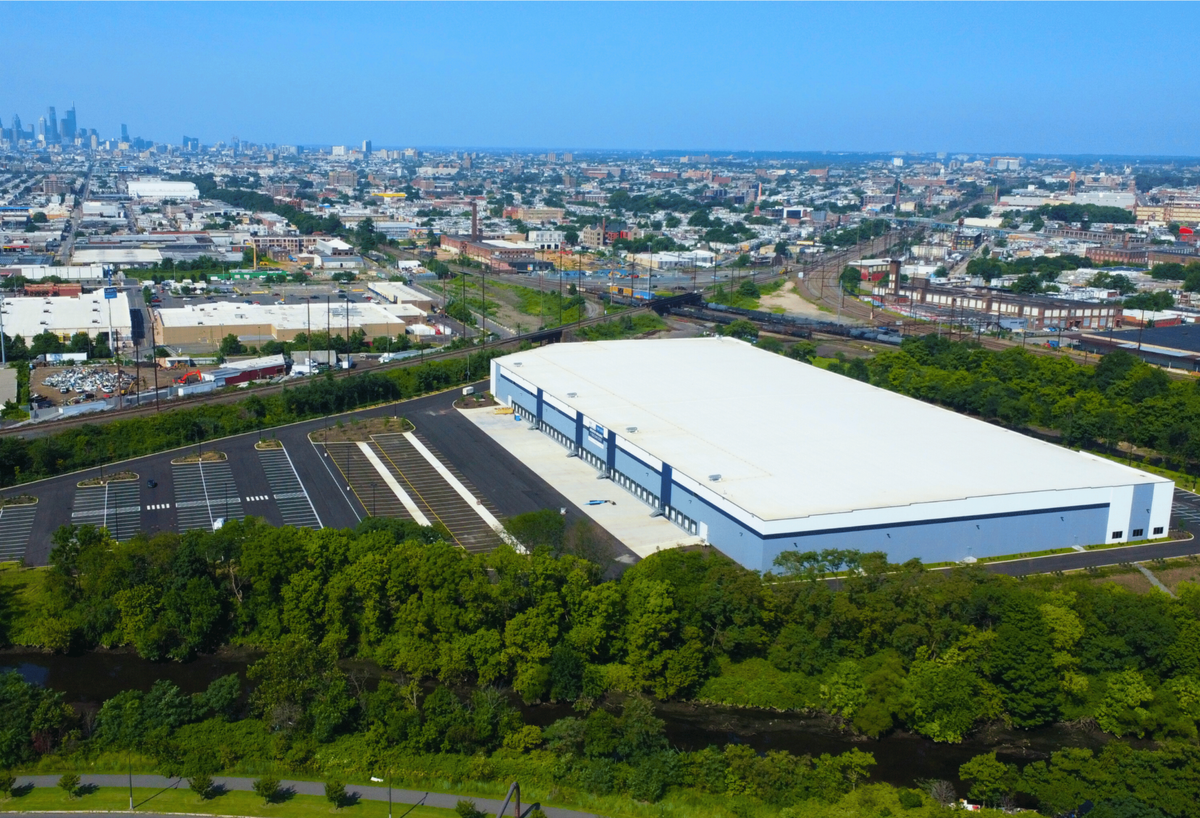
The post-pandemic industrial boom brought a wave of speculative big-box construction to Philadelphia proper, a market with little precedent for that type of product.
Owners are now breaking up those buildings to accommodate the smaller footprints of the tenants that actually want space in the city.

Courtesy of Greek Real Estate Partners
Greek Real Estate Partners’ warehouse at 2121 Wheatsheaf Lane
All of the five leases signed for speculative, newly built Philly warehouses between Q1 2025 and Q2 2026 were for demised spaces, according to data provided by Colliers Philadelphia Market Research Director Rosemary Penny.
These deals for subdivided space contributed to a 30-basis-point decrease in the city’s industrial vacancy rate, which fell to 11.9% last quarter, according to the brokerage’s latest report. That is still well above the 5% vacancy rate in late 2022, the era when many of the big spec projects were planned or under construction.
“There was a little bit of a lack of intelligence on what was the right product to build for this market,” KBC Advisors Industrial & Logistics Real Estate Adviser Brad Boone said of Philadelphia.
“The wrong-size buildings were built,” he added.
Philly had never fielded a large wave of new Class-A supply before the pandemic, and Boone said many developers saw the city as a “generic” big-box market ripe for the hulking warehouses cropping up nationwide.
Demand for those spaces wasn’t as durable as spec developers had projected during the pandemic-era e-commerce blitz, the broker said. Builders also didn’t account for the relatively small-footprint users that make up Philly’s long-term tenant base, Boone added.
Large users willing to fill big-box warehouses are hard to come by these days, especially as they increasingly prioritize the cheaper rents available outside the city, Greek Real Estate Partners Managing Partner David Greek said.
He completed a 287K SF warehouse at 2121 Wheatsheaf Lane in North Philly last year. The project received interest from three potential full-building tenants, he said. Two ended up opting for locations in the suburbs, and the third is still looking.
The long period of high vacancy has led many owners to pivot toward multitenant lease-ups, Colliers Vice President Adam Gorodesky said.
“Maybe it’s not the most functional. Maybe it’s not their first choice. Maybe it’s not what they or their lenders would have preferred,” he said. “But given how long some of these buildings have sat vacant and where demand stands at the moment, they’re willing to make it work.”
Kadima Industrial Partners generated more demand for its 759K SF, two-building industrial complex at 5000 Richmond St. in Bridesburg earlier this year by pivoting to a multitenant plan.
The building is now 71% occupied after three tenants signed on in the first quarter. Wholesale electronics distributor Virkin took 287K SF, and Savannah River Fulfillment and Port City Logistics each took just under 125K SF.
“Over the course of the last 12 months, that has materially picked up,” Kadima Head of Acquisitions Ariel Tambor said of leasing velocity. “Especially once we were open to dividing the spaces and getting creative with tenants in terms of lease terms.”
Like most big-box developers, Kadima was hoping to secure full-building tenants when the project delivered last year. The firm’s pivot away from that goal came with trade-offs.
“It’s always hard to make that first decision to demise a space because you’re spending the dollars, and then you’re still going to end up with vacancy,” Tambor said.
In addition to the cost of the wall itself, he said Kadima had to construct additional office spaces and bathrooms for the new tenants as well as welcoming thresholds where workers can enter and exit.
Kadima is now pursuing a similar repositioning plan across town as it seeks to lease up a fully vacant, newly built 280K SF warehouse at 3060 S. 61st St. in Southwest Philadelphia.

Kadima Industrial Partners’ industrial property at 5000 Richmond St.
Other industrial owners in the city are making the same pivot.
GREP is now advertising 2121 Wheatsheaf with a series of potential demising plans, including one that would split the building roughly in half.
Greek estimated that it would cost about $2M to build the wall needed for that. The other major expense he foresaw was splitting the building’s utilities. Otherwise, the developer aims to offload those expenses onto his tenants.
GREP underwrote the possibility of splitting the building twice when buying the lot in 2023.
“We’re not in trouble because we planned for this up-front, but there’s certainly instances of other developers across Pennsylvania who didn’t leave that flexibility in their budgeting and are struggling right now,” Greek said of the region’s elevated vacancy.
“One of the main themes that emerges is the buildings themselves were not built in a way that allowed the owners to subdivide them,” he added.
While some of the ability to demise is dependent on entrances and loading dock placement, Greek said owners also must make sure neighboring tenants don’t have needs that conflict.
Errant noises and smells and the rigid parking requirements some users have are complications that often arise with multitenant leasing, Greek said.
And even if an owner manages to match neighboring occupants, he said it is possible a lender will refuse to sign off on the plan.
The trend of demising industrial spaces isn’t unique to Philadelphia proper.
Across the 38 leases signed in spec buildings regionwide between Q1 2025 and Q2 2026, Penny found that 55% were for demised spaces. This accounted for 37% of all the square footage leased over that period.
It is common at the national level as well.
Roughly 70% of industrial leases nationally for buildings larger than 500K SF were in multitenant properties between 2023 and last quarter, which was up from about 60% between 2018 and 2022, according to data provided by CoStar National Director of U.S. Industrial Analytics Juan Arias.
But he added that demised spaces in greater Philly are still leasing to tenants that are abnormally large for the market, which is currently defined by strong demand for shallow bay.
Multitenant properties above 500K SF have leased to tenants with an average size of 176K SF, while those between 100K SF and 500K SF lease to 54K SF users on average.
“These properties are still targeting larger tenants, and are unable to subdivide spaces small enough for where most of the new lease activity is happening: small bay spaces below 20K SF,” Arias said in an emailed statement.
“It is hard for these larger properties to compete for smaller tenants who are also looking for proximity to end consumers, basically higher CRE density nearby, which is mainly achieved by leasing an older, in-fill location, rather than leasing space in a newer/larger box,” he added.