1 Reason I Haven’t Bought Figma and Don’t See a Scenario Where I Ever Will

The premise is clever enough. Figma (FIG +6.32%) lets members of a team working from different computers — even working in different locations — design, edit, and even test user interfaces for mobile apps, websites, and slide decks. Clearly there’s demand for such digital tools.
There’s also a significant challenge this company’s business, however, that will never go away. Indeed, the more Figma’s business grows, the bigger this challenge gets.
Nothing to stop competitors from stepping up
Online collaboration tools aren’t exactly new, or unique. Platforms like Slack, Dropbox, Microsoft Teams, and Monday.com (just to name a few) are in this category.
To its credit, however, Figma is different than most of them in that it facilitates the simultaneous co-development of a visual interface, allowing team members to create and make changes to an app’s interface or website design. As of March, the company was serving over 15,000 customers paying at least $10,000 per year for access to this technology, and serving over 1,500 paying customers worth more than $100,000 in annual revenue. Both numbers were well up year over year, extending existing trends.

Image source: Getty Images.
It’s not the only name in the visual collaboration business, though. While they’re not household names, platforms like Penpot, Uizard, Adobe‘s XD, UXPin, and Sketch — again just to name a few (many of which are free) — are growing their user bases as well.
Perhaps the greater threat, though, is growing interest in the visual prototyping space from bigger and better-funded players like Google, or the aforementioned Microsoft. Both are among the many that could build their own alternative, or simply acquire a third-party provider and integrate that solution into their existing suite of office productivity software.
See, there’s no copyright or patent protection of a mere idea for what software is supposed to do, or how it does it — anybody can push their way deep into this business. Eventually, somebody’s going to do so. It’s already happening, in fact, with the help of artificial intelligence-coded solutions.
Fiscal results are moving in the wrong direction
Then there’s the other thing. That’s the fact that while Figma may be growing its customer head count as well as its revenue, it’s spending a fortune to do so.
The chart below tells the tale. Although erratic, generally speaking, the company’s losses are getting bigger as it grows, largely due to soaring spending on research and development (R&D), sales and marketing, and general and administrative costs. After being commercialized for a decade, one would expect this heavy degree of profit-destroying spending to be in the rearview mirror.
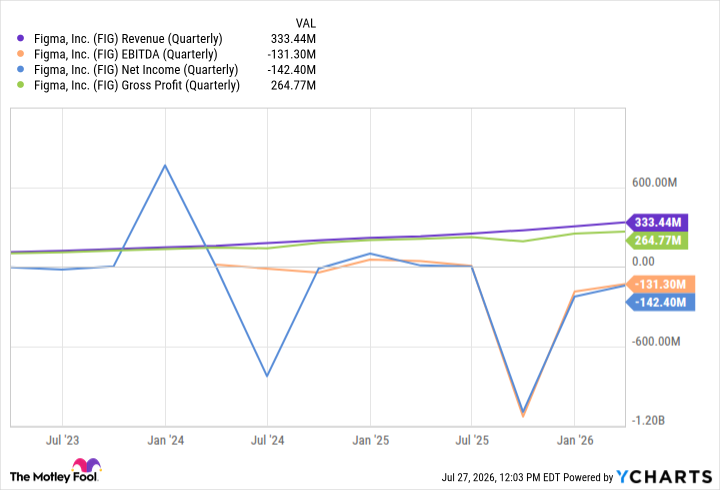
FIG Revenue (Quarterly) data by YCharts
This may or may not always be the case. As it stands right now, however, it’s arguable that the company is simply buying more growth than it’s actually winning or earning with its existing portfolio of products. It remains to be seen if Figma can compete cost-effectively.
Just too much risk right now
None of this is to suggest Figma can’t or won’t push through these challenges. Anything’s possible. There seems to be too much risk, though, and not enough assurance of an adequate reward for taking that risk. I’d pick many other stocks over this one for the foreseeable future, waiting for proof that this business can actually be reliably profitable.