Inherited shares, mutual funds or bonds? NRIs should follow these steps to claim them in India
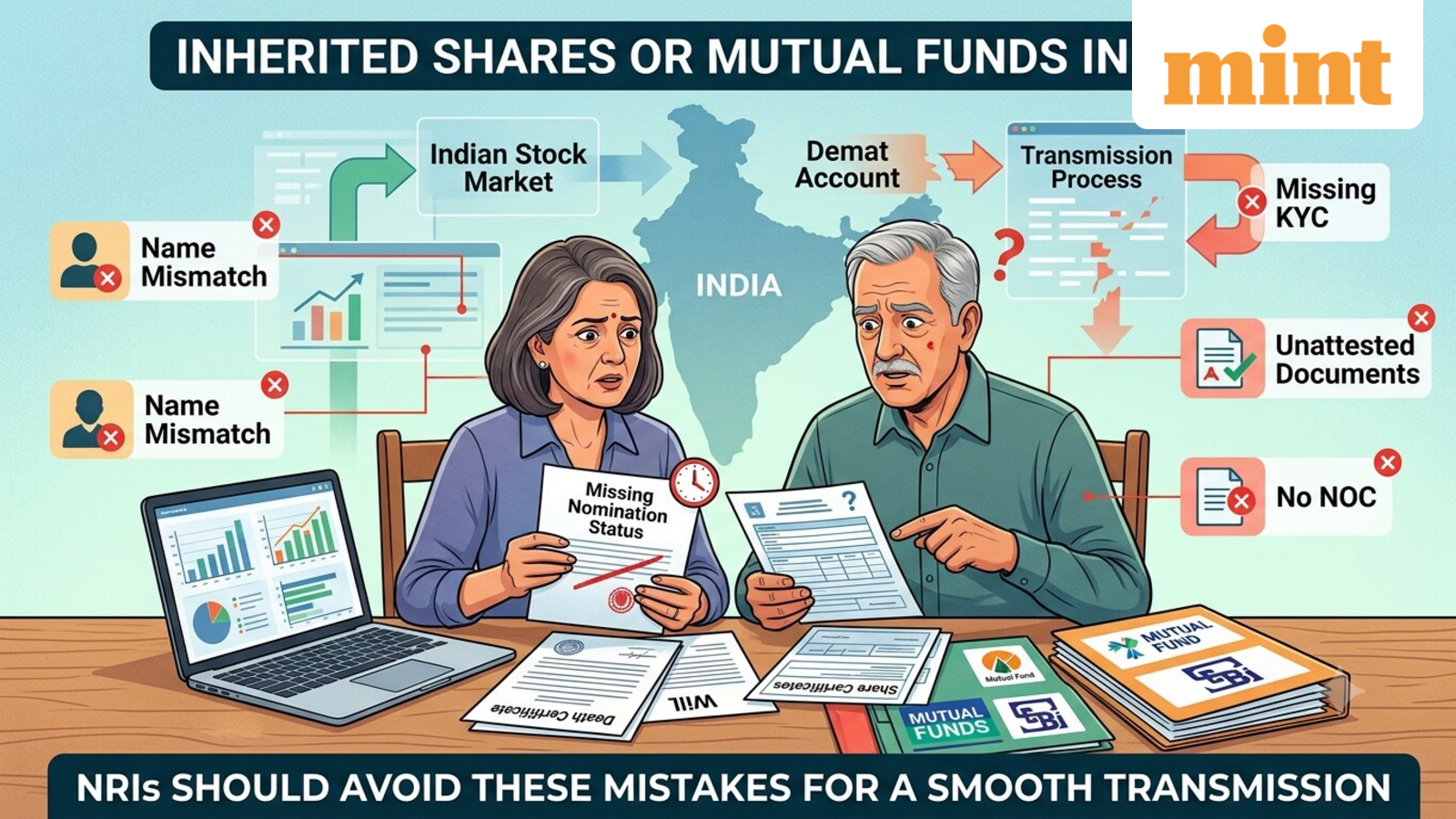
When a family member passes away, inheriting financial assets such as shares, mutual funds and bonds can be emotionally overwhelming, especially for non-resident Indians (NRIs). While inheritance itself may seem straightforward, the transmission process often gets delayed because of missing documents, outdated nominations or paperwork errors.
Experts say the process has become simpler following the Securities and Exchange Board of India’s (SEBI) latest transmission framework, but NRIs still need to complete several procedural steps before they can claim or sell inherited investments.
Start by identifying all investments and checking the nomination
The first step is to identify every financial asset left behind, including demat accounts, mutual fund folios and bond holdings. A Consolidated Account Statement (CAS) can help locate most investments, while physical share certificates and bond documents should also be traced.
“Before approaching any registrar or mutual fund, the NRI heir should collect the death certificate and verify whether a nomination exists for each folio or demat account,” said Abhishek Mishra, Director, SKG Investments and Advisory.
Checking the nomination status is critical because it determines the documentation required. Where a valid nominee exists, transmission is generally much simpler than cases where assets pass through a Will or intestate succession.
Shraddha Nileshwar, Head of Will & Estate Planning at 1 Finance, said NRIs should also obtain multiple certified copies of the death certificate and have them notarised, as several financial institutions ask for original or notarised copies during transmission.
If the heir is living overseas, appointing a trusted representative in India through a notarised and apostilled Power of Attorney (PoA) can help complete formalities locally.
Transmission timelines vary, but paperwork is often the biggest hurdle
Transmission timelines differ depending on the asset type and whether a nominee has been registered.
According to Nileshwar, mutual funds with a nominee are generally transmitted within 7-15 working days, while listed shares in demat form typically take 15-30 working days. However, where there is no nominee and transmission is based on a Will or succession certificate, the process can extend from two months to six months or even longer in complex cases.
Mishra pointed out that SEBI’s new transmission framework, introduced on 23 July 2026, aims to simplify and standardise the process across listed companies, registrars, depositories and mutual funds. Under the revised framework, transmission requests are expected to be processed within 21 calendar days once all required documents are submitted.
However, he cautioned that regulatory timelines are rarely the main bottleneck for NRIs.
“The real delay usually comes from overseas documentation, including apostille requirements, embassy attestation and courier timelines, rather than the regulator’s processing window,” he said.
Simple mistakes can delay transmission by months
Experts say incomplete or inconsistent documentation remains the biggest reason for delays.
One of the most common issues is a mismatch in names across PAN, demat accounts, mutual fund folios and death certificates. Even minor variations can lead to repeated document requests.
Other frequent hurdles include:
- Missing or outdated KYC records
- Unattested foreign documents
- Signature mismatches
- Missing No-Objection Certificates (NOCs) from other legal heirs
- Lost physical share certificates
- Delays in obtaining succession certificates where no nominee or valid Will exists
For NRIs, foreign documents generally need notarisation and apostille before they are accepted in India. Experts say many applications are rejected simply because documents were self-attested when notarisation or apostille was required.
A Will helps, but nomination is equally important
A registered Will can significantly reduce disputes among legal heirs and provides greater clarity on the deceased’s intentions. However, experts say it should not be seen as a substitute for maintaining updated nominations across financial accounts.
Nileshwar said some institutions continue to seek additional documentation for higher-value estates even where a registered Will exists, although SEBI’s latest framework has eased several procedural requirements.
Mishra noted that SEBI has removed the mandatory requirement of probate for transmission under its revised framework, making the process easier than before.
Still, from a practical standpoint, an updated nominee often enables faster transmission than relying solely on a Will.
Experts therefore recommend that investors maintain both a registered Will and updated nominations across demat accounts, mutual funds and other financial assets. This combination can significantly reduce paperwork and help NRI heirs access inherited investments with fewer delays.