Banks Turn $5.3 Million Wires Into Strategic Assets
Wire payments are starting to look less like back-office plumbing and more like a competitive tool for banks.
That shift anchors “Rewiring Wires: Modernizing CHIPS and Fedwire for a New Era of Demand,” a May report from PYMNTS Intelligence and Volante Technologies. The report finds that financial institutions are upgrading the systems that move large, time-sensitive payments as clients seek faster processing, better information and more dependable service. Modern platforms can also help banks connect Clearing House Interbank Payments System (CHIPS) and Fedwire with treasury tools and other payment rails, giving them a clearer view of how money moves.
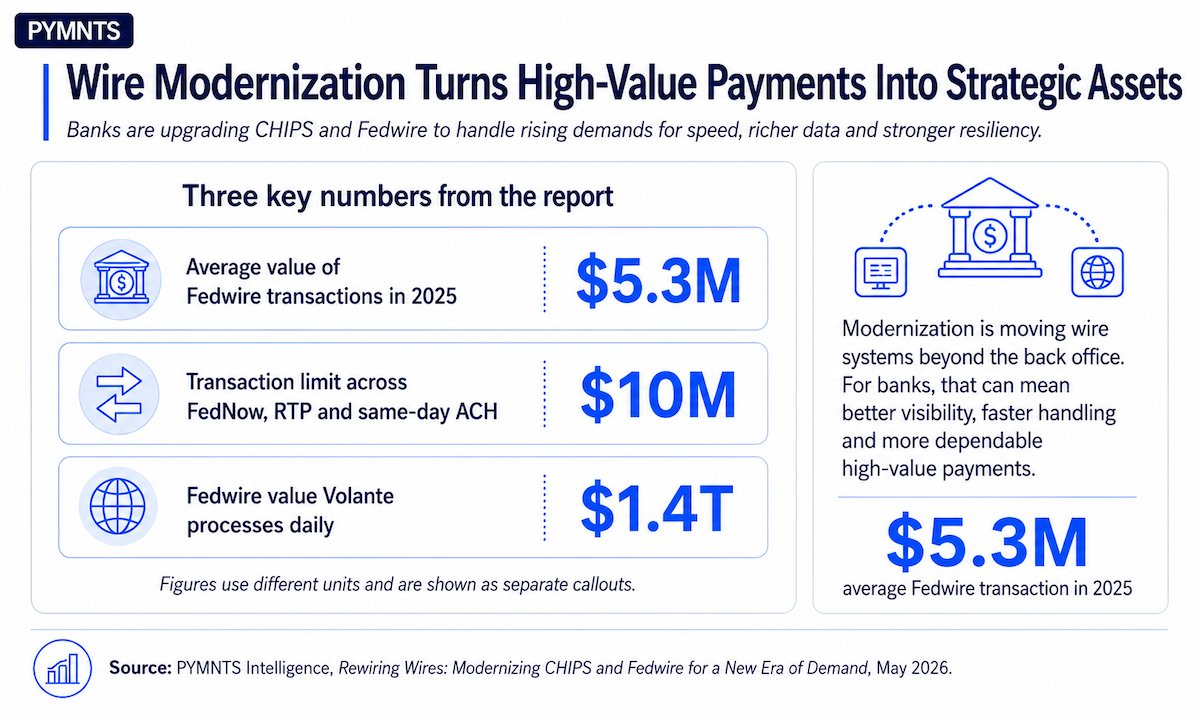
- $5.3 million: The average value of a Fedwire transaction in 2025. That scale raises the cost of delays, errors and outages while increasing the value of stronger monitoring and automation.
- $10 million: The transaction limit now available across the FedNow® Service, the RTP® network and same-day ACH. Higher limits are bringing more payment rails into the market for time-sensitive transfers and pushing banks to improve how they choose and manage each route.
- $1.4 trillion: The approximate value of Fedwire payments that Volante processes each day. The figure illustrates the operating demands placed on systems that financial institutions and their clients rely on for critical transfers.
The report’s third finding carries the most encouraging message. Modernization can turn wire infrastructure into a strategic asset rather than a system banks maintain mainly because they must. Cloud-based platforms can scale processing capacity, while automated workflows can reduce manual work and speed the handling of payment exceptions. Application programming interfaces (APIs) can link wire systems with liquidity tools, treasury platforms and wider payment networks.
ISO 20022 also gives banks more structured payment information. Institutions can use that data to improve compliance checks, manage liquidity and give clients better visibility into transactions. In that sense, the new infrastructure works like a control tower, helping banks see several payment routes and direct traffic with more precision.
The transition still brings costs and operational risks. Many banks rely on aging systems, manual workarounds and separate platforms for CHIPS and Fedwire. Data conversion errors can delay payments and business email compromise attacks continue to target high-value transfers.
Still, the report outlines a practical route forward. Banks can adopt cloud-based infrastructure, build systems that handle ISO 20022 data, spread workloads across multiple cloud providers and use APIs to connect payment platforms. Together, those steps can make wire payments more reliable, transparent and useful to clients while helping institutions compete in a faster payments market.
At PYMNTS Intelligence, we work with businesses to uncover insights that fuel intelligent, data-driven discussions on changing customer expectations, a more connected economy and the strategic shifts necessary to achieve outcomes. With rigorous research methodologies and unwavering commitment to objective quality, we offer trusted data to grow your business. As our partner, you’ll have access to our diverse team of PhDs, researchers, data analysts, number crunchers, subject matter veterans and editorial experts.