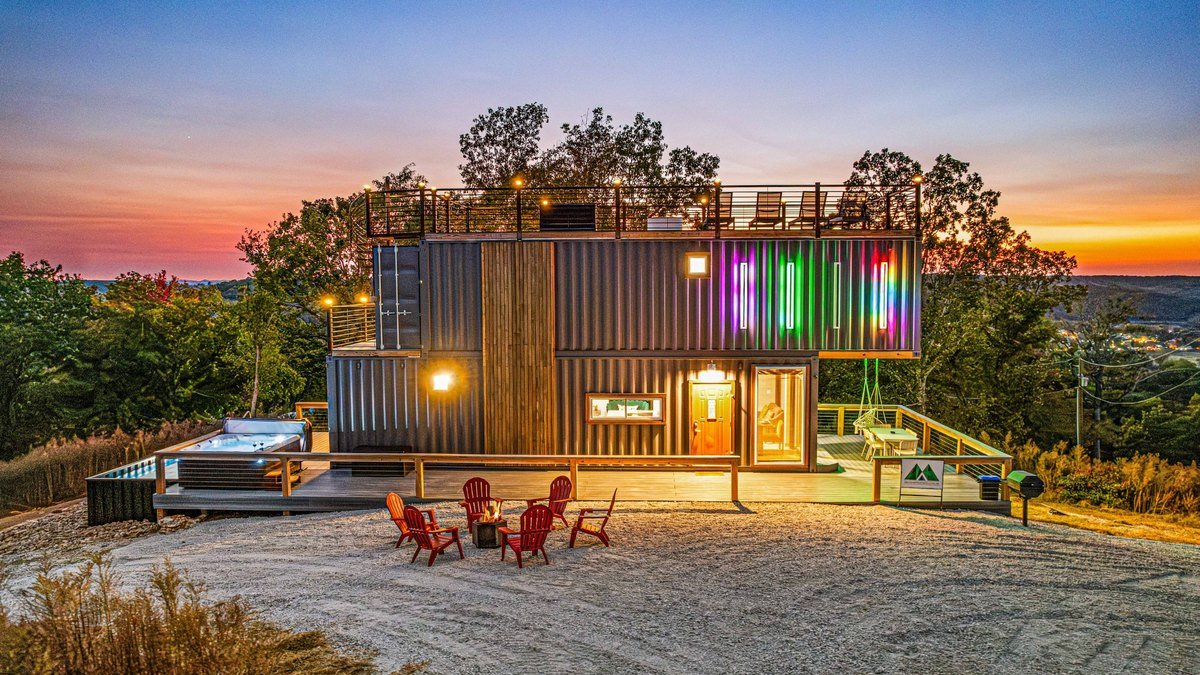
I Built a Container Home on a Clifftop—and It’s For Sale
When Airbnb made a big push to promote homes that fit within unique categories—caves, treehouses, windmills—investor Ryan Duffy, 41, knew he had to capitalize on the moment.
He didn’t have a cave or the right spot to build a treehouse at the time—but a container house seemed most within reach.
He already owned half an acre 20 minutes outside Branson, MO, in Lake View, AR. It overlooked Table Rock Lake–but even more important was that the land was unrestricted. He could build anything, so long as it complied with septic regulations.
And that’s exactly what he did.
Thinking inside the box
In February 2022, he started.
It took seven months to build the 1,300-square-foot, three-bedroom, three-bathroom home in the steel container.
The total cost was $300,000, not including the pool, added later. At $260 per square foot, the build was not any cheaper than traditional construction. In fact, Duffy, who worked in construction, was building homes closer to $160 a foot in that area.
“People are assuming container home builds will be cheaper—it’s already framed in, so they think you just drop in the containers and cut doors and windows,” he says.
Not so. Steel is notorious for very quickly transferring heat. That means to have a more stable interior temperature in the home, the exterior walls have to be framed out to allow for the installation of insulation.
Furthermore, post construction, there’s the issue that container homes can’t easily be appraised—at least not yet.
“There was nothing in the area to comp it to,” explains Duffy, who is also a real estate agent and the co-owner of Ozark Mountain realty group.
He learned this the hard way when he was trying to get a construction loan to cover the build costs. When that didn’t work, he took out a line of credit against one of his other properties—Duffy had been investing in short-term rental properties since 2019—and maxed out his credit cards.
The reality of living in a box
As the build neared completion, a friend expressed interest in partnering on the deal. That friend had found a bank offering a typical residential-home mortgage on the container house, which would allow Duffy to pull out most of his initial investment upon completion.
But then the market adjusted. Duffy’s friend called. His bank just phoned. They had changed their minds, deciding the house was “too risky of an asset.”
“It was a pretty big kick in the teeth,” Duffy says.
He was eight weeks away from the project completion, and two weeks after that, his line of credit was due in full. His friend still wanted in, and had $100,000 cash to invest. They found a third partner who brought $200,000. Duffy had bought the land for $80,000 and contributed his time building.
The home has proven to be a solid investment. In 2025, it grossed $100,000 on Airbnb. In July, some nights fetched more than $900. Renters are drawn to the home for the same reason Duffy liked the idea of a container home: “weirdness.”
That and the view of the lake.
A one-time deal
But is it a project he would do again?
“Definitely not,” he says. The cost is too high. And the idiosyncrasies are many. The steel, even after being properly insulated, still runs up an electricity bill twice that of a stick-built home.
Then there’s the noise.
“When the wind was blowing just right, it would cause railings to vibrate–and it would sound like a bass boat going right next to your head. People couldn’t sleep because it was so loud.”
Cleverly installed zip-ties fixed that issue.
Metal construction also calls for certain considerations.
After Duffy built this, a few other container houses popped up in Branson. With his background in construction, he knew to weld steel to create openings for the doors and windows. These new homes used wood to frame the doors and windows.
“If you’re not intentional about how you design them, there is a high potential for leaks to develop,” he says. “Wood and metal expand and contract at different rates.” In the other homes, water is entering through those openings.
Quirks aside, the home has remained a popular rental the last three years on Airbnb. “We get a lot of positive feedback,” Duffy says.
But as with many builders, he is ready for a new project. This container home, at the time this story runs, is for sale. That same drive and curiosity that led Duffy to build a container home is the same force compelling him to explore what’s next.
Get real estate news in your inbox