EU fines today, Trump 301 tariffs tomorrow?
Pres. Trump is on TruthSocial saying:
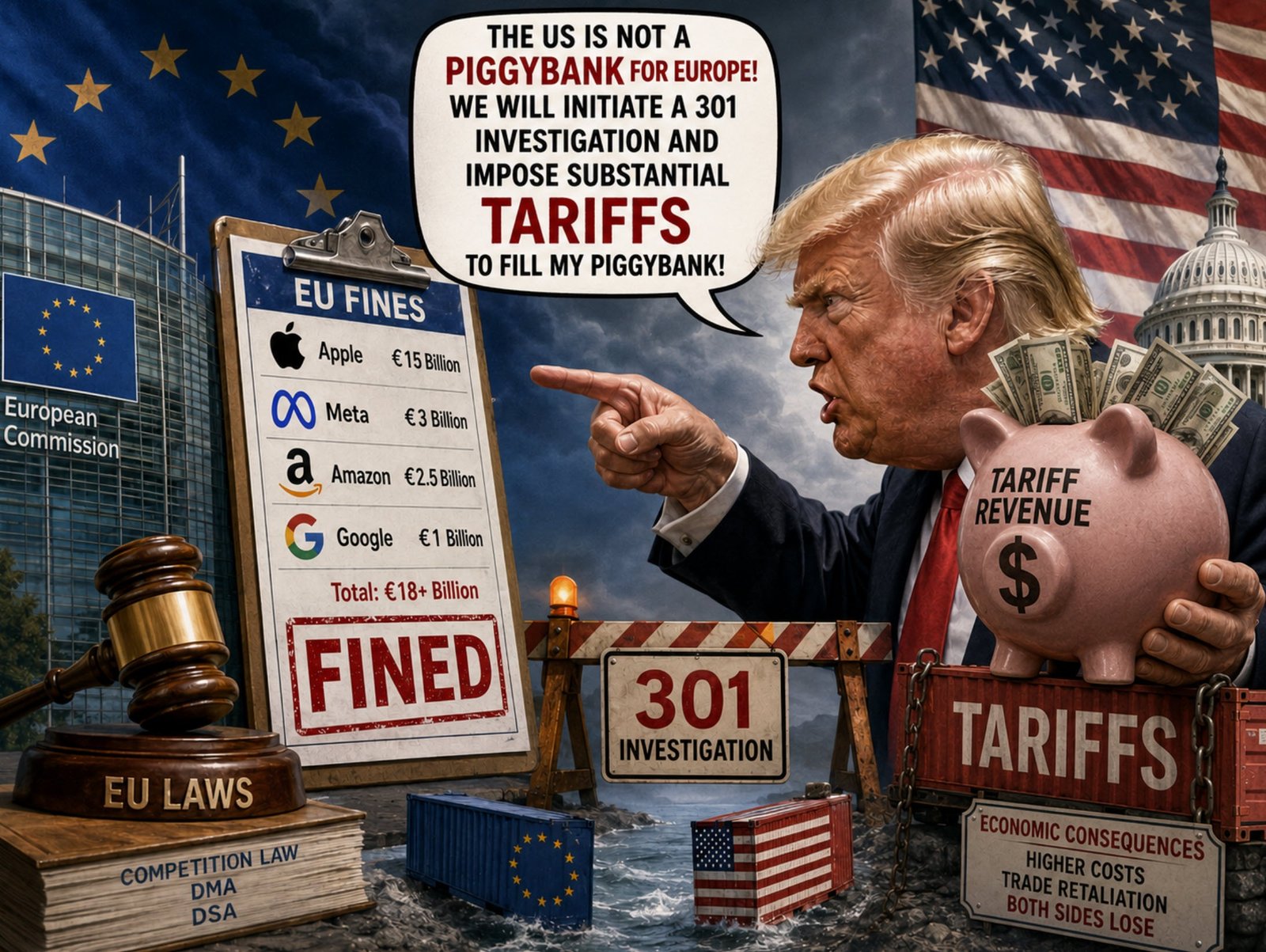
“The European Union is at it again and, as usual, taking direct aim at GREAT American Companies! After having fined Apple, for no reason at all, 15 Billion Dollars, Meta, 3 Billion Dollars, Amazon 2.5 Billion Dollars, and many others, we have just been informed that Google, a truly advanced and amazing group, has been fined yet another 1 Billion Dollars, without explanation. This brings the Google total to over 18 Billion Dollars! This illegal and highly discriminatory practice started at these high levels during the first year of the Sleepy Joe Biden Administration, but it’s not going to continue during the Trump Administration. The United States of America is not a “PIGGYBANK” for Europe, nor will we allow it to be! Please let this TRUTH serve to represent that we will immediately initiate a 301 Investigation into the practice of “ROBBING” American Companies and, in turn, the American Taxpayer. The European Union will pay a very big price for this illegal and highly unethical conduct, which I have consistently warned them about. The penalties will be entirely reversed and, we anticipate, a substantial TARIFF to be placed on them at the earliest possible moment. Stay tuned! President DONALD J. TRUMP”
Does the EU have the authority to fine US companies the way they do?
Yes. The European Union does have the legal authority to investigate and fine companies—including U.S. technology firms—if they are found to have violated EU laws while operating in the EU.
The European Commission derives this authority from several legal frameworks, including:
- EU Competition Law (Antitrust): The Commission can fine companies for abusing a dominant market position, engaging in anti-competitive practices, or participating in cartels. Fines can be as high as 10% of a company’s global annual revenue.
- Digital Markets Act (DMA): Applies to designated “gatekeeper” companies such as Apple, Google, Meta, Amazon, Microsoft, and ByteDance. It imposes rules aimed at promoting competition in digital markets. Violations can also result in fines of up to 10% of worldwide annual turnover, rising to 20% for repeat offenses.
- Digital Services Act (DSA): Governs online platforms’ responsibilities for content moderation, transparency, and user safety, with fines of up to 6% of global annual revenue.
The companies are subject to these laws because they conduct business within the EU and serve EU consumers.
The United States, however, has long argued that many of these investigations disproportionately target American technology companies. Critics—including President Trump in the post you shared—contend that the fines amount to unfair treatment or a form of economic protectionism. EU officials reject that characterization, maintaining that the rules apply equally to any company that meets the legal criteria, regardless of where it is headquartered.
So there are two separate issues:
- Legal authority: Yes, the EU clearly has the authority under its laws to investigate and fine companies operating in its market.
- Policy debate: Whether those fines are fair, consistently applied, or disproportionately affect U.S. firms is a matter of ongoing political and legal dispute between the U.S. and the EU.
On the otherside, is that if that the EU could replicate some of the companies. They just haven’t because it is a daunting task. Why should the US companies be penalized because the EU companies don’t want to play the game?
How long does the legal process last.
A typical timeline looks like this:
- European Commission decision: The Commission investigates (often for 2–5 years) and issues a fine.
- Appeal to the EU General Court: Companies almost always appeal. It typically takes 2–4 years for the court to issue a ruling.
- Further appeal to the European Court of Justice (ECJ): If either side appeals on points of law, this can add 1–2 more years.
In total, it is not unusual for a case to take 5–8 years from the start of an investigation to a final judgment.
Trump’s latest response links the EU’s fines on U.S. companies to the prospect of new tariffs on European imports.
That raises an interesting question: Is the primary objective of Trump to protect American companies from what he views as unfair treatment, or is it to use fines as a means to collect tariffs on EU goods – filling the government coffers.
Now, by threatening tariffs, the administration appears to be signaling that there could be economic consequences if the EU continues imposing large penalties on U.S. firms. Will the EU be swayed to avoid the tariffs?
What we do know is Trump would like any excuse to reimpose the tariff flow.