5 Key Takeaways From Elon Musk’s Latest Interview
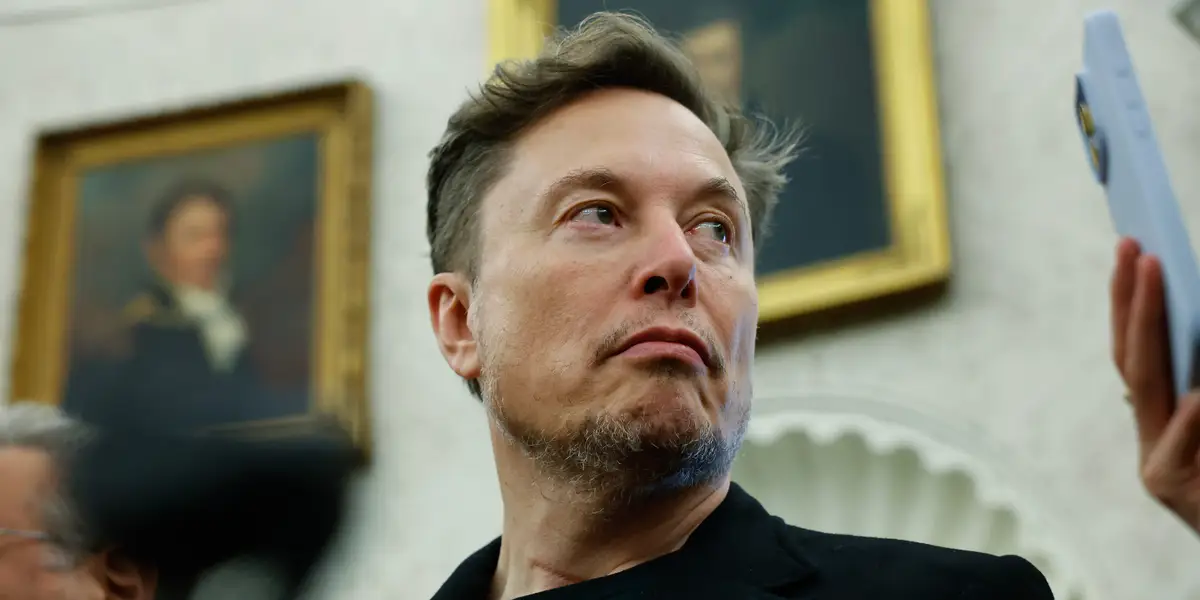
Elon Musk sat down with The Economist’s editor in chief Zanny Minton Beddoes on Thursday for a wide-ranging interview, covering everything from superintelligent AI to his controversial stint in government.
Musk, the world’s richest person, is the CEO of Tesla and SpaceX and owns the social media platform X, where he has roughly 250 million followers. He also runs xAI, his artificial intelligence startup, putting him at the center of the AI race he discussed at length.
Here are the five biggest takeaways from the 90-minute interview:
1. Musk thinks AI will surpass the sum of human intelligence within roughly 5 years
Musk said AI may exceed humanity’s collective intelligence “in around five years,” adding that soon, “there really won’t be anything that AI can’t do better than humans, apart from being human, perhaps.”
He painted a utopian picture of what comes next: an “age of amazing abundance” where “anyone can have anything they can think of.”
However, he was less reassuring on who will be in charge, comparing the coming intelligence gap to the one between humans and chimpanzees: “It’s hard to imagine that the chimpanzee would be in charge.”
2. He’s made peace with an AI risk he can’t stop
Musk has previously put the odds of AI wiping out humanity at 10% to 20%, and he didn’t walk that back. What’s changed is his attitude: he said he’d reached a “philosophical conclusion” to look on the bright side, because the momentum behind AI and robotics is now unstoppable.
“Let’s enjoy the ride, is my philosophy at this point,” he said, suggesting that even if a stop button existed, “we probably shouldn’t press it.”
He also said, with some irony, that his own attempts to steer AI safely, including co-founding OpenAI, which Anthropic later spun out of, mostly accelerated the technology. His conclusion: “You can’t beat ’em? Join ’em.”
3. He admits he got ‘carried away’ with politics
“I think I got a little too involved in politics, got carried away, frankly,” Musk said, in one of the interview’s more reflective moments.
Musk donated heavily to Trump’s 2024 reelection campaign and took a prominent role in the early months of the administration, spearheading the Department of Government Efficiency. He later fell out with Trump over the president’s Big Beautiful Bill.
In the interview, Musk defended the underlying aim of his DOGE work: tackling a deficit so large, he said, that interest payments on the debt now exceed US defense and intelligence spending combined.
The goal, he argued, was to make sure money wasn’t being “wasted or spent on fraudulent activities,” though he said he “got a lot of flak” for it.
4. He wants rival AI labs to police each other, despite the personal feuds
Musk proposed that leading AI companies hold safety calls every few weeks and review each other’s new models before release, arguing competitors are better placed than governments to spot problems.
Minton Beddoes said she keeps hearing that a system needs to be in place within six months. Musk said that “six months is a long time,” given the pace of breakthroughs.
Getting there would mean papering over some deep rifts. Musk repeated his grievance that OpenAI, which he cofounded as a nonprofit, became an $800 billion, closed-source, for-profit company. He also renewed his long-standing criticisms of fellow founder Sam Altman, with whom he has spent much of the past two years locked in a legal battle.
He praised Anthropic’s Dario Amodei, who left OpenAI to found the company, as “a very principled person.”
If it comes to it, he said, they’ll “set aside our personal differences for the good of the world.”
5. He continues to insist that ‘zero’ people died from USAID cuts
Musk flatly denied that the aid cuts presided over by his short-lived Department of Government Efficiency cost lives. Asked whether children in Africa died because funding was pulled so suddenly, he was emphatic: “Zero,” later repeating “0.0”
He argued that philanthropic organizations like the Gates Foundation and MacKenzie Scott’s Yield Giving could have stepped in — and if they didn’t, “they’re equally responsible” — and dismissed reports of deaths as being from “fraudulent organizations” seeking restored funding.
Minton Beddoes pushed back, saying the pace of the cuts “will almost certainly have caused unnecessary suffering and deaths.”
Watch the full exchange here: