Bank OZK Continues To Cut Real Estate Portfolio

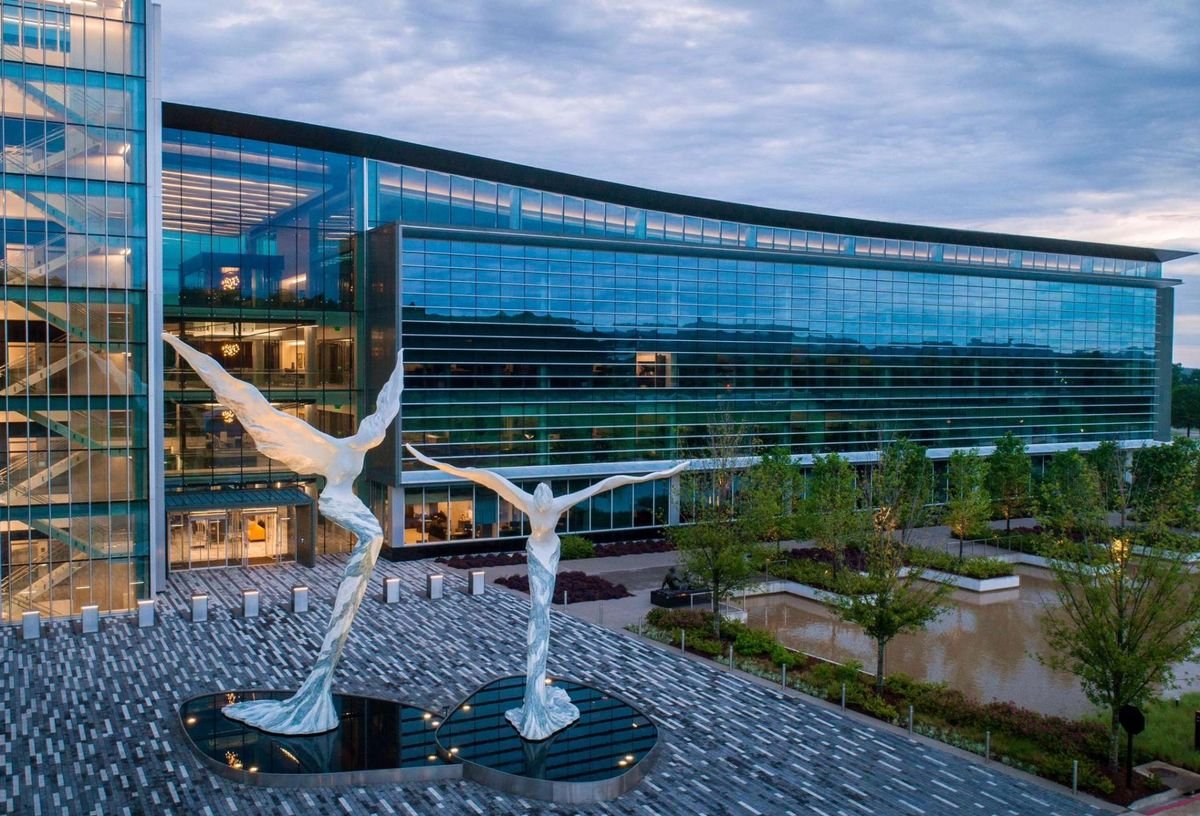
The Arkansas headquarters for Bank OZK
One of the largest construction lenders in the U.S. is still shrinking its real estate portfolio, according to second-quarter earnings results.
Bank OZK‘s real estate exposure fell to 47% of its overall loan book in the second quarter, down from 52% in the first quarter and well below its historical average as it follows its December game plan of cutting nonperforming real estate assets.
The bank originated $1B in real estate loans in the second quarter, roughly the same amount as the previous quarter. It was the slowest second quarter for originations for the bank in five years, following the slowest first quarter in that time frame.
Bank OZK previously said it intended to lend roughly $5B to real estate in 2026.
According to the bank, part of the slowdown is because sponsors are having trouble raising equity for new construction projects due to macro uncertainty. One headwind plaguing development is material prices remaining high due to tariffs.
While the country’s overall construction pipeline is improving, it’s mainly due to data center projects. Bank OZK’s real estate portfolio largely consists of multifamily, residential, mixed-use, industrial, office and life sciences assets.
Some projects are finding a way, however, such as Stonelake Capital Partners securing construction financing from Bank OZK in June to start construction of a 17-story spec office building in Dallas.
A surge in debt liquidity and “significant competition” for the deals that do secure equity have also dampened the bank’s ability to lend, it said.
But it is also intentionally continuing to slow. Looking forward, the bank said it hopes its real estate exposure will mirror corporate and institutional banking, which makes up 22.2% of its overall loan portfolio. It predicts this happening sometime next year.
Meanwhile, its book is still showing strain, and the bank expects CRE charge-offs to continue to increase. Charge-offs, which realize losses from bad loans, were 0.69% of its loan book in Q2, up from the previous quarter’s 0.57%. The bank recognized charge-offs on four real estate loans.
Nonperforming assets make up 1.42% of the bank’s portfolio, up from 1.08% in Q1 and double from 0.53% year-over-year. Four real estate loans are the bulk of them, making up 77 of the total 92 basis points for both past-due and nonperforming loans. One is in negotiations to be sold, another is on the way to recapitalization, and two are pending sales.
The bank foreclosed on six real estate properties, which are in the process of liquidation, in the second quarter. Half of them are office properties, located in Santa Monica, California, Seattle and Atlanta. Two are life sciences assets in Chicago and Seattle, and a Los Angeles land parcel is the final property.
On the other hand, Bank OZK’s level of real estate repayments was elevated, which was expected this quarter because of increased debt financing. It recorded $2.9B in loan repayments, up from $1.6B last quarter. Executives expect real estate repayments to remain high for at least the next year and a half.
Overall profit for Bank OZK was $163M, an 8.7% decrease year-over-year. This number is a 2.5% increase from $159M in the first quarter. Its income for the first half of 2026 fell 7% from the previous year to $322M.
While Bank OZK is still pulling back on real estate, its banking peers can’t say the same. For example, Goldman Sachs increased commercial real estate loans 21% year-over-year in the second quarter.
So far, that strategy has paid off, as JPMorgan Chase, Bank of America, Citigroup, Wells Fargo and Goldman Sachs blew analyst expectations out of the water in the second quarter. JPMorgan posted a 41% increase in profit to $21B in Q2. Bank of America’s net income also surged, with a 27% increase year-over-year due to artificial intelligence and data center CRE investment.