Historical Mortgage Rates: See Averages and Trends by Decade
Key Takeaways
- By historical standards, today’s mortgage rates are pretty on par with what homeowners have paid in the past. Since Freddie Mac began tracking rates in April 1971, the median 30-year mortgage rate is 7.23%.
- However, it’s still true that rates are high by modern standards, since the typical rate observed over the past decade is about 4.2%.
- Mortgage rates have been historic in their own right during the past few years. The average 30-year fixed rate reached an all-time record low of 2.65% in January 2021 before surging to 7.79% in October 2023.
Compared to the pandemic-era record lows observed just a few years ago, mortgage rates feel uncomfortably high. But when someone points out that mortgages are still painfully expensive right now, a well-seasoned homeowner is quick to chime in, “When I bought my first house in the ’80s, the interest rate was 13%.”
In fact, mortgage rates reached 18.63% in October 1981. Keep reading to learn more about how mortgage rates have changed over time, what moves interest rates and how these have impacted the housing market throughout history.

View today’s mortgage rates for a wide variety of products and find the best rates for your needs. Save thousands of dollars over the life of your loan.
Historical Mortgage Rates Chart
Historical Mortgage Rates by Decade
| Minimum Mortgage Rate | Maximum Mortgage Rate | Median Mortgage Rate | |
| 1971-1979 | 7.23% | 12.9% | 8.89% |
| 1980-1989 | 9.03% | 18.63% | 12.82% |
| 1990-1999 | 6.49% | 10.67% | 7.88% |
| 2000-2009 | 4.71% | 8.64% | 6.18% |
| 2010-2019 | 3.31% | 5.21% | 4.03% |
| 2020-Present | 2.65% | 7.79% | 6.30% |
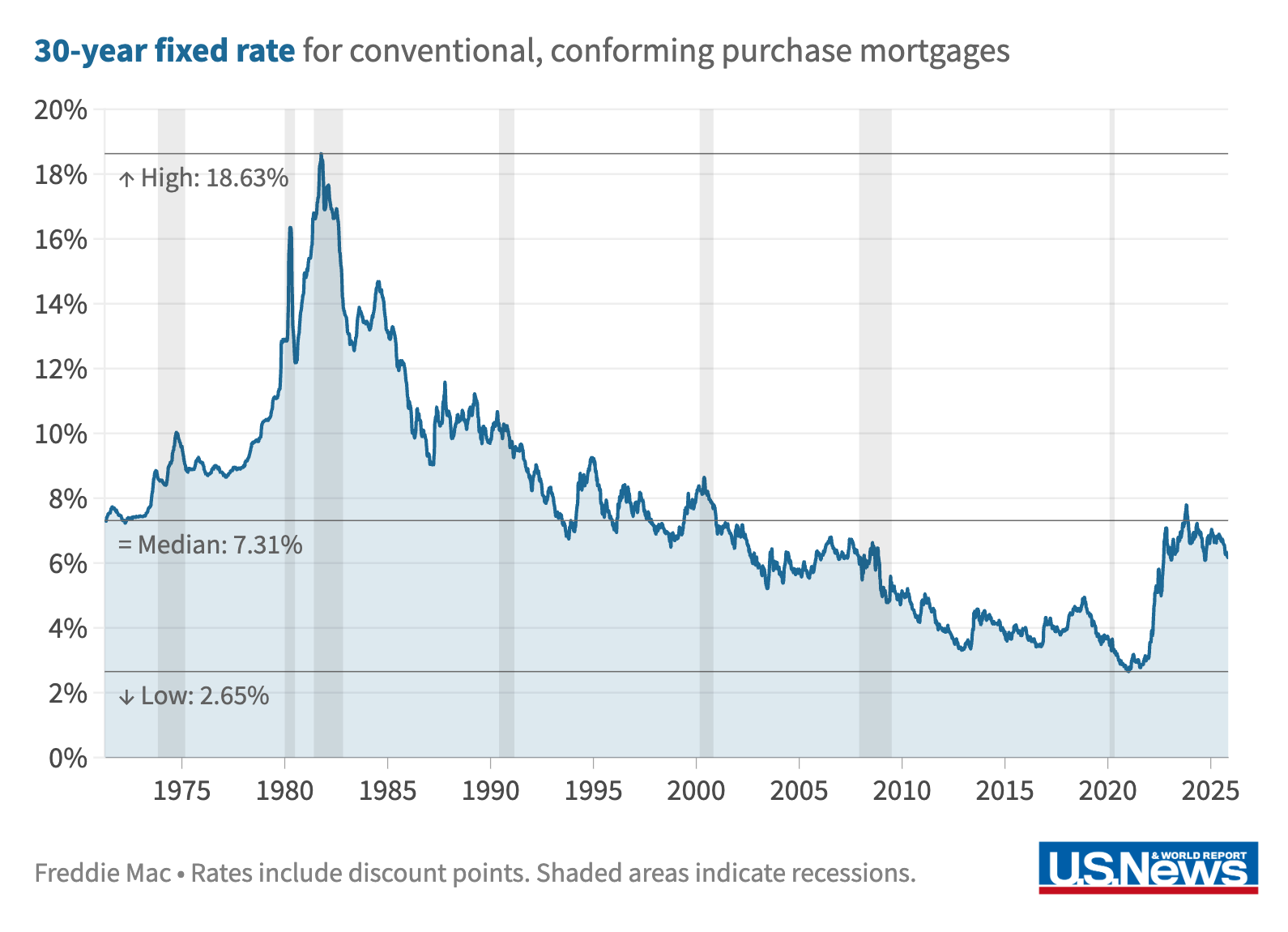
The graphic above shows how mortgage rates have fluctuated over the past five decades. It’s evident that while today’s mortgage rates are high compared with just a few years ago, they’re actually quite typical from a historical standpoint.
Of course, you can’t talk about the history of mortgage rates without comparing other metrics such as home prices and incomes. The median price for new single-family homes sold in the U.S. during 1981 – when mortgage rates reached record highs – was $68,900, according to Census Bureau data. That would be equivalent to more than $245,000 in today’s dollars, using the consumer price index inflation calculator. Meanwhile, the actual median new home sales price is $422,500 as of June 2026.
Compare Top Mortgage Lenders
The monthly mortgage principal and interest payment on a home at 1981 prices with an 18% mortgage rate would be $831, assuming a 20% down payment and using our mortgage calculator. On the other hand, a home at today’s prices and a 6.5% rate would come with a monthly P&I payment of $2,136.
But don’t forget to account for inflation: That $831 housing payment in 1981 would cost nearly $3,000 today.
Lastly, consider earnings versus housing expenses. The median household income in 1981 was $22,390 per the Census Bureau, and that salary would be equivalent to $79,832 today. The observed household income in the U.S. was $83,730 in 2024, according to the most recent census.
All told, housing affordability is fairly similar to what it was in the ’80s, but remember the context. Housing affordability was at record lows back then. So, next time you hear about how high mortgage rates were in 1981, keep in mind that homebuying conditions are just as challenging now – even though rates are much lower.
The average 30-year fixed mortgage rate reached an all-time record low of 2.65% in January 2021, according to Freddie Mac. Starting in March 2020, the Federal Reserve cut the effective benchmark rate to zero and purchased billions of dollars’ worth of mortgage-backed securities to stabilize the economy amid the COVID-19 pandemic. These actions resulted in historically low mortgage rates until early 2022, when the Fed began tightening its balance sheet and raising rates to combat inflation.
From 1971 to present, the highest average mortgage rate ever recorded was 18.63% in October 1981. Mortgage rates held steady above 18% in the two-month span between Sept. 10 and Nov. 12, 1981. That happened after the Fed raised rates into the double digits starting in 1980 to fight rampant inflation from the late 1970s. By July 1981, the federal funds effective rate exceeded 22%, lifting mortgage rates along with it.
It’s safe to say that the sub-3% mortgage rates observed during the COVID-19 pandemic were an anomaly. Besides the fact that the Fed held the benchmark rate at near-zero during much of that time, the central bank was also buying up billions’ worth of mortgage-backed securities. The Fed employed this strategy (called quantitative easing) to keep the U.S. economy afloat amid the pandemic, and it’s unlikely that policymakers will need to use this method again – of course, unless there’s another unforeseen financially catastrophic event. And you never know: The pandemic was unforeseen, after all.
How Mortgage Rates Impact the Housing Market
Mortgage rates aren’t the reason people move, but they can influence whether a first-time homebuyer can afford a home or whether homeowners decide to sell, refinance or stay put.
Lower mortgage interest rates translate to lower monthly housing payments, which can encourage homebuying. And the opposite is true: When rates are high, homebuying becomes more expensive, and some shoppers may simply be priced out. Here’s how that’s played out in previous years.
Explore Mortgage Rates
Get a personalized list of mortgage lenders within your location
Mortgage Rates and Home Prices
Historically, mortgage rates haven’t had an outsized impact on the housing market, at least not as much as other factors like seasonality or recessions in the U.S. economy – until recently.
Consider the housing market from the Great Recession to today. In the years following the 2008 housing bubble, the real estate market was injected with inventory from subprime foreclosures and home prices crashed. From its peak in late 2006 to the trough in early 2012, home prices declined by 27%, according to the Case-Shiller Home Price Index. Suffice to say, Americans were thinking more about property values than their mortgage rate.
Things stayed relatively uneventful in the housing market during most of the decade following the Great Recession. Mortgage rates hovered between 3.5% and 5.5% in the 2010s. By 2017, home values recovered from the damage sustained during the 2008 crash, and home price appreciation continued at a typical rate of a few percentage points per year. That is, until the COVID-19 pandemic ushered in an era of record-low mortgage rates.
With mortgage rates at 3% or even lower, more homebuyers could afford to enter the market in the early 2020s. Home sales picked up, but housing inventory was insufficient to keep up with demand. Decades of housing underproduction in the U.S. resulted in more homebuyers than homes for sale, fostering competition and driving home prices to levels unforeseen. From the start of the pandemic in March 2020 until the Federal Reserve began hiking rates in March 2022, home prices rose 37%, according to Case-Shiller.
In late 2022, home sales activity came to an abrupt halt when mortgage rates climbed from about 3% to above 7% in a matter of months. Buyers are still facing higher mortgage rates than they’ve seen in recent memory – on top of that, home prices are still staying stubbornly high after the pandemic housing boom. For many, especially first-time homebuyers who lack tappable equity, monthly mortgage payments have become unaffordable at these new interest rates.
The housing market is in a mortgage rate stalemate: Homebuyers are priced out, and homeowners are reluctant to sell and trade in their low mortgage rates.
Mortgage Rates and Refinancing Activity
Refinance demand tends to be more sensitive to mortgage rates than home purchase demand. That’s because for many homeowners, the goal of refinancing is to lock in a lower mortgage rate.
Of course, there are other reasons people refinance, such as switching from an adjustable mortgage rate to a fixed one or tapping their home’s equity with a cash-out refinance. But the primary draw of a refinance is saving money through a lower mortgage interest rate.
When mortgage rates fell to record lows in the early 2020s, millions of homeowners took the opportunity to refinance to a sub-3% rate. According to the Federal Housing Finance Agency, 75% of existing mortgages have an interest rate below 6% – and 22% carry a rate below 3%.
The vast majority of homeowners with a mortgage have a lower rate than what’s currently available, and, as a result, refinance activity is nowhere near the levels observed during the height of the 2020 refinance boom, according to Fannie Mae’s Refinance Application-Level Index.
Even today’s homebuyers are feeling the impact of that refi boom. Current homeowners have little incentive to sell and risk losing a record-low mortgage rate, which is keeping home sales stagnant.