What Anthropic’s latest Claude research means for banks
I spend much of my time studying AI adoption in financial services. I follow technical progress closely, but I rarely write about new AI research papers. Most have little immediate relevance for bank executives.
Processing Content
The research is technical, but the basic idea is simple enough. Anthropic found evidence of a limited internal workspace, the J-space, where Claude appears to hold and process concepts before producing an answer. In plain English, the research gives us a better look at what may be happening inside the model before the words come out.
That is what makes it relevant for banks. Banks are not just asking whether AI can produce useful answers. They are asking whether AI can be understood, tested and trusted in controlled, regulated, high-stakes settings. That is the gap this research attempts to address.
For banks and regulators, the immediate issue is interpretability, because they want to know not just what the model said, but how it got there.
Three issues stand out:
- Researchers will need to test whether other LLMs have comparable internal workspaces. If they do, the next question is whether those workspaces can be monitored and audited reliably across different model families and use cases.
- The governance standard may change. Better visibility into model reasoning could help banks detect errors, fabrications and weak reasoning earlier. But it may also raise expectations. If banks have tools to inspect how a model reached an answer, regulators, auditors and risk committees may eventually ask whether those tools were used.
- The research will give new energy to the consciousness debate. That debate should be handled carefully. This research does not prove that Claude, or any other LLM, is conscious or self-aware in the human sense. For bank executives, the more immediate question is whether a model can form internal judgments that affect business decisions.
Anthropic’s J-space research points to progress on two barriers that have kept LLMs out of higher-stakes banking work: interpretability and the management of hallucination risk. This gives the financial industry a more disciplined agenda for understanding LLMs.
A new window into how LLMs work
If, like me, you have wondered how next-token prediction can produce long-form content that is well structured and not obviously implied by the words around it,
To say LLMs are next-token prediction machines is not wrong. That’s how they generate text. But Anthropic’s research reveals that, in more complex tasks, some of the important work happens before the next token is chosen.
The J-space does not appear to represent the immediate next word the model is about to produce. Instead, it appears to hold a small, evolving set of unspoken concepts that the model is actively using. Only in the final layers does that internal computation become more closely aligned with the actual next-token prediction.
That separation between internal reasoning and final token prediction matters. Routine language tasks, such as grammar, sentence continuation or language matching, may not rely much on the J-space. Anthropic found that suppressing it did not prevent Claude from producing ordinary fluent text. But tasks requiring planning, multi-step reasoning or flexible generalization appear to rely on it more.
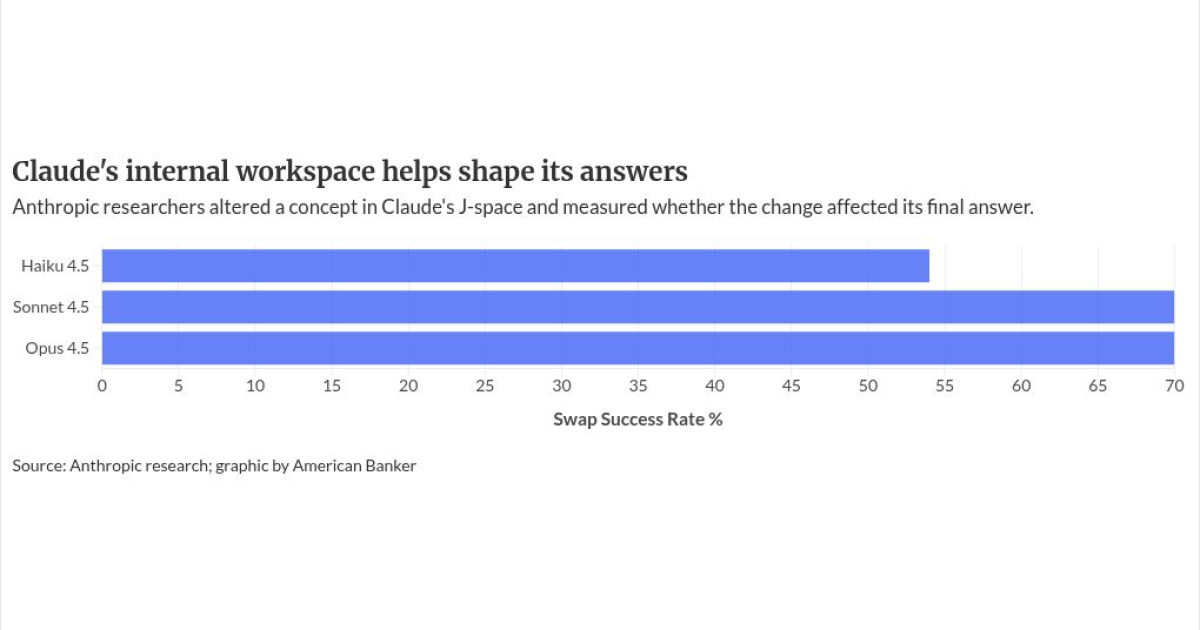
The research matters because it suggests that some internal representations inside LLMs may become inspectable, testable and eventually shaped.
Read more:
Why this matters for bank AI governance
Much of today’s AI governance still operates around the model rather than inside it, through prompts, retrieval systems and human-in-the-loop review. But if interpretability tools improve, governance may eventually move closer to reviewing the model’s internal process, not just its final answer.
For example, not all hallucinations are equally damaging. A model that misremembers a fact is different from a model that recognizes a problem and fabricates an answer anyway. Anthropic’s research suggests that those failures may leave different internal traces.
For use cases such as compliance review, customer communications and software development, that distinction could matter. The bank does not only want to know that the answer was wrong. It wants to know why.
The second implication is training, and whether model behavior can become more accountable.
If parts of a model’s internal reasoning can be observed, future training may also try to shape that reasoning more directly.
That could matter a great deal in finance. Banks already try to guide model behavior by giving it better context, fine-tuning it on preferred responses and surrounding it with controls. A more ambitious path is to train the model to carry principles such as accuracy, escalation, disclosure, fairness and compliance into its reasoning process.
The J-space research offers a glimpse of what that kind of training might look like.
This research is still early. The J-lens, Anthropic’s tool for reading parts of the J-space, is not yet a production-grade governance tool for banks. The findings are based on Anthropic’s models, so we should not assume the same internal structure exists in the same way across other model families.
That caveat should not obscure the larger point. If internal reasoning becomes more visible, banks will have a better basis for deciding when LLMs can be trusted, when they need oversight and when they should not be used.
For banks, that is where meaningful AI accountability begins.