Miami Beach’s ‘Little Buenos Aires’ Prepares for World Cup Final
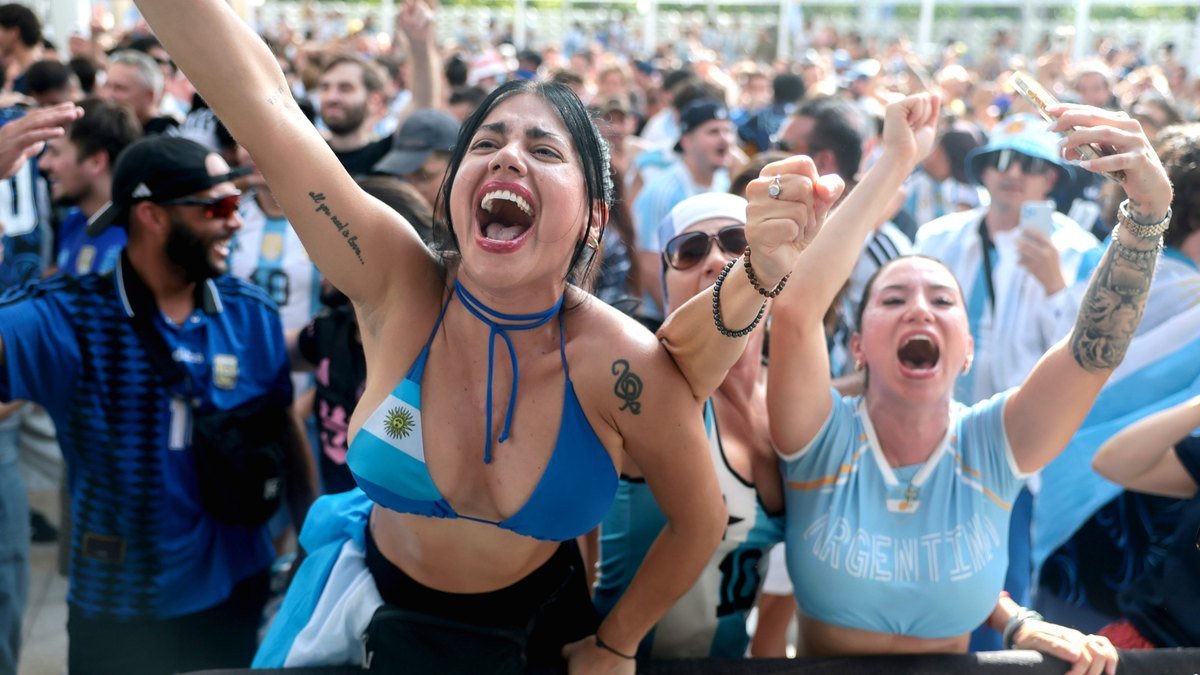
Argentina is set to face Spain in the final match of the World Cup, and the North Beach section of Miami Beach will be ardently cheering on the defending champs.
Known as “Little Buenos Aires,” the northernmost section of Miami Beach is home to one of the largest Argentine communities in the United States, and residents are preparing to take to the streets to support Argentinian soccer star Lionel Messi and his teammates.
After Argentina won their semifinal game against England in a stunning extra-time comeback, thousands of Argentinian fans filled the streets of North Beach to celebrate, with several videos going viral on social media.
The World Cup Final on Sunday, July 19, is primed to be even bigger, with a huge scheduled watch party on 72nd Street and Collins Avenue, which is right in the heart of Little Buenos Aires.
The Mayor of Miami Beach Steven Meiner is even getting in on the action, saying, “Our local watch parties are electric with the community’s unstoppable passion.”
How did North Beach become home for so many Argentinians?
Though many ex-pats from Argentina began calling Miami “home” in the 1970s, financial crisis and political uncertainty in Argentina in the late-90s and early 2000s led to a large influx of Argentinians to the Miami area. At one point in 2002, the Argentine Consulate estimated there were more than 90,000 Argentinians living in Miami. And as their numbers grew, so did their community.
“North Beach’s Argentine identity developed organically over several decades,” says Kenley Cervera, a Miami-based luxury real estate advisor and director of sales for two of North Beach’s most exclusive new developments—72 Park and PALMA Residences. “The neighborhood offered many Argentine families an accessible, welcoming entry point to Miami Beach, with a Spanish-speaking community, walkable residential buildings, and a relaxed coastal lifestyle that felt entirely distinct from South Beach.”
As more residents arrived, Argentine bakeries, restaurants and other family-owned businesses followed, creating a network effect that made the neighborhood feel increasingly familiar.
“Once the first wave of Argentinian families settled here, friends and relatives followed, and over time that created the strong sense of community the neighborhood is known for today,” says Marcelo Steinmander, a top real estate agent for Berkshire Hathaway HomeServices EWM Realty.
Steinmander is also a member of the Argentinian community and a resident of North Beach for over a decade. “While South Beach continued to redevelop itself, North Beach remained a quaint, beachfront neighborhood for years,” he says.
However, while the Argentinian community factors prominently into this area of Miami Beach, it’s not the entirety of North Beach.
“When people refer to ‘Little Buenos Aires,’ they’re generally talking about the Collins Avenue corridor between 69th and 74th Streets,” says Steinmander. “It’s not an officially designated neighborhood, but it’s where you’ll find a very high concentration of Argentinian businesses, and where the community rallies to support La Selección [the name that Argentinian fans call their World Cup team].”
While North Beach’s World Cup fervor has put more focus on the Little Buenos Aires area at the moment, the truth is that more people have already started discovering this neighborhood on their own in recent years, and it’s led to some exciting new real estate development of the North Beach area.
How new developments are bolstering the North Beach
Even without the World Cup putting this area on peoples’ radar, North Beach has recently been growing in popularity for a variety of reasons.
“The appeal of Miami Beach is fairly self-explanatory: Florida’s business-friendly environment, Miami’s connectivity to Latin America, South Florida’s rich culture and year-round beach access make it a natural choice for buyers seeking a U.S. home base,” says Cervera.
And with demand comes more development. Lefferts, a real estate firm that creates residential and commercial properties in Miami and New York City, has recently made significant investments in the North Beach community by developing four luxury residential and retail real estate projects.
One of those is the recently completed 72 Park, the first major new luxury condominium in North Beach in years. Though it just opened in 2025, it’s already 90% sold, with units currently starting in the $900,000s, depending on residence type and availability.
Lefferts’ second planned development, PALMA Miami Beach Residences, a 14-story building with 126 fully-furnished turnkey residences, is poised to break ground later this year and has sold more than 30% of its units already. Condos in this building will start in the $650,000 range.
The company has two more large projects on the horizon as well—72 Carlyle and 880 71st Street—and has made a financial commitment to revitalizing the North Beach area, but without losing the sense of what makes this community so special.
“Across Lefferts’ North Beach projects, approximately 76% of buyers are from Latin America, with Argentines accounting for roughly 14.1% of sales,” says Cervera.
Additionally, the recently developed Argentine Football Association’s international training center and academy in nearby North Bay Village has further strengthened the area’s connection to Argentina and continues to bring additional visibility to the community.
But while the Argentinian community is certainly a huge part of the North Beach story, it’s only one piece.
“North Beach has evolved into one of Miami Beach’s most authentic and diverse neighborhoods,” says Steinmander. “As investment continues and more people discover the area, I think people are realizing that North Beach isn’t the next South Beach, and it doesn’t need to be.”
Who is gravitating towards North Beach
Few neighborhoods in Miami offer the range of housing North Beach does.
“You can find entry-level condos and, just a block away, a beachfront tower designed by Pritzker prize winning architect Renzo Piano,” says Steinmander. “We have single family homes on the water as well as homes overlooking the Normandy Shores Golf Club, all within the same neighborhood.”
The demographics are also varied, with the current buyer pool reflecting Miami itself.
“We see local professionals, families, retirees, international buyers, and plenty of people who already know Miami but want a more casual, coastal lifestyle,” says Steinmander. “Argentinian buyers and renters remain a meaningful part of that market, but the neighborhood has become increasingly diverse.”
Prices also run the gamut, which aids in serving this diversity as well. According to Corcoran’s Miami Beaches & Coastal Mainland Market Report: 2Q 2026, the average condominium price in North Beach runs $564,000, while the average single-family home price is $3.7 million.
Perhaps the biggest draw to the area, however, is a feeling of authenticity.
“While much of Miami Beach revolves around tourism, North Beach is where people live their everyday lives,” says Steinmander. “You have families walking to school or the beach, neighbors who know each other, locally owned businesses that have been there for years, and a strong sense of community that’s becoming harder to find as Miami continues to grow.”
The final word on the World Cup and North Beach’s allure
There is no doubt that the 2026 World Cup has certainly put a spotlight on North Beach and its community. “During Argentina’s matches, the energy throughout the neighborhood is incredible, unlike any other in Miami,” says Steinmander. “People are naturally drawn to a neighborhood that celebrates together.”
However, World Cup excitement notwithstanding, North Beach is continuing to emerge from the shadow of South Beach and Mid-Beach.
“For a long time, North Beach was Miami Beach’s best-kept secret, but I don’t think it’s a secret anymore,” says Steinmander. “As more people discover what North Beach has to offer, values have steadily increased. It’s still one of the more attainable neighborhoods of Miami Beach, but the gap continues to narrow.”
The neighborhood has historically offered a quieter, more residential feel, but waves of new investment are now bringing boutique luxury development, new restaurants, and renewed attention to the area without erasing the cultural fabric that has made it distinctive.
“North Beach was Little Buenos Aires long before Lionel Messi became the global icon he is today—even though he has become a familiar face in the neighborhood, often dining at local favorite Prima Pasta with his family—and before Argentina’s national team began its recent run of international success,” says Cervera. “The World Cup has not created that identity; it’s just given the rest of the world a much bigger window into a community that was already firmly established.”